On the new Snowden documents

If you don’t follow NSA news obsessively, you might have missed yesterday’s massive Snowden document dump from Der Spiegel. The documents provide a great deal of insight into how the NSA breaks our cryptographic systems. I was very lightly involved in looking at some of this material, so I’m glad to see that it’s been published.

Unfortunately with so much material, it can be a bit hard to separate the signal from the noise. In this post I’m going to try to do that a little bit — point out the bits that I think are interesting, the parts that are old news, and the things we should keep an eye on.

Background

Those who read this blog will know that I’ve been wondering for a long time how NSA works its way around our encryption. This isn’t an academic matter, since it affects just about everyone who uses technology today.

What we’ve learned since 2013 is that NSA and its partners hoover up vast amounts of Internet traffic from fiber links around the world. Most of this data is plaintext and therefore easy to intercept. But at least some of it is encrypted — typically protected by protocols such as SSL/TLS or IPsec.

Conventional wisdom pre-Snowden told us that the increasing use of encryption ought to have shut the agencies out of this data trove. Yet the documents we’ve seen so far indicate just the opposite. Instead, the NSA and GCHQ have somehow been harvesting massive amounts of SSL/TLS and IPSEC traffic, and appear to be making inroads into other technologies such as Tor as well.

How are they doing this? To repeat an old observation, there are basically three ways to crack an encrypted connection:

  1. Go after the mathematics. This is expensive and unlikely to work well against modern encryption algorithms (with a few exceptions). The leaked documents give very little evidence of such mathematical breaks — though a bit more on this below.
  2. Go after the implementation. The new documents confirm a previously-reported and aggressive effort to undermine commercial cryptographic implementations. They also provide context for how important this type of sabotage is to the NSA.
  3. Steal the keys. Of course, the easiest way to attack any cryptosystem is simply to steal the keys. Yesterday we received a bit more evidence that this is happening.
I can’t possibly spend time on everything that’s covered by these documents — you should go read them yourself — so below I’m just going to focus on the highlights.

Not so Good Will Hunting

First, the disappointing part. The NSA may be the largest employer of cryptologic mathematicians in the United States, but — if the new story is any indication — those guys really aren’t pulling their weight.

In fact, the only significant piece of cryptanalytic news in the entire stack comes is a 2008 undergraduate research project looking at AES. Sadly, this is about as unexciting as it sounds — in fact it appears to be nothing more than a summer project by a visiting student. More interesting is the context it gives around the NSA’s efforts to break block ciphers such as AES, including the NSA’s view of the difficulty of such cryptanalysis, and confirmation that NSA has some ‘in-house techniques’.

Additionally, the documents include significant evidence that NSA has difficulty decrypting certain types of traffic, including Truecrypt, PGP/GPG, Tor and ZRTP from implementations such as RedPhone. Since these protocols share many of the same underlying cryptographic algorithms — RSA, Diffie-Hellman, ECDH and AES — some are presenting this as evidence that those primitives are cryptographically strong.

As with the AES note above, this ‘good news’ should also be taken with a grain of salt. With a small number of exceptions, it seems increasingly obvious that the Snowden documents are geared towards NSA’s analysts and operations staff. In fact, many of the systems actually seem aimed at protecting knowledge of NSA’s cryptanalytic capabilities from NSA’s own operational staff (and other Five Eyes partners). As an analyst, it’s quite possible you’ll never learn why a given intercept was successfully decrypted.

 To put this a bit more succinctly: the lack of cryptanalytic red meat in these documents may not truly be representative of the NSA’s capabilities. It may simply be an artifact of Edward Snowden’s clearances at the time he left the NSA.

Tor

One of the most surprising aspects of the Snowden documents — to those of us in the security research community anyway — is the NSA’s relative ineptitude when it comes to de-anonymizing users of the Tor anonymous communications network.

The reason for our surprise is twofold. First, Tor was never really designed to stand up against a global passive adversary — that is, an attacker who taps a huge number of communications links. If there’s one thing we’ve learned from the Snowden leaks, the NSA (plus GCHQ) is the very definition of the term. In theory at least, Tor should be a relatively easy target for the agency.

The real surprise, though, is that despite this huge signals intelligence advantage, the NSA has barely even tested their ability to de-anonymize users. In fact, this leak provides the first concrete evidence that NSA is experimenting with traffic confirmation attacks to find the source of Tor connections. Even more surprising, their techniques are relatively naive, even when compared to what’s going on in the ‘research’ community.

This doesn’t mean you should view Tor as secure against the NSA. It seems very obvious that the agency has identified Tor as a high-profile target, and we know they have the resources to make much more headway against the network. The real surprise is that they haven’t tried harder. Maybe they’re trying now.

SSL/TLS and IPSEC

 A few months ago I wrote a long post speculating about how the NSA breaks SSL/TLS. Because it’s increasingly clear that the NSA does break these protocols, and at relatively large scale.

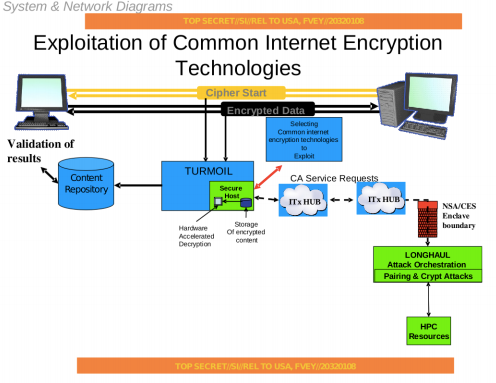
The new documents don’t tell us much we didn’t already know, but they do confirm the basic outlines of the attack. The first portion requires endpoints around the world that are capable of performing the raw decryption of SSL/TLS sessions provided they know the session keys. The second is a separate infrastructure located on US soil that can recover those session keys when needed.

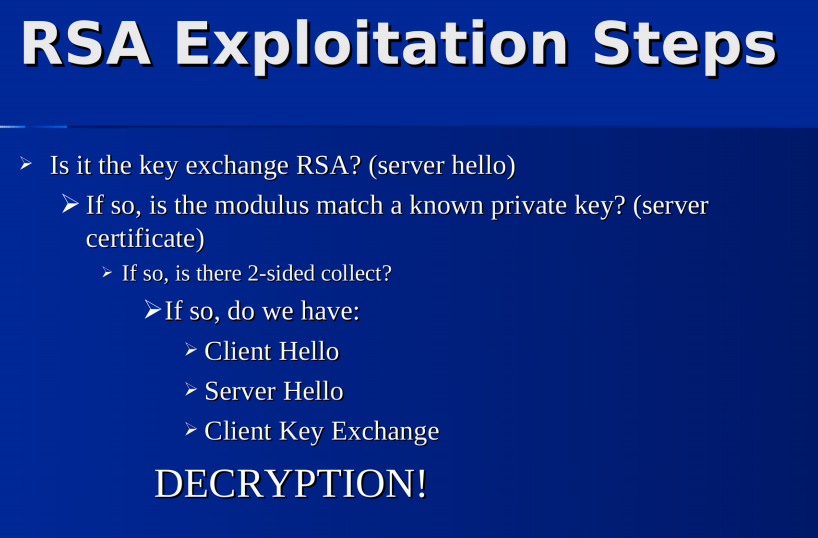
All of the real magic happens within the key recovery infrastructure. These documents provide the first evidence that a major attack strategy for NSA/GCHQ involves key databases containing the private keys for major sites. For the RSA key exchange ciphersuites of TLS, a single private key is sufficient to recover vast amounts of session traffic — in real time or even after the fact.

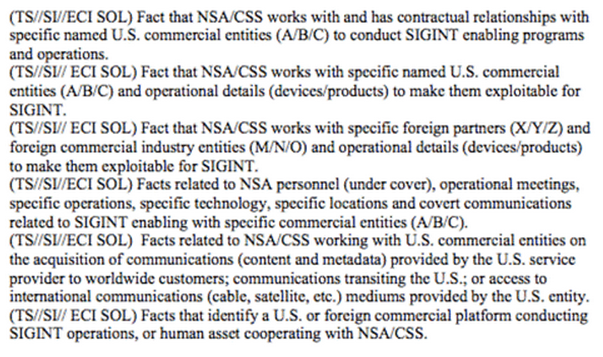
The interesting question is how the NSA gets those private keys. The easiest answer may be the least technical. A different Snowden leak shows gives some reason to believe that the NSA may have relationships with employees at specific named U.S. entities, and may even operate personnel “under cover”. This would certainly be one way to build a key database.


But even without the James Bond aspect of this, there’s every reason to believe that NSA has other means to exfiltrate RSA keys from operators. During the period in question, we know of at least one vulnerability (Heartbleed) that could have been used to extract private keys from software TLS implementations. There are still other, unreported vulnerabilities that could be used today.

 Pretty much everything I said about SSL/TLS also applies to VPN protocols, with the additional detail that many VPNs use broken protocols and relatively poorly-secured pre-shared secrets that can in some cases be brute-forced. The NSA seems positively gleeful about this.

Open Source packages: Redphone, Truecrypt, PGP and OTR

The documents provide at least circumstantial evidence that some open source encryption technologies may thwart NSA surveillance. These include Truecrypt, ZRTP implementations such as RedPhone, PGP implementations, and Off the Record messaging. These packages have a few commonalities:

  1. They’re all open source, and relatively well studied by researchers.
  2. They’re not used at terribly wide scale (as compared to e.g., SSL or VPNs)
  3. They all work on an end-to-end basis and don’t involve service providers, software distributers, or other infrastructure that could be corrupted or attacked.

What’s at least as interesting is which packages are not included on this list. Major corporate encryption protocols such as iMessage make no appearance in these documents, despite the fact that they ostensibly provide end-to-end encryption. This may be nothing. But given all we know about NSA’s access to providers, this is definitely worrying.

A note on the ethics of the leak

Before I finish, it’s worth addressing one major issue with this reporting: are we, as citizens, entitled to this information? Would we be safer keeping it all under wraps? And is this all ‘activist nonsense‘?

This story, more than some others, skates close to a line. I think it’s worth talking about why this information is important.

To sum up a complicated issue, we live in a world where targeted surveillance is probably necessary and inevitable. The evidence so far indicates that NSA is very good at this kind of work, despite some notable failures in actually executing on the intelligence it produces.

Unfortunately, the documents released so far also show that a great deal of NSA/GCHQ surveillance is not targeted at all. Vast amounts of data are scooped up indiscriminately, in the hope that some of it will someday prove useful. Worse, the NSA has decided that bulk surveillance justifies its efforts to undermine many of the security technologies that protect our own information systems. The President’s own hand-picked review council has strongly recommended this practice be stopped, but their advice has — to all appearances — been disregarded. These are matters that are worthy of debate, but this debate hasn’t happened.

Unfortunate if we can’t enact changes to fix these problems, technology is probably about all that’s left. Over the next few years encryption technologies are going to be widely deployed, not only by individuals but also by corporations desperately trying to reassure overseas customers who doubt the integrity of US technology.

In that world, it’s important to know what works and doesn’t work. Insofar as this story tells us that, it makes us all better off.

Zero Knowledge Proofs: An illustrated primer

One of the best things about modern cryptography is the beautiful terminology. You could start any number of punk bands (or Tumblrs) named after cryptography terms like ‘hard-core predicate’, ‘trapdoor function’, or ‘impossible differential cryptanalysis’. And of course, I haven’t even mentioned the one term that surpasses all of these. That term is ‘zero knowledge‘.

In fact, the term ‘zero knowledge’ is so appealing that it leads to problems. People misuse it, assuming that zero knowledge must be synonymous with ‘really, really secure‘. Hence it gets tacked onto all kinds of stuff — like encryption systems and anonymity networks — that really have nothing to do with true zero knowledge protocols.

This all serves to underscore a point: zero-knowledge proofs are one of the most powerful tools cryptographers have ever devised. But unfortunately they’re also relatively poorly understood. In this series of posts I’m going try to give a (mostly) nonmathematical description of what ZK proofs are, and what makes them so special. In this post and the next I’ll talk about some of the ZK protocols we actually use.

Origins of Zero Knowledge

The notion of ‘zero knowledge’ was first proposed in the 1980s by MIT researchers Shafi Goldwasser, Silvio Micali and Charles Rackoff. These researchers were working on problems related to interactive proof systems, theoretical systems where a first party (called a ‘Prover’) exchanges messages with a second party (‘Verifier’) to convince the Verifier that some mathematical statement is true.*

Prior to Goldwasser et al., most work in this area focused the soundness of the proof system. That is, it considered the case where a malicious Prover attempts to ‘trick’ a Verifier into believing a false statement. What Goldwasser, Micali and Rackoff did was to turn this problem on its head. Instead of worrying only about the Prover, they asked: what happens if you don’t trust the Verifier? 

The specific concern they raised was information leakage. Concretely, they asked, how much extra information is the Verifier going to learn during the course of this proof, beyond the mere fact that the statement is true?

It’s important to note that this is not simply of theoretical interest. There are real, practical applications where this kind of thing matters.

Here’s one: imagine that a real-world client wishes to log into a web server using a password. The standard ‘real world’ approach to this problem involves storing a hashed version of the password on the server. The login can thus be viewed as a sort of ‘proof’ that a given password hash is the output of a hash function on some password — and more to the point, that the client actually knows the password.

Most real systems implement this ‘proof’ in the absolute worst possible way. The client simply transmits the original password to the server, which re-computes the password hash and compares it to the stored value. The problem here is obvious: at the conclusion of the protocol, the server has learned my cleartext password. Modern password hygiene therefore involves a good deal of praying that servers aren’t compromised.

What Goldwasser, Micali and Rackoff proposed was a new hope for conducting such proofs. If fully realized, zero knowledge proofs would allow us to prove statements like the one above, while provably revealing no information beyond the single bit of information corresponding to ‘this statement is true’.

A ‘real world’ example

So far this discussion has been pretty abstract. To make things a bit more concrete, let’s go ahead and give a ‘real’ example of a (slightly insane) zero knowledge protocol.

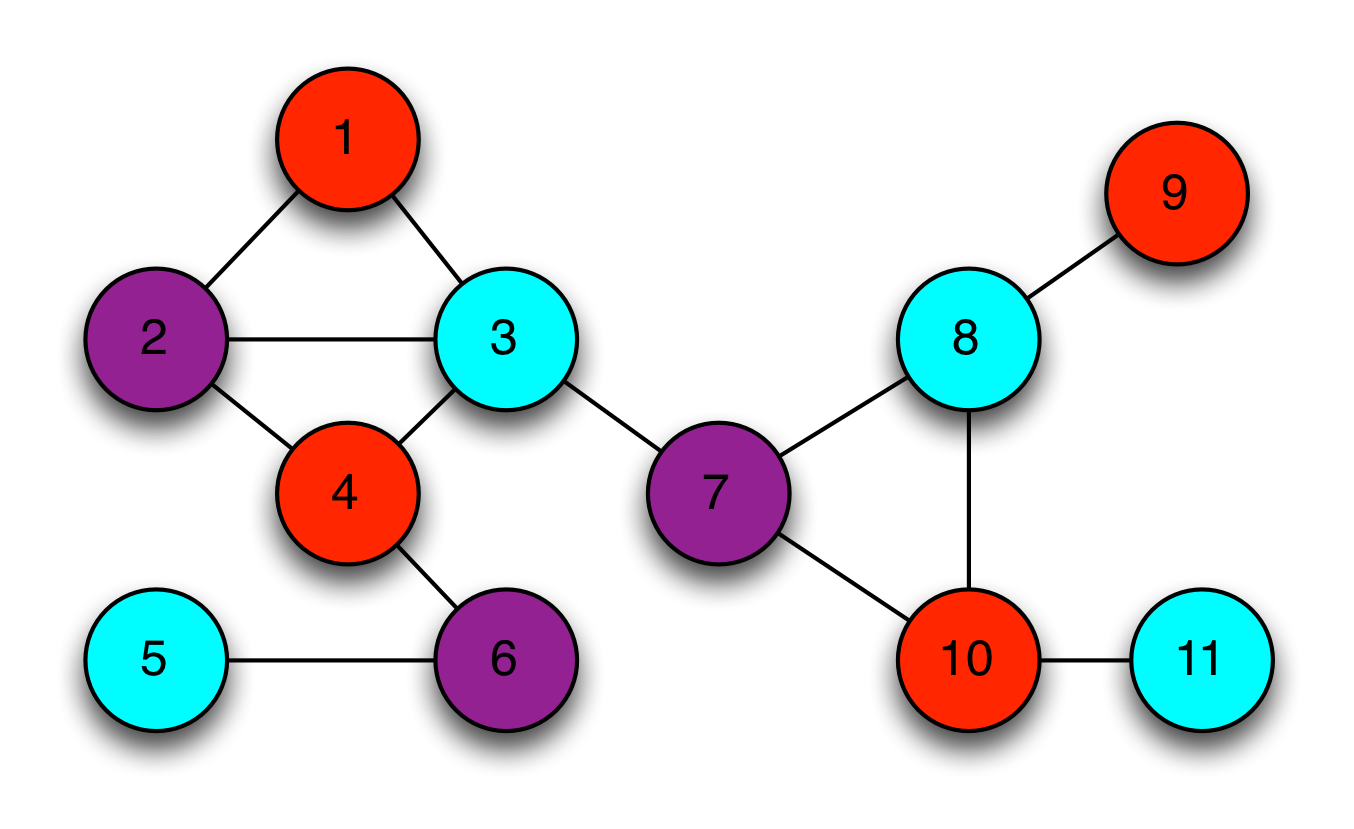
For the purposes of this example, I’d like you to imagine that I’m a telecom magnate in the process of deploying a new cellular communications network. My network structure is represented by the graph below. Each vertex in this graph represents a cellular radio tower, and the connecting lines (edges) indicate locations where two cells overlap, meaning that their transmissions are likely to interfere with each other.

This overlap is problematic, since it means that signals from adjacent towers are likely to scramble reception. Fortunately my network design allows me to configure each tower to one of three different frequency bands to avoid such interference.

Thus the challenge in deploying my network is to assign frequency bands to the towers such that no two overlapping cells share the same frequencies. If we use colors to represent the frequency bands, we can quickly work out one solution to the problem:

Of course, many of you will notice that what I’m describing here is simply an instance of the famous theory problem called the graph three-coloring problem. You might also know that what makes this problem interesting is that, for some graphs, it can be quite hard to find a solution, or even to determine if a solution exists. In fact, graph three-coloring — specifically, the decision problem of whether a given graph supports a solution with three colors — is known to be in the complexity class NP-complete.

It goes without saying that the toy example above is easy to solve by hand. But what if it wasn’t? For example, imagine that my cellular network was very large and complex, so much so that the computing power at my disposal was not sufficient to find a solution. In this instance, it would be desirable to outsource the problem to someone else who has plenty of computing power. For example, I might hire my friends at Google to solve it for me on spec.

But this leads to a problem.

Suppose that Google devotes a large percentage of their computing infrastructure to searching for a valid coloring for my graph. I’m certainly not going to pay them until I know that they really have such a coloring. At the same time, Google isn’t going to give me a copy of their solution until I’ve paid up. We’ll wind up at an impasse.

In real life there’s probably a common-sense answer to this dilemma, one that involves lawyers and escrow accounts. But this is not a blog about real life, it’s a blog about cryptography. And if you’ve ever read a crypto paper, you’ll understand that the right way to solve this problem is to dream up an absolutely crazy technical solution.

A crazy technical solution (with hats!)

The engineers at Google consult with Silvio Micali at MIT, who in consultation with his colleagues Oded Goldreich and Avi Wigderson, comes up with the following clever protocol — one so elegant that it doesn’t even require any computers. All it requires is a large warehouse, lots of crayons, and plenty of paper. Oh yes, and a whole bunch of hats.**

Here’s how it works.

First I will enter the warehouse, cover the floor with paper, and draw a blank representation of my cell network graph. Then I’ll exit the warehouse. Google can now enter enter, shuffle a collection of three crayons to pick a random assignment of the three agreed-upon crayon colors (red/blue/purple, as in the example above), and color in the graph in with their solution. Note that it doesn’t matter which specific crayons they use, only that the coloring is valid.

Before leaving the warehouse, Google covers up each of the vertices with a hat. When I come back in, this is what I’ll see:

Obviously this approach protects Google’s secret coloring perfectly. But it doesn’t help me at all. For all I know, Google might have filled in the graph with a random, invalid solution. They might not even have colored the graph at all.

To address my valid concerns, Google now gives me an opportunity to ‘challenge’ their solution to the graph coloring. I’m allowed to pick — at random — a single ‘edge’ of this graph (that is, one line between two adjacent hats). Google will then remove the two corresponding hats, revealing a small portion of their solution:

Notice that there are two outcomes to my experiment:

  1. If the two revealed vertices are the same color (or aren’t colored in at all!) then I definitely know that Google is lying to me. Clearly I’m not going to pay Google a cent.
  2. If the two revealed vertices are different colors, then Google might not be lying to me.
Hopefully the first proposition is obvious. The second one requires a bit more consideration. The problem is that even after our experiment, Google could still be lying to me — after all, I only looked under two of the hats. If there are E different edges in the graph, then Google could fill in an invalid solution and still get away with it most of the time. Specifically, after one test they could succeed in cheating me with probability up to (E-1)/E (which for a 1,000 edge graph works out to 99.9% of the time).

Fortunately Google has an answer to this. We’ll just run the protocol again!

We put down fresh paper with a new, blank copy of the graph. Google now picks a new (random) shuffle of the three crayons. Next they fill in the graph with a valid solution, but using the new random ordering of the three colors.

The hats go back on. I come back in and repeat the challenge process, picking a new random edge. Once again the logic above applies. Only this time if all goes well, I should now be slightly more confident that Google is telling me the truth. That’s because in order to cheat me, Google would have had to get lucky twice in a row. That can happen — but it happens with relatively lower probability. The chance that Google fools me twice in a row is now (E-1)/E * (E-1)/(or about 99.8% probability for our 1,000 edge example above).

Fortunately we don’t have to stop at two challenges. In fact, we can keep trying this over and over again until I’m confident that Google is probably telling me the truth.

But don’t take my word for it. Thanks to some neat Javascript, you can go try it yourself.

Note that I’ll never be perfectly certain that Google is being honest — there’s always going to be a tiny probability that they’re cheating me. But after a large number of iterations (E^2, as it happens) I can eventually raise my confidence to the point where Google can only cheat me with negligible probability — low enough that for all practical purposes it’s not worth worrying about. And then I’ll be able to safely hand Google my money.

What you need to believe is that Google is also protected. Even if I try to learn something about their solution by keeping notes between protocol runs, it shouldn’t matter. I’m foiled by Google’s decision to randomize their color choices between each iteration. The limited information I obtain does me no good, and there’s no way for me to link the data I learn between interactions.

What makes it ‘zero knowledge’?

I’ve claimed to you that this protocol leaks no information about Google’s solution. But don’t let me get away with this! The first rule of modern cryptography is never to trust people who claim such things without proof.

Goldwasser, Micali and Rackoff proposed three following properties that every zero-knowledge protocol must satisfy. Stated informally, they are:

  1. Completeness. If Google is telling the truth, then they will eventually convince me (at least with high probability).
  2. Soundness. Google can only convince me if they’re actually telling the truth.
  3. Zero-knowledgeness. (Yes it’s really called this.) I don’t learn anything else about Google’s solution.
We’ve already discussed the argument for completeness. The protocol will eventually convince me (with a negligible error probability), provided we run it enough times. Soundness is also pretty easy to show here. If Google ever tries to cheat me, I will detect their treachery with overwhelming probability.

The hard part here is the ‘zero knowledgeness’ property. To do this, we need to conduct a very strange thought experiment.

A thought experiment (with time machines)

First, let’s start with a crazy hypothetical. Imagine that Google’s engineers aren’t quite as capable as people make them out to be. They work on this problem for weeks and weeks, but they never manage to come up with a solution. With twelve hours to go until showtime, the Googlers get desperate. They decide to trick me into thinking they have a coloring for the graph, even though they don’t.

Their idea is to sneak into the GoogleX workshop and borrow Google’s prototype time machine. Initially the plan is to travel backwards a few years and use the extra working time to take another crack at solving the problem. Unfortunately it turns out that, like most Google prototypes, the time machine has some limitations. Most critically: it’s only capable of going backwards in time four and a half minutes.

So using the time machine to manufacture more working time is out. But still, it turns out that even this very limited technology can still be used to trick me.

I don’t really know what’s going on here
but it seemed apropos.

The plan is diabolically simple. Since Google doesn’t actually know a valid coloring for the graph, they’ll simply color the paper with a bunch of random colors, then put the hats on. If by sheer luck, I challenge them on a pair of vertices that happen to be different colors, everyone will heave a sigh of relief and we’ll continue with the protocol. So far so good.

Inevitably, though, I’m going to pull off a pair of hats and discover two vertices of the same color. In the normal protocol, Google would now be totally busted. And this is where the time machine comes in. Whenever Google finds themselves in this awkward situation, they simply fix it. That is, a designated Googler pulls a switch, ‘rewinds’ time about four minutes, and the Google team recolors the graph with a completely new random solution. Now they let time roll forward and try again.

In effect, the time machine allows Google to ‘repair’ any accidents that happen during their bogus protocol execution, which makes the experience look totally legitimate to me. Since bad challenge results will occur only 1/3 of the time, the expected runtime of the protocol (from Google’s perspective) is only moderately greater than the time it takes to run the honest protocol. From my perspective I don’t even know that the extra time machine trips are happening.

This last point is the most important. In fact, from my perspective, being unaware that the time machine is in the picture, the resulting interaction is exactly the same as the real thing. It’s statistically identical. And yet it’s worth pointing out again that in the time machine version, Google has absolutely no information about how to color the graph.

What the hell is the point of this?

What we’ve just shown is an example of a simulation. Note that in a world where time runs only forward and nobody can trick me with a time machine, the hat-based protocol is correct and sound, meaning that after E^2 rounds I should be convinced (with all but negligible probability) that the graph really is colorable and that Google is putting valid inputs into the protocol.

What we’ve just shown is that if time doesn’t run only forward — specifically, if Google can ‘rewind’ my view of time — then they can fake a valid protocol run even if they have no information at all about the actual graph coloring.

From my perspective, what’s the difference between the two protocol transcripts? When we consider the statistical distribution of the two, there’s no difference at all. Both convey exactly the same amount of useful information.

Believe it or not, this proves something very important.

Specifically, assume that I (the Verifier) have some strategy that ‘extracts’ useful information about Google’s coloring after observing an execution of the honest protocol. Then my strategy should work equally well in the case where I’m being fooled with a time machine. The protocol runs are, from my perspective, statistically identical. I physically cannot tell the difference.

Thus if the amount of information I can extract is identical in the ‘real experiment’ and the ‘time machine experiment’, yet the amount of information Google puts into the ‘time machine’ experiment is exactly zero — then this implies that even in the real world the protocol must not leak any useful information.

Thus it remains only to show that computer scientists have time machines. We do! (It’s a well-kept secret.)

Getting rid of the hats (and time machines)

Of course we don’t actually want to run a protocol with hats. And even Google (probably?) doesn’t have a literal time machine.

To tie things together, we first need to bring our protocol into the digital world. This requires that we construct the digital equivalent of a ‘hat’: something that both hides a digital value, while simultaneously ‘binding’ (or ‘committing’) the maker to it, so she can’t change her mind after the fact.

Fortunately we have a perfect tool for this application. It’s called a digital commitment scheme. A commitment scheme allows one party to ‘commit’ to a given message while keeping it secret, and then later ‘open’ the resulting commitment to reveal what’s inside. They can be built out of various ingredients, including (strong) cryptographic hash functions.******

Given a commitment scheme, we now have all the ingredients we need to run the zero knowledge protocol electronically. The Prover first encodes its vertex colorings as a set of digital messages (for example, the numbers 0, 1, 2), then generates digital commitments to each one. These commitments get sent over to the Verifier. When the Verifier challenges on an edge, the Prover simply reveals the opening values for the commitments corresponding to the two vertices.

So we’ve managed to eliminate the hats. But how do we prove that this protocol is zero knowledge?

Fortunately now that we’re in the digital world, we no longer need a real time machine to prove things about this protocol. A key trick is to specify in our setting that the protocol is not going to be run between two people, but rather between two different computer programs (or, to be more formal, probabilistic Turing machines.)

What we can now prove is the following theorem: if you could ever come up with a computer program (for the Verifier) that extracts useful information after participating in a run of the protocol, then it would be possible to use a ‘time machine’ on that program in order to make it extract the same amount of useful information from a ‘fake’ run of the protocol where the Prover doesn’t put in any information to begin with.

And since we’re now talking about computer programs, it should be obvious that rewinding time isn’t such an extraordinary feat at all. In fact, we rewind computer programs all the time. For example, consider using virtual machine software with a snapshot capability.

Example of rewinding through VM snapshots. An initial VM is played forward, rewound to an
initial snapshot, then execution is forked to a new path.

Even if you don’t have fancy virtual machine software, any computer program can be ‘rewound’ to an earlier state, simply by starting the program over again from the beginning and feeding it exactly the same inputs. Provided that the inputs — including all random numbers — are fixed, the program will always follow the same execution path. Thus you can rewind a program just by running it from the start and ‘forking’ its execution when it reaches some desired point.

Ultimately what we get is the following theorem. If there exists any Verifier computer program that successfully extracts information by interactively running this protocol with some Prover, then we can simply use the rewinding trick on that program to commit to a random solution, then ‘trick’ the Verifier by rewinding its execution whenever we can’t answer its challenge correctly. The same logic holds as we gave above: if such a Verifier succeeds in extracting information after running the real protocol, then it should be able to extract the same amount of information from the simulated, rewinding-based protocol. But since there’s no information going into the simulated protocol, there’s no information to extract. Thus the information the Verifier can extract must always be zero.

Ok, so what does this all mean?

So let’s recap. We know that the protocol is complete and sound, based on our analysis above. The soundness argument holds in any situation where we know that nobody is fiddling with time — that is, the Verifier is running normally and nobody is rewinding its execution.

At the same time, the protocol is also zero knowledge. To prove this, we showed that any Verifier program that succeeds in extracting information must also be able to extract information from a protocol run where rewinding is used and no information is available in the first place. Which leads to an obvious contradiction, and tells us that the protocol can’t leak information in either situation.

There’s an important benefit to all this. Since it’s trivial for anyone to ‘fake’ a protocol transcript, even after Google proves to me that they have a solution, I can’t re-play a recording of the protocol transcript to prove anything to anyone else (say, a judge). That’s because the judge would have no guarantee that the video was recorded honestly, and that I didn’t simply edit in the same way Google might have done using the time machine. This means that protocol transcripts themselves contain no information. The protocol is only meaningful if I myself participated, and I can be sure that it happened in real time.

Proofs for all of NP!

If you’ve made it this far, I’m pretty sure you’re ready for the big news. Which is that 3-coloring cellphone networks isn’t all that interesting of a problem — at least, not in and of itself.

The really interesting thing about the 3-coloring problem is that it’s in the class NP-complete. To put this informally, the wonderful thing about such problems is that any other problem in the class NP can be translated into an instance of that problem.In a single stroke, this result — due to Goldreich, Micali and Wigderson — proves that ‘efficient’ ZK proofs exists for a vast class of useful statements, many of which are way more interesting than assigning frequencies to cellular networks. You simply find a statement (in NP) that you wish to prove, such as our hash function example from above, then translate it into an instance of the 3-coloring problem. At that point you simply run the digital version of the hat protocol.

In summary, and next time

Of course, actually running this protocol for interesting statements would be an insanely silly thing for anyone to do, since the cost of doing so would include the total size of the original statement and witness, plus the reduction cost to convert it into a graph, plus the E^2 protocol rounds you’d have to conduct in order to convince someone that the proof is valid. Theoretically this is ‘efficient’, since the total cost of the proof would be polynomial in the input size, but in practice it would be anything but.

So what we’ve shown so far is that such proofs are possible. It remains for us to actually find proofs that are practical enough for real-world use.

In the next post I’ll talk about some of those — specifically, the efficient proofs that we use for various useful statements. I’ll give some examples (from real applications) where these things have been used. Also at reader request: I’ll also talk about why I dislike SRP so much.

See here for Part 2.


Notes:

* Formally, the goal of an interactive proof is to convince the Verifier that a particular string belongs to some language. Typically the Prover is very powerful (unbounded), but the Verifier is limited in computation.

** This example is based on the original solution of Goldwasser, Micali and Rackoff, and the teaching example using hats is based on an explanation by Silvio Micali. I take credit only for the silly mistakes.

****** A simple example of a commitment can be built using a hash function. To commit to the value “x” simply generate some (suitably long) string of random numbers, which we’ll call ‘salt’, and output the commitment C = Hash(salt || x). To open the commitment, you simply reveal ‘x’ and ‘salt’. Anyone can check that the original commitment is valid by recomputing the hash. This is secure under some (moderately strong) assumptions about the function itself.
Attack of the Week: Unpicking PLAID

A few years ago I came across an amusing Slashdot story: ‘Australian Gov’t offers $560k Cryptographic Protocol for Free‘. The story concerned a protocol developed by Australia’s Centrelink, the equivalent of our Health and Human Services department, that was wonderfully named the Protocol for Lightweight Authentication of ID, or (I kid you not), ‘PLAID‘.

Now to me this headline did not inspire a lot of confidence. I’m a great believer in TANSTAAFL — in cryptographic protocol design and in life. I figure if someone has to use ‘free’ to lure you in the door, there’s a good chance they’re waiting in the other side with a hammer and a bottle of chloroform, or whatever the cryptographic equivalent might be.

A quick look at PLAID didn’t disappoint. The designers used ECB like it was going out of style; did unadvisable things with RSA encryption, and that was only the beginning.

What PLAID was not, I thought at the time, was bad to the point of being exploitable. Moreover, I got the idea that nobody would use the thing. It appears I was badly wrong on both counts.

This is apropos of a new paper authored by Degabriele, Fehr, Fischlin, Gagliardoni, Günther, Marson, Mittelbach and Paterson entitled ‘Unpicking Plaid: A Cryptographic Analysis of an ISO-standards-track Authentication Protocol‘. Not to be cute about it, but this paper shows that PLAID is, well, bad.

As is typical for this kind of post, I’m going to tackle the rest of the content in a ‘fun’ question and answer format.

What is PLAID?

In researching this blog post I was somewhat amazed to find that Australians not only have universal healthcare, but that they even occasionally require healthcare. That this surprised me is likely due to the fact that my knowledge of Australia mainly comes from the first two Crocodile Dundee movies.

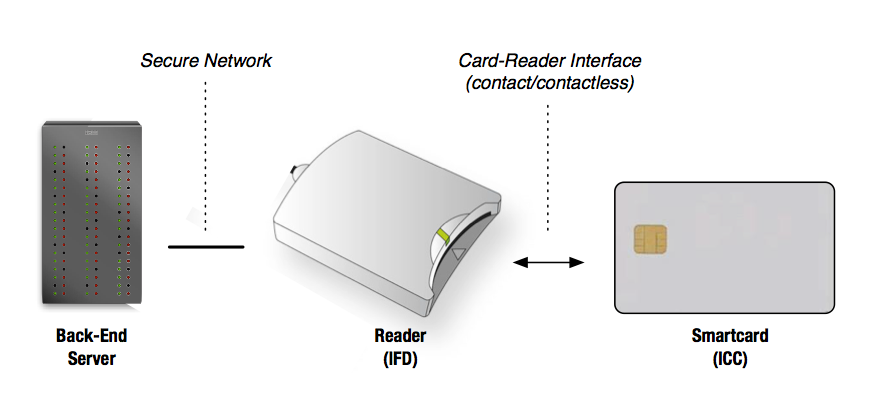
It seems that not only do Australians have healthcare, but they also have access to a ‘smart’ ID card that allows them to authenticate themselves. These contactless smartcards run the proprietary PLAID protocol, which handles all of the ugly steps in authenticating the bearer, while also providing some very complicated protections to prevent user tracking.

This protocol has been standardized as Australian standard AS-5185-2010 and is currently “in the fast track standardization process for ISO/IEC 25185-1.2”. You can obtain your own copy of the standard for a mere 118 Swiss Francs, which my currency converter tells me is entirely too much money. So I’ll do my best to provide the essential details in this post — and many others are in the research paper.

How does PLAID work?

Accompanying tinfoil hat
not pictured.

PLAID is primarily an identification and authentication protocol, but it also attempts to offer its users a strong form of privacy. Specifically, it attempts to ensure that only authorized readers can scan your card and determine who you are.

This is a laudable goal, since contactless smartcards are ‘promiscuous’, meaning that they can be scanned by anyone with the right equipment. Countless research papers have been written on tracking RFID devices, so the PLAID designers had to think hard about how they were going to prevent this sort of issue.

Before we get to what steps the PLAID designers took, let’s talk about what one shouldn’t do in building such systems.

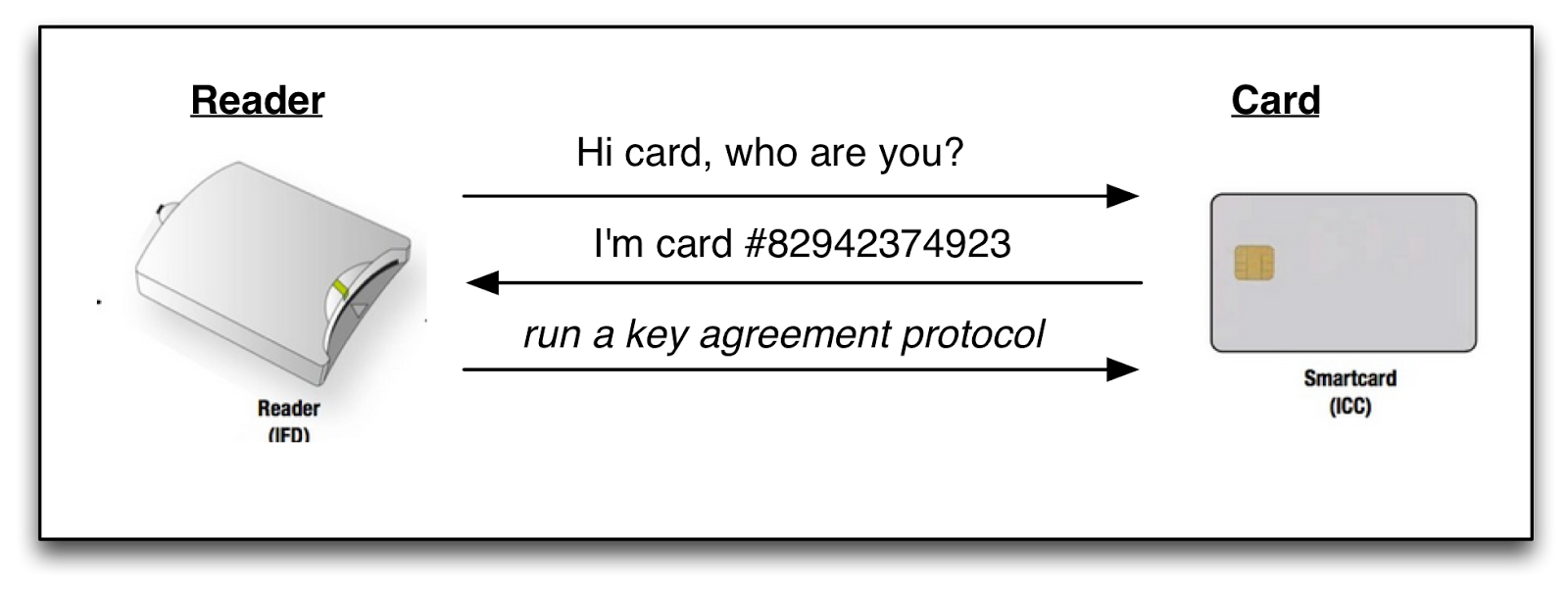
Let’s imagine you have a smartcard talking to a reader where anyone can query the card. The primary goal of an authentication protocol is to perform some sort of mutual authentication handshake and derive a session key that the card can use to exchange sensitive data. The naive protocol might look like this:

Naive approach to an authentication protocol. The card identifies itself
before the key agreement protocol is run, so the reader can look up a card-specific key.

The obvious problem with this protocol is that it reveals the card ID number to anyone who asks. Yet such identification appears necessary, since each card will have its own secret key material — and the reader must know the card’s key in order to run an authenticated key agreement protocol.

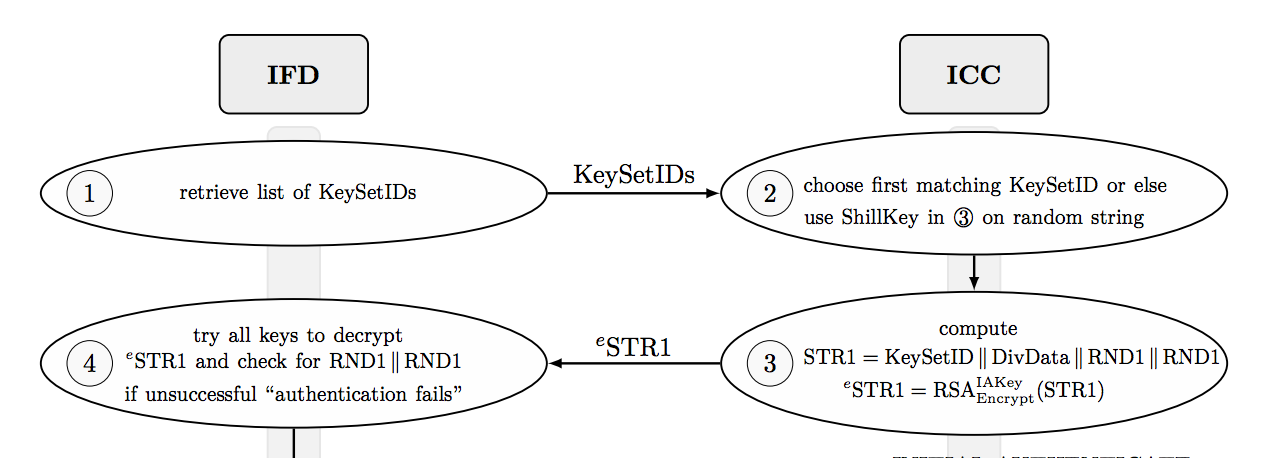
PLAID solves this problem by storing a set of RSA public keys corresponding to various authorized applications. When the reader says “Hi, I’m a hospital“, a PLAID card determines which public key it use to talk to hospitals, then encrypts data under the key and sends it over. Only a legitimate hospital should know the corresponding RSA secret key to decrypt this value.

So what’s the problem here?

PLAID’s approach would be peachy if there were only one public key to deal with. However PLAID cards can be provisioned to support many applications (called ‘capabilities’). For example, a citizen who routinely finds himself wrestling crocodiles might possess a capability unique to the Reptile Wound Treatment unit of a local hospital.* If the card responds to this capability, it potentially leaks information about the bearer.

To solve this problem, PLAID cards do some truly funny stuff.

Specifically, when a reader queries the card, the reader initially transmits a set of capabilities that it will support (e.g., ‘hospital’, ‘bank’, ‘social security center’). If the PLAID card has been provisioned with a matching public key, it goes ahead and uses it. If no matching key is found, however, the card does not send an error — since this would reveal user-specific information. Instead, it fakes a response by encrypting junk under a special ‘dummy’ RSA public key (called a ‘shill key’) that’s stored within the card. And herein lies the problem.

You see, the ‘shill key’ is unique to each card, which presents a completely new avenue for tracking individual cards. If an attacker can induce an error and subsequently fingerprint the resulting RSA ciphertext — that is, figure out which shill key was used to encipher it — they can potentially identify your card the next time they encounter you.

A portion of the PLAID protocol (source). The reader (IFD) is on the left, the card (ICC) is on the right.

Thus the problem of tracking PLAID cards devolves to one of matching RSA ciphertexts to unknown public keys. The PLAID designers assumed this would not be possible. What Degabriele et al. show is that they were wrong.

What do German Tanks have to do with RSA encryption?


To distinguish the RSA moduli of two different cards, the researchers employed of an old solution to a problem called the German Tank Problem. As the name implies, this is a real statistical problem that the allies ran up against during WWII.

The problem can be described as follows:

Imagine that a factory is producing tanks, where each tank is printed with a sequential serial number in the ordered sequence 1, 2, …, N. Through battlefield captures you then obtain a small and (presumably) random subset of k tanks. From the recovered serial numbers, your job is to estimate N, the total number of tanks produced by the factory.

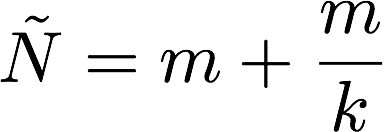
Happily, this is the rare statistical problem with a beautifully simple solution.** Let m be the maximum serial number in the set of k tanks you’ve observed. To obtain a rough guess Ñ for the total number of tanks produced, you can simply compute the following formula:

So what’s this got to do with guessing an unknown RSA key?

Well, this turns out to be another instance of exactly the same problem. Imagine that I can repeatedly query your card with bogus ‘capabilities’ and thus cause it to enter its error state. To foil tracking, the card will send me a random RSA ciphertext encrypted with its (card-specific) “shill key”. I don’t know the public modulus corresponding to your key, but I do know that the ciphertext was computed using the standard RSA encryption formula m^e mod N.

My goal, as it was with the tanks, is to make a guess for N.

It’s worth pointing out that RSA is a permutation, which means that, provided the plaintext messages are randomly distributed, the ciphertexts will be randomly distributed as well. So all I need to do is collect a number of ciphertexts and apply the equation above. The resulting guess Ñ should then serve as a (fuzzy) identifier for any given card.

Results for identifying a given card in a batch of (up to) 100 cards. Each card was initially ‘fingerprinted’ by collecting k1=1000 RSA ciphertexts. Arbitrary cards were later identified by collecting varying number of ciphertexts (k2).

Now obviously this isn’t the whole story — the value Ñ isn’t exact, and you’ll get different levels of error depending on how many ciphertexts you get, and how many cards you have to distinguish amongst. But as the chart above shows, it’s possible to identify a specific card within in a real system (containing 100 cards) with reasonable probability.

But that’s not realistic at all. What if there are other cards in play?

It’s important to note that real life is nothing like a laboratory experiment. The experiment above considered a ‘universe’ consisting of only 100 cards, required an initial ‘training period’ of 1000 scans for a given card, and subsequent recognition demanded anywhere from 50 to 1000 scans of the card.

Since the authentication time for the cards is about 300 milliseconds per scan, this means that even the minimal number (50) of scans still requires about 15 seconds, and only produces the correct result with about 12% probability. This probability goes up dramatically the more scans you get to make.

Nonetheless, even the 50-scan result is significantly better than guessing, and with more concerted scans can be greatly improved. What this attack primarily serves to prove is that homebrew solutions are your enemy. Cooking up a clever approach to foiling tracking might seem like the right way to tackle a problem, but sometimes it can make you even more vulnerable than you were before.

How should one do this right?

The basic property that the PLAID designers were trying to achieve with this protocol is something called key privacy. Roughly speaking, a key private cryptosystem ensures that an attacker cannot link a given ciphertext (or collection of ciphertexts) to the public key that created them — even if the attacker knows the public key itself.

There are many excellent cryptosystems that provide strong key privacy. Ironically, most are more efficient than RSA; one solution to the PLAID problem is simply to switch to one of these. For example, many elliptic-curve (Diffie-Hellman or Elgamal) solutions will generally provide strong key privacy, provided that all public keys in the system are set in the same group.

A smartcard encryption scheme based on, say, Curve25519 would likely avoid most of the problems presented above, and might also be significantly faster to boot.

What else should I know about PLAID?

There are a few other flaws in the PLAID protocol that make the paper worthy of a careful read — if only to scare you away from designing your own protocols.

In addition to the shill key fingerprinting attacks, the authors also show how to identify the set of capabilities that a card supports, using a relatively efficient binary search approach. Beyond this, there are also many significantly more mundane flaws due to improper use of cryptography.

By far the ugliest of these are the protocol’s lack of proper RSA-OAEP padding, which may present potential (but implementation specific) vulnerabilities to Bleichenbacher’s attack. There’s also some almost de rigueur misuse of CBC mode encryption, and a handful of other flaws that should serve as audit flags if you ever run into them in the wild.

At the end of the day, bugs in protocols like PLAID mainly help to illustrate the difficulty of designing secure protocols from scratch. They also keep cryptographers busy with publications, so perhaps I shouldn’t complain too much.

You should probably read up a bit on Australia before you post again.

I would note that this really isn’t a question. But it’s absolutely true. And to this end: I would sincerely like to apologize to any Australian citizens who may have been offended by this post.

Notes:

* This capability is not explicitly described in the PLAID specification.

** The solution presented here — and used in the paper — is the frequentist approach to the problem. There is also a Bayesian approach, but it isn’t required for this application.

Attack of the week: POODLE

Believe it or not, there’s a new attack on SSL. 4241034941_3188086980_mYes, I know you’re thunderstruck. Let’s get a few things out of the way quickly.

First, this is not another Heartbleed. It’s bad, but it’s not going to destroy the Internet. Also, it applies only to SSLv3, which is (in theory) an obsolete protocol that we all should have ditched a long time ago. Unfortunately, we didn’t.

Anyway, enough with the good news. Let’s get to the bad.

The attack is called POODLE, and it was developed by Bodo Möller, Thai Duong and Krzysztof Kotowicz of Google. To paraphrase Bruce Schneier, attacks only get better — they never get worse. The fact that this attack is called POODLE also tells us that attack names do get worse. But I digress.

The rough summary of POODLE is this: it allows a clever attacker who can (a) control the Internet connection between your browser and the server, and (b) run some code (e.g., script) in your browser to potentially decrypt authentication cookies for sites such as Google, Yahoo and your bank. This is obviously not a good thing, and unfortunately the attack is more practical than you might think. You should probably disable SSLv3 everywhere you can. Sadly, that’s not so easy for the average end user.

To explain the details, I’m going to use the usual ‘fun’ question and answer format I employ for attacks like these.

What is SSL?

SSL is probably the most important security protocol on the Internet. It’s used to encrypt connections between two different endpoints, most commonly your web browser and a web server. We mostly refer to SSL by the dual moniker SSL/TLS, since the protocol suite known as Secure Sockets Layer was upgraded and renamed to Transport Layer Security back in 1999.

This bug has nothing to do with TLS, however. It’s purely a bug in the old pre-1999 SSL, and specifically version 3 — something we should have ditched a long time ago. Unfortunately, for legacy reasons many browsers and servers still support SSLv3 in their configurations. It turns out that when you try to turn this option off, a good portion of the Internet stops working correctly, thanks to older browsers and crappy load balancers, etc.

As a result, many modern browsers and servers continue to support SSLv3 as an option. The worst part of this is that in many cases an active attacker can actually trigger a fallback. That is, even if both the server and client support more modern protocols, as long as they’re willing to support SSLv3, an active attacker can force them to use this old, terrible protocol. In many cases this fallback is transparent to the user.

What’s the matter with SSL v3?

So many things it hurts to talk about. For our purposes we need focus on just one. This has to do with the structure of encryption padding used when encrypting with the CBC mode ciphersuites of SSLv3.

SSL data is sent in ‘record’ structures, where each record is first authenticated using a MAC. It’s subsequently enciphered using a block cipher (like 3DES or AES) in CBC mode. This MAC-then-encrypt design has been the cause of much heartache in the past. It’s also responsible for the problems now.

Here’s the thing: CBC mode encryption requires that the input plaintext length be equal to a multiple of the cipher’s block size (8 bytes in the case of 3DES, 16 bytes for AES). To make sure this is the case, SSL implementations add ‘padding’ to the plaintext before encrypting it. The padding can be up to one cipher block in length, is not covered by the MAC, and always ends with a single byte denoting the length of the padding that was added.

In SSLv3, the contents of the rest of the padding is unspecified. This is the problem that will vex us here.

How does the attack work?

Let’s imagine that I’m an active attacker who is able to obtain a CBC-encrypted record containing an interesting message like a cookie. I want to learn a single byte of this cookie — and I’m willing to make the assumption that this byte happens to live at the end of a cipher block boundary.

(Don’t worry about how I know that the byte I want to learn is in this position. Just accept this as a given for now.)

Imagine further that the final block of the record in question contains a full block of padding. If we’re using AES as our cipher, this means that the last byte of the plaintext of the final block contains a ’15’ value, since there are 15 bytes of padding. The preceding 15 bytes of said block contain arbitrary values that the server will basically strip off and ignore upon decryption, since SSLv3 doesn’t specify what they should contain. (NB: TLS does, which prevents this issue.)

The attack works like this. Since I control the Internet connection, I can identify the enciphered block that I want to learn within an encrypted record. I can then substitute (i.e., move) this block in place of the final block that should contain only padding.

When the server receives this new enciphered record, it will go ahead and attempt to decrypt the final block (which I’ll call C_n) using the CBC decryption equation, which looks like this:

Decrypted final block := Decipher(C_n) XOR C_{n-1}

Note that C_{n-1} is the second-to-last block of the encrypted record.

If the decrypted final block does not contain a ’15’ in the final position, the server will assume either that the block is bogus (too much padding) or that there’s less padding in the message than we intended. In the former case it will simply barf. In the latter case it will assume that the meaningful message is longer than it actually is, which should trigger an error in decryption since MAC verification will fail. This should also terminate the SSL connection.

Indeed, this is by far the most likely outcome of our experiment, since the deciphered last byte is essentially random — thus failure will typically occur 255 out of every 256 times we try this experiment. In this case we have to renegotiate the handshake and try again.

Every once in a while we’ll get lucky. In 1/256 of the cases, the deciphered final block will contain a 15 byte at the final position, and the server will accept this as as a valid padding length. The preceding fifteen bytes have also probably been changed, but the server will then strip off and ignore those values — since SSLv3 doesn’t care about the contents of the padding. No other parts of the ciphertext have been altered, so decryption will work perfectly and the server should report no errors.

This case is deeply meaningful to us. If this happens, we know that the decipherment of the final byte of C_n, XORed with the final byte of the preceding ciphertext block, is equal to ’15’. From this knowledge we can easily determine the actual plaintext value of the original byte we wanted to learn. We can recover this value by XORing it with the final byte of the preceding ciphertext block, then XOR that with the last byte of the ciphertext block that precedes the original block we targeted.

Voila, in this case — which occurs with probability 1/256 — we’ve decrypted a single byte of the cookie.

The important thing to know is that if at first we don’t succeed, we can try, try again. That’s because each time we fail, we can re-run the SSL handshake (which changes the encryption key) and try the attack again. As long as the cookie byte we’re attacking stays in the same position, we can continue our attempts until we get lucky. The expected number of attempts needed for success is 256.

We’ve got one byte, how do we get the rest?

The ability to recover a single byte doesn’t seem so useful, but in fact it’s all we need to decipher the entire cookie — if we’re able to control the cookie’s alignment and location within the enciphered record. In this case, we can simply move one byte after another into that critical final-byte-of-the-cipher-block location and run the attack described above.

One way to do this is to trick the victim’s browser into running some Javascript we control. This script will make SSL POST requests to a secure site like Google. Each time it does so, it will transmit a request path first, followed by an HTTP cookie and other headers, followed by a payload it controls.

Source: Möller et al.

Since the script controls the path and payload, by varying these values and knowing the size of the intermediate headers, the script can systematically align each specific byte of the cookie to any location it wants. It can also adjust the padding length to ensure that the final block of the record contains 16 bytes of padding.

This means that our attack can now be used to decrypt an entire cookie, with an average of 256 requests per cookie byte. That’s not bad at all.

So should we move to West Virginia and stock up on canned goods?

Portions of the original SSL v3 specification being
reviewed at IETF 90.

Maybe. But I’m not so sure. For a few answers on what to do next, see Adam Langley and Rob Graham’s blog posts on this question.

Note that this entire vulnerability stems from the fact that SSLv3 is older than Methuselah. In fact, there are voting-age children who are younger than SSLv3. And that’s worrying.

The obvious and correct solution to this problem is find and kill SSLv3 anywhere it lurks. In fact, this is something we should have done in the early 2000s, if not sooner. We can do it now, and this whole problem goes away.

The problem with the obvious solution is that our aging Internet infrastructure is still loaded with crappy browsers and servers that can’t function without SSLv3 support. Browser vendors don’t want their customers to hit a blank wall anytime they access a server or load balancer that only supports SSLv3, so they enable fallback. Servers administrators don’t want to lock out the critical IE6 market, so they also support SSLv3. And we all suffer.

Hopefully this will be the straw that breaks the camel’s back and gets us to abandon obsolete protocols like SSLv3. But nobody every went bankrupt betting on insecurity. It’s possible that ten years from now we’ll still be talking about ways to work around POODLE and its virulent flesh-eating offspring. All we can do is hope that reason will prevail.

Why can’t Apple decrypt your iPhone?

Last week I wrote about Apple’s new default encryption policy for iOS 8. Apple_Computer_Logo_rainbow.svgSince that piece was intended for general audiences I mostly avoided technical detail. But since some folks (and apparently the Washington Post!) are still wondering about the nitty-gritty details of Apple’s design, I thought it might be helpful to sum up what we know and noodle about what we don’t.

To get started, it’s worth pointing out that disk encryption is hardly new with iOS 8. In fact, Apple’s operating system has enabled some form of encryption since before iOS 7. What’s happened in the latest update is that Apple has decided to protect much more of the interesting data on the device under the user’s passcode. This includes photos and text messages — things that were not previously passcode-protected, and which police very much want access to.*

Excerpt fro Apple iOS Security Guide, 9/2014.

So to a large extent the ‘new’ feature Apple is touting in iOS 8 is simply that they’re encrypting more data. But it’s also worth pointing out that newer iOS devices — those with an “A7 or later A-series processor” — also add substantial hardware protections to thwart device cracking.

In the rest of this post I’m going to talk about how these protections may work and how Apple can realistically claim not to possess a back door.

One caveat: I should probably point out that Apple isn’t known for showing up at parties and bragging about their technology — so while a fair amount of this is based on published information provided by Apple, some of it is speculation. I’ll try to be clear where one ends and the other begins.

Password-based encryption 101

Normal password-based file encryption systems take in a password from a user, then apply a key derivation function (KDF) that converts a password (and some salt) into an encryption key. This approach doesn’t require any specialized hardware, so it can be securely implemented purely in software provided that (1) the software is honest and well-written, and (2) the chosen password is strong, i.e., hard to guess.

The problem here is that nobody ever chooses strong passwords. In fact, since most passwords are terrible, it’s usually possible for an attacker to break the encryption by working through a ‘dictionary‘ of likely passwords and testing to see if any decrypt the data. To make this really efficient, password crackers often use special-purpose hardware that takes advantage of parallelization (using FPGAs or GPUs) to massively speed up the process.

Thus a common defense against cracking is to use a ‘slow’ key derivation function like PBKDF2 or scrypt. Each of these algorithms is designed to be deliberately resource-intensive, which does slow down normal login attempts — but hits crackers much harder. Unfortunately, modern cracking rigs can defeat these KDFs by simply throwing more hardware at the problem. There are some approaches to dealing with this — this is the approach of memory-hard KDFs like scrypt — but this is not the direction that Apple has gone.

How Apple’s encryption works

Apple doesn’t use scrypt. Their approach is to add a 256-bit device-unique secret key called a UID to the mix, and to store that key in hardware where it’s hard to extract from the phone. Apple claims that it does not record these keys nor can it access them. On recent devices (with A7 chips), this key and the mixing process are protected within a cryptographic co-processor called the Secure Enclave.

The Apple Key Derivation function ‘tangles’ the password with the UID key by running both through PBKDF2-AES — with an iteration count tuned to require about 80ms on the device itself.** The result is the ‘passcode key’. That key is then used as an anchor to secure much of the data on the phone.

Overview of Apple key derivation and encryption (iOS Security Guide, p.10)

Since only the device itself knows UID — and the UID can’t be removed from the Secure Enclave — this means all password cracking attempts have to run on the device itself. That rules out the use of FPGA or ASICs to crack passwords. Of course Apple could write a custom firmware that attempts to crack the keys on the device but even in the best case such cracking could be pretty time consuming, thanks to the 80ms PBKDF2 timing.

(Apple pegs such cracking attempts at 5 1/2 years for a random 6-character password consisting of lowercase letters and numbers. PINs will obviously take much less time, sometimes as little as half an hour. Choose a good passphrase!)

So one view of Apple’s process is that it depends on the user picking a strong password. A different view is that it also depends on the attacker’s inability to obtain the UID. Let’s explore this a bit more.

Securing the Secure Enclave

The Secure Enclave is designed to prevent exfiltration of the UID key. On earlier Apple devices this key lived in the application processor itself. Secure Enclave provides an extra level of protection that holds even if the software on the application processor is compromised — e.g., jailbroken.

One worrying thing about this approach is that, according to Apple’s documentation, Apple controls the signing keys that sign the Secure Enclave firmware. So using these keys, they might be able to write a special “UID extracting” firmware update that would undo the protections described above, and potentially allow crackers to run their attacks on specialized hardware.

Which leads to the following question? How does Apple avoid holding a backdoor signing key that allows them to extract the UID from the Secure Enclave?

It seems to me that there are a few possible ways forward here.

  1. No software can extract the UID. Apple’s documentation even claims that this is the case; that software can only see the output of encrypting something with UID, not the UID itself. The problem with this explanation is that it isn’t really clear that this guarantee covers malicious Secure Enclave firmware written and signed by Apple.

Update 10/4: Comex and others (who have forgotten more about iPhone internals than I’ve ever known) confirm that #1 is the right answer. The UID appears to be connected to the AES circuitry by a dedicated path, so software can set it as a key, but never extract it. Moreover this appears to be the same for both the Secure Enclave and older pre-A7 chips. So ignore options 2-4 below.

  • Apple does have the ability to extract UIDs. But they don’t consider this a backdoor, even though access to the UID should dramatically decrease the time required to crack the password. In that case, your only defense is a strong password.
  • Apple doesn’t allow firmware updates to the Secure Enclave firmware period. This would be awkward and limiting, but it would let them keep their customer promise re: being unable to assist law enforcement in unlocking phones.
  • Apple has built a nuclear option. In other words, the Secure Enclave allows firmware updates — but before doing so, the Secure Enclave will first destroy intermediate keys. Firmware updates are still possible, but if/when a firmware update is requested, you lose access to all data currently on the device.


All of these are valid answers. In general, it seems reasonable to hope that the answer is #1. But unfortunately this level of detail isn’t present in the Apple documentation, so for the moment we just have to cross our fingers.

Addendum: how did Apple’s “old” backdoor work?

One wrinkle in this story is that allegedly Apple has been helping law enforcement agencies unlock iPhones for a while. This is probably why so many folks are baffled by the new policy. If Apple could crack a phone last year, why can’t they do it today?

But the most likely explanation for this policy is probably the simplest one: Apple was never really ‘cracking’ anything. Rather, they simply had a custom boot image that allowed them to bypass the ‘passcode lock’ screen on a phone. This would be purely a UI hack and it wouldn’t grant Apple access to any of the passcode-encrypted data on the device. However, since earlier versions of iOS didn’t encrypt all of the phone’s interesting data using the passcode, the unencrypted data would be accessible upon boot.

No way to be sure this is the case, but it seems like the most likely explanation.

Notes:

* Previous versions of iOS also encrypted these records, but the encryption key was not derived from the user’s passcode. This meant that (provided one could bypass the actual passcode entry phase, something Apple probably does have the ability to do via a custom boot image), the device could decrypt this data without any need to crack a password.

** As David Schuetz notes in this excellent and detailed piece, on phones with Secure Enclave there is also a 5 second delay enforced by the co-processor. I didn’t (and still don’t) want to emphasize this, since I do think this delay is primarily enforced by Apple-controlled software and hence Apple can disable it if they want to. The PBKDF2 iteration count is much harder to override.

What’s the matter with PGP?

Last Thursday, Yahoo announced their plans to support end-to-end 6443976239_b20c3cbb28_mencryption using a fork of Google’s end-to-end email extension. This is a Big Deal. With providers like Google and Yahoo onboard, email encryption is bound to get a big kick in the ass. This is something email badly needs.

So great work by Google and Yahoo! Which is why following complaint is going to seem awfully ungrateful. I realize this and I couldn’t feel worse about it.

As transparent and user-friendly as the new email extensions are, they’re fundamentally just re-implementations of OpenPGP — and non-legacy-compatible ones, too. The problem with this is that, for all the good PGP has done in the past, it’s a model of email encryption that’s fundamentally broken.

It’s time for PGP to die.

In the remainder of this post I’m going to explain why this is so, what it means for the future of email encryption, and some of the things we should do about it. Nothing I’m going to say here will surprise anyone who’s familiar with the technology — in fact, this will barely be a technical post. That’s because, fundamentally, most of the problems with email encryption aren’t hyper-technical problems. They’re still baked into the cake.

Background: PGP

Back in the late 1980s a few visionaries realized that this new ‘e-mail’ thing was awfully convenient and would likely be the future — but that Internet mail protocols made virtually no effort to protect the content of transmitted messages. In those days (and still in these days) email transited the Internet in cleartext, often coming to rest in poorly-secured mailspools.

This inspired folks like Phil Zimmermann to create tools to deal with the problem. Zimmermann’s PGP was a revolution. It gave users access to efficient public-key cryptography and fast symmetric ciphers in package you could install on a standard PC. Even better, PGP was compatible with legacy email systems: it would convert your ciphertext into a convenient ASCII armored format that could be easily pasted into the sophisticated email clients of the day — things like “mail”, “pine” or “the Compuserve e-mail client”.

It’s hard to explain what a big deal PGP was. Sure, it sucked badly to use. But in those days, everything sucked badly to use. Possession of a PGP key was a badge of technical merit. Folks held key signing parties. If you were a geek and wanted to discreetly share this fact with other geeks, there was no better time to be alive.

We’ve come a long way since the 1990s, but PGP mostly hasn’t. While the protocol has evolved technically — IDEA replaced BassOMatic, and was in turn replaced by better ciphers — the fundamental concepts of PGP remain depressingly similar to what Zimmermann offered us in 1991. This has become a problem, and sadly one that’s difficult to change.

Let’s get specific.

PGP keys suck

Before we can communicate via PGP, we first need to exchange keys. PGP makes this downright unpleasant. In some cases, dangerously so.

Part of the problem lies in the nature of PGP public keys themselves. For historical reasons they tend to be large and contain lots of extraneous information, which it difficult to print them a business card or manually compare. You can write this off to a quirk of older technology, but even modern elliptic curve implementations still produce surprisingly large keys.

Three public keys offering roughly the same security level. From top-left: (1) Base58-encoded Curve25519 public key used in miniLock. (2) OpenPGP 256-bit elliptic curve public key format. (3a) GnuPG 3,072 bit RSA key and (3b) key fingerprint.

Since PGP keys aren’t designed for humans, you need to move them electronically. But of course humans still need to verify the authenticity of received keys, as accepting an attacker-provided public key can be catastrophic.

PGP addresses this with a hodgepodge of key servers and public key fingerprints. These components respectively provide (untrustworthy) data transfer and a short token that human beings can manually verify. While in theory this is sound, in practice it adds complexity, which is always the enemy of security.

Now you may think this is purely academic. It’s not. It can bite you in the ass.

Imagine, for example, you’re a source looking to send secure email to a reporter at the Washington Post. This reporter publishes his fingerprint via Twitter, which means most obvious (and recommended) approach is to ask your PGP client to retrieve the key by fingerprint from a PGP key server. On the GnuPG command line can be done as follows:

Now let’s ignore the fact that you’ve just leaked your key request to an untrusted server via HTTP. At the end of this process you should have the right key with high reliability. Right?

Except maybe not: if you happen to do this with GnuPG 2.0.18 — one version off from the very latest GnuPG — the client won’t actually bother to check the fingerprint of the received key. A malicious server (or HTTP attacker) can ship you back the wrong key and you’ll get no warning. This is fixed in the very latest versions of GPG but… Oy Vey.

PGP Key IDs are also pretty terrible,
due to the short length and continued
support for the broken V3 key format.

You can say that it’s unfair to pick on all of PGP over an implementation flaw in GnuPG, but I would argue it speaks to a fundamental issue with the PGP design. PGP assumes keys are too big and complicated to be managed by mortals, but then in practice it practically begs users to handle them anyway. This means we manage them through a layer of machinery, and it happens that our machinery is far from infallible.

Which raises the question: why are we bothering with all this crap infrastructure in the first place. If we must exchange things via Twitter, why not simply exchange keys? Modern EC public keys are tiny. You could easily fit three or four of them in the space of this paragraph. If we must use an infrastructure layer, let’s just use it to shunt all the key metadata around.

PGP key management sucks

Manual key management is a mug’s game. Transparent (or at least translucent) key management is the hallmark of every successful end-to-end secure encryption system.

If you can’t trust Phil, who can you trust?

Now often this does involve some tradeoffs — e.g.,, the need to trust a central authority to distribute keys — but even this level of security would be lightyears better than the current situation with webmail.

To their credit, both Google and Yahoo have the opportunity to build their own key management solutions (at least, for those who trust Google and Yahoo), and they may still do so in the future. But today’s solutions don’t offer any of this, and it’s not clear when they will. Key management, not pretty web interfaces, is the real weakness holding back widespread secure email.

signalstring
ZRTP authentication string, as used in Signal.

For the record, classic PGP does have a solution to the problem. It’s called the “web of trust“, and it involves individuals signing each others’ keys. I refuse to go into the problems with WoT because, frankly, life is too short. The TL;DR is that ‘trust’ means different things to you than it does to me. Most OpenPGP implementations do a lousy job of presenting any of this data to their users anyway.

The lack of transparent key management in PGP isn’t unfixable. For those who don’t trust Google or Yahoo, there are experimental systems like Keybase.io that attempt to tie keys to user identities. In theory we could even exchange our offline encryption keys through voice-authenticated channels using apps like OpenWhisperSystems’ Signal. So far, nobody’s bothered to do this — all of these modern encryption tools are islands with no connection to the mainland. Connecting them together represents one of the real challenges facing widespread encrypted communications.

No forward secrecy

Try something: go delete some mail from your Gmail account. You’ve hit the archive button. Presumably you’ve also permanently wiped your Deleted Items folder. Now make sure you wipe your browser cache and the mailbox files for any IMAP clients you might be running (e.g., on your phone). Do any of your devices use SSD drives? Probably a safe bet to securely wipe those devices entirely. And at the end of this Google may still have a copy which could be vulnerable to law enforcement request or civil subpoena.

(Let’s not get into the NSA’s collect-it-all policy for encrypted messages. If the NSA is your adversary just forget about PGP.)

Forward secrecy (usually misnamed “perfect forward secrecy”) ensures that if you can’t destroy the ciphertexts, you can at least dispose of keys when you’re done with them. Many online messaging systems like off-the-record messaging use PFS by default, essentially deriving a new key with each message volley sent. Newer ‘ratcheting’ systems like Trevor Perrin’s Axolotl (used by TextSecure) have also begun to address the offline case.

Adding forward secrecy to asynchronous offline email is a much bigger challenge, but fundamentally it’s at least possible to some degree. While securing the initial ‘introduction’ message between two participants may be challenging*, each subsequent reply can carry a new ephemeral key to be used in future communications. However this requires breaking changes to the PGP protocol and to clients — changes that aren’t likely to happen in a world where webmail providers have doubled down on the PGP model.

The OpenPGP format and defaults suck

Poking through a modern OpenPGP implementation is like visiting a museum of 1990s crypto. For legacy compatibility reasons, many clients use old ciphers like CAST5 (a cipher that predates the AES competition). RSA encryption uses padding that looks disturbingly like PKCS#1v1.5 — a format that’s been relentlessly exploited in the past. Key size defaults don’t reach the 128-bit security level. MACs are optional. Compression is often on by default. Elliptic curve crypto is (still!) barely supported.

If Will Smith looked like this when your cryptography was current, you need better cryptography.

Most of these issues are not exploitable unless you use PGP in a non-standard way, e.g., for instant messaging or online applications. And some people do use PGP this way.

But even if you’re just using PGP just to send one-off emails to your grandmother, these bad defaults are pointless and unnecessary. It’s one thing to provide optional backwards compatibility for that one friend who runs PGP on his Amiga. But few of my contacts do — and moreover, client versions are clearly indicated in public keys.** Even if these archaic ciphers and formats aren’t exploitable today, the current trajectory guarantees we’ll still be using them a decade from now. Then all bets are off.

On the bright side, both Google and Yahoo seem to be pushing towards modern implementations that break compatibility with the old. Which raises a different question. If you’re going to break compatibility with most PGP implementations, why bother with PGP at all?

Terrible mail client implementations

This is by far the worst aspect of the PGP ecosystem, and also the one I’d like to spend the least time on. In part this is because UX isn’t technically PGP’s problem; in part because the experience is inconsistent between implementations, and in part because it’s inconsistent between users: one person’s ‘usable’ is another person’s technical nightmare.

But for what it’s worth, many PGP-enabled mail clients make it ridiculously easy to send confidential messages with encryption turned off, to send unimportant messages with encryption turned on, to accidentally send to the wrong person’s key (or the wrong subkey within a given person’s key). They demand you encrypt your key with a passphrase, but routinely bug you to enter that passphrase in order to sign outgoing mail — exposing your decryption keys in memory even when you’re not reading secure email.

Most of these problems stem from the fact that PGP was designed to retain compatibility with standard (non-encrypted) email. If there’s one lesson from the past ten years, it’s that people are comfortable moving past email. We now use purposebuilt messaging systems on a day-to-day basis. The startup cost of a secure-by-default environment is, at this point, basically an app store download.

Incidentally, the new Google/Yahoo web-based end-to-end clients dodge this problem by providing essentially no user interface at all. You enter your message into a separate box, and then plop the resulting encrypted data into the Compose box. This avoids many of the nastier interface problems, but only by making encryption non-transparent. This may change; it’s too soon to know how.

So what should we be doing?

Quite a lot actually. The path to a proper encrypted email system isn’t that far off. At minimum, any real solution needs:

  • A proper approach to key management. This could be anything from centralized key management as in Apple’s iMessage — which would still be better than nothing — to a decentralized (but still usable) approach like the one offered by Signal or OTR. Whatever the solution, in order to achieve mass deployment, keys need to be made much more manageable or else submerged from the user altogether.
  • Forward secrecy baked into the protocol. This should be a pre-condition to any secure messaging system.
  • Cryptography that post-dates the Fresh Prince. Enough said.
  • Screw backwards compatibility. Securing both encrypted and unencrypted email is too hard. We need dedicated networks that handle this from the start.

A number of projects are already going in this direction. Aside above-mentioned projects like Axolotl and TextSecure — which pretend to be text messaging systems, but are really email in disguise — projects like Mailpile are trying to re-architect the client interface (though they’re sticking with the PGP paradigm). Projects like SMIMP are trying to attack this at the protocol level.*** At least in theory projects like DarkMail are also trying to adapt text messaging protocols to the email case, though details remain few and far between.

It also bears noting that many of the issues above could, in principle at least, be addressed within the confines of the OpenPGP format. Indeed, if you view ‘PGP’ to mean nothing more than the OpenPGP transport, a lot of the above seems easy to fix — with the exception of forward secrecy, which really does seem hard to add without some serious hacks. But in practice, this is rarely all that people mean when they implement ‘PGP’.

Conclusion

I realize I sound a bit cranky about this stuff. But as they say: a PGP critic is just a PGP user who’s actually used the software for a while. At this point so much potential in this area and so many opportunities to do better. It’s time for us to adopt those ideas and stop looking backwards.

Notes:

* Forward security even for introduction messages can be implemented, though it either require additional offline key distribution (e.g., TextSecure’s ‘pre-keys’) or else the use of advanced primitives. For the purposes of a better PGP, just handling the second message in a conversation would be sufficient.

** Most PGP keys indicate the precise version of the client that generated them (which seems like a dumb thing to do). However if you want to add metadata to your key that indicates which ciphers you prefer, you have to use an optional command.

*** Thanks to Taylor Hornby for reminding me of this.

Noodling about IM protocols

The last couple of months have been a bit slow in the blogging department. It’s hard to blog when there are exciting things going on. But also: I’ve been a bit blocked. I have two or three posts half-written, none of which I can quite get out the door.

Instead of writing and re-writing the same posts again, I figured I might break the impasse by changing the subject. Usually the easiest way to do this is to pick some random protocol and poke at it for a while to see what we learn.

The protocols I’m going to look at today aren’t particularly ‘random’ — they’re both popular encrypted instant messaging protocols. The first is OTR (Off the Record Messaging). The second is Cryptocat’s group chat protocol. Each of these protocols has a similar end-goal, but they get there in slightly different ways.
I want to be clear from the start that this post has absolutely no destination. If you’re looking for exciting vulnerabilities in protocols, go check out someone else’s blog. This is pure noodling.

The OTR protocol

OTR is probably the most widely-used protocol for encrypting instant messages. If you use IM clients like Adium, Pidgin or ChatSecure, you already have OTR support. You can enable it in some other clients through plugins and overlays.

OTR was originally developed by Borisov, Goldberg and Brewer and has rapidly come to dominate its niche. Mostly this is because Borisov et al. are smart researchers who know what they’re doing. Also: they picked a cool name and released working code.

OTR works within the technical and usage constraints of your typical IM system. Roughly speaking, these are:

  1. Messages must be ASCII-formatted and have some (short) maximum length.
  2. Users won’t bother to exchange keys, so authentication should be “lazy” (i.e., you can authenticate your partners after the fact).
  3. Your chat partners are all FBI informants so your chat transcripts must be plausibly deniable — so as to keep them from being used as evidence against you in a court of law.

Coming to this problem fresh, you might find goal (3) a bit odd. In fact, to the best of my knowledge no court in the history of law has ever used a cryptographic transcript as evidence that a conversation occurred. However it must be noted that this requirement makes the problem a bit more sexy. So let’s go with it!

“Dammit, they used a deniable key exchange protocol” said no Federal prosecutor ever.

The OTR (version 2/3) handshake is based on the SIGMA key exchange protocol. Briefly, it assumes that both parties generate long-term DSA public keys which we’ll denote by (pubA, pubB). Next the parties interact as follows:

The OTRv2/v3 AKE. Diagram by Bonneau and Morrison, all colorful stuff added. There’s also
an OTRv1 protocol that’s too horrible to talk about here.

There are four elements to this protocol:

  1. Hash commitment. First, Bob commits to his share of a Diffie-Hellman key exchange (g^x) by encrypting it under a random AES key r and sending the ciphertext and a hash of g^x over to Alice.
  2. Diffie-Hellman Key Exchange. Next, Alice sends her half of the key exchange protocol (g^y). Bob can now ‘open’ his share to Alice by sending the AES key r that he used to encrypt it in the previous step. Alice can decrypt this value and check that it matches the hash Bob sent in the first message.Now that both sides have the shares (g^x, g^y) they each use their secrets to compute a shared secret g^{xy} and hash the value several ways to establish shared encryption keys (c’, Km2, Km’2) for subsequent messages. In addition, each party hashes g^{xy} to obtain a short “session ID”.

    The sole purpose of the commitment phase (step 1) is to prevent either Alice or Bob from controlling the value of the shared secret g^{xy}. Since the session ID value is derived by hashing the Diffie-Hellman shared secret, it’s possible to use a relatively short session ID value to authenticate the channel, since neither Alice nor Bob will be able to force this ID to a specific value.

  3. Exchange of long-term keys and signatures. So far Alice and Bob have not actually authenticated that they’re talking to each other, hence their Diffie-Hellman exchange could have been intercepted by a man-in-the-middle attacker. Using the encrypted channel they’ve previously established, they now set about to fix this.Alice and Bob each send their long-term DSA public key (pubA, pubB) and key identifiers, as well as a signature on (a MAC of) the specific elements of the Diffie-Hellman message (g^x, g^y) and their view of which party they’re communicating with. They can each verify these signatures and abort the connection if something’s amiss.**
  4. Revealing MAC keys. After sending a MAC, each party waits for an authenticated response from its partner. It then reveals the MAC keys for the previous messages.
  5. Lazy authentication. Of course if Alice and Bob never exchange public keys, this whole protocol execution is still vulnerable to a man-in-the-middle (MITM) attack. To verify that nothing’s amiss, both Alice and Bob should eventually authenticate each other. OTR provides three mechanisms for doing this: parties may exchange fingerprints (essentially hashes) of (pubA, pubB) via a second channel. Alternatively, they can exchange the “session ID” calculated in the second phase of the protocol. A final approach is to use the Socialist Millionaires’ Problem to prove that both parties share the same secret.
The OTR key exchange provides the following properties:

Protecting user identities. No user-identifying information (e.g., long-term public keys) is sent until the parties have first established a secure channel using Diffie-Hellman. The upshot is that a purely passive attacker doesn’t learn the identity of the communicating partners — beyond what’s revealed by the higher-level IM transport protocol.*

Unfortunately this protection fails against an active attacker, who can easily smash an existing OTR connection to force a new key agreement and run an MITM on the Diffie-Hellman used during the next key agreement. This does not allow the attacker to intercept actual message content — she’ll get caught when the signatures don’t check out — but she can view the public keys being exchanged. From the client point of view the likely symptoms are a mysterious OTR error, followed immediately by a successful handshake.

One consequence of this is that an attacker could conceivably determine which of several clients you’re using to initiate a connection.

Weak deniability. The main goal of the OTR designers is plausible deniability. Roughly, this means that when you and I communicate there should be no binding evidence that we really had the conversation. This rules out obvious solutions like GPG-based chats, where individual messages would be digitally signed, making them non-repudiable.

Properly defining deniability is a bit complex. The standard approach is to show the existence of an efficient ‘simulator’ — in plain English, an algorithm for making fake transcripts. The theory is simple: if it’s trivial to make fake transcripts, then a transcript can hardly be viewed as evidence that a conversation really occurred.

OTR’s handshake doesn’t quite achieve ‘strong’ deniability — meaning that anyone can fake a transcript between any two parties — mainly because it uses signatures. As signatures are non-repudiable, there’s no way to fake one without actually knowing your public key. This reveals that we did, in fact, communicate at some point. Moreover, it’s possible to create an evidence trail that I communicated with you, e.g., by encoding my identity into my Diffie-Hellman share (g^x). At very least I can show that at some point you were online and we did have contact.

But proving contact is not the same thing as proving that a specific conversation occurred. And this is what OTR works to prevent. The guarantee OTR provides is that if the target was online at some pointand you could contact them, there’s an algorithm that can fake just about any conversation with the individual. Since OTR clients are, by design, willing to initiate a key exchange with just about anyone, merely putting your client online makes it easy for people to fake such transcripts.***

Towards strong deniability. The ‘weak’ deniability of OTR requires at least tacit participation of the user (Bob) for which we’re faking the transcript. This isn’t a bad property, but in practice it means that fake transcripts can only be produced by either Bob himself, or someone interacting online with Bob. This certainly cuts down on your degree of deniability.

A related concept is ‘strong deniability‘, which ensures that any party can fake a transcript using only public information (e.g., your public keys).

OTR doesn’t try achieve strong deniability — but it does try for something in between. The OTR version of deniability holds that an attacker who obtains the network traffic of a real conversation — even if they aren’t one of the participants — should be able alter the conversation to say anything he wants. Sort of.

The rough outline of the OTR deniability process is to generate a new message authentication key for each message (using Diffie-Hellman) and then reveal those keys once they’ve been used up. In theory, a third party can obtain this transcript and — if they know the original message content — they can ‘maul’ the AES-CTR encrypted messages into messages of their choice, then they can forge their own MACs on the new messages.

OTR message transport (source: Bonneau and Morrison, all colored stuff added).

Thus our hypothetical transcript forger can take an old transcript that says “would you like a Pizza and turn it into a valid transcript that says, for example, “would you like to hack STRATFOR“… Except that they probably can’t, since the first message is too short and… oh lord, this whole thing is a stupid idea — let’s stop talking about it.

The OTRv1 handshake. Oh yes, there’s also an OTRv1 protocol that has a few issues and isn’t really deniable. Even better, an MITM attacker can force two clients to downgrade to it, provided both support that version. Yuck.

So that’s the OTR protocol. While I’ve pointed out a few minor issues above, the truth is that the protocol is generally an excellent way to communicate. In fact it’s such a good idea that if you really care about secrecy it’s probably one of the best options out there.

Cryptocat

Since we’re looking at IM protocols I thought it might be nice to contrast with another fairly popular chat protocol: Cryptocat‘s group chat. Cryptocat is a web-based encrypted chat app that now runs on iOS (and also in Thomas Ptacek’s darkest nightmares).

Cryptocat implements OTR for ‘private’ two-party conversations. However OTR is not the default. If you use Cryptocat in its default configuration, you’ll be using its hand-rolled protocol for group chats.

The Cryptocat group chat specification can be found here, and it’s remarkably simple. There are no “long-term” keys in Cryptocat. Diffie-Hellman keys are generated at the beginning of each session and re-used for all conversations until the app quits. Here’s the handshake between two parties:

Cryptocat group chat handshake (current revision). Setting is Curve25519. Keys are generated when the application launches, and re-used through the session.

If multiple people join the room, every pair of users repeats this handshake to derive a shared secret between every pair of users. Individuals are expected to verify each others’ keys by checking fingerprints and/or running the Socialist Millionaire protocol.

Unlike OTR, the Cryptocat handshake includes no key confirmation messages, nor does it attempt to bind users to their identity or chat room. One implication of this is that I can transmit someone else’s public key as if it were my own — and the recipients of this transmission will believe that the person is actually part of the chat.

Moreover, since public keys aren’t bound to the user’s identity or the chat room, you could potentially route messages between a different user (even a user in a different chat room) while making it look like they’re talking to you. Since Cryptocat is a group chat protocol, there might be some interesting things you could do to manipulate the conversation in this setting.****

Does any of this matter? Probably not that much, but it would be relatively easy (and good) to fix these issues.

Message transmission and consistency. The next interesting aspect of Cryptocat is the way it transmits encrypted chat messages. One of the core goals of Cryptocat is to ensure that messages are consistent between individual users. This means that all users should be able to verify that the other user is receiving the same data as it is.

Cryptocat uses a slightly complex mechanism to achieve this. For each pair of users in the chat, Cryptocat derives an AES key and an MAC key from the Diffie-Hellman shared secret. To send a message, the client:

  1. Pads the message by appending 64 bytes of random padding.
  2. Generates a random 12-byte Initialization Vector for each of the Nusers in the chat.
  3. Encrypts the message using AES-CTR under the shared encryption key for each user.
  4. Concatenates all of the N resulting ciphertexts/IVs and computes an HMAC of the whole blob under each recipient’s key.
  5. Calculates a ‘tag’ for the message by hashing the following data:

    padded plaintext || HMAC-SHA512alice || HMAC-SHA512bob || HMAC-SHA512carol || …

  6. Broadcasts the ciphertexts, IVs, MACs and the single ‘tag’ value to all users in the conversation.

When a recipient receives a message from another user, it verifies that:

  1. The message contains a valid HMAC under its shared key.
  2. This IV has not been received before from this sender.
  3. The decrypted plaintext is consistent with the ‘tag’.

Roughly speaking, the idea here is to make sure that every user receives the same message. The use of a hashed plaintext is a bit ugly, but the argument here is that the random padding protects the message from guessing attacks. Make what you will of this.

Anti-replay. Cryptocat also seeks to prevent replay attacks, e.g., where an attacker manipulates a conversation by simply replaying (or reflecting) messages between users, so that users appear to be repeating statements. For example, consider the following chat transcripts:

Replays and reflection attacks.

Replay attacks are prevented through the use of a global ‘IV array’ that stores all previously received and sent IVs to/from all users. If a duplicate IV arrives, Cryptocat will reject the message. This is unwieldy but it generally seems ok to prevent replays and reflection.

A limitation of this approach is that the IV array does not live forever. In fact, from time to time Cryptocat will reset the IV array without regenerating the client key. This means that if Alice and Bob both stay online, they can repeat the key exchange and wind up using the same key again — which makes them both vulnerable to subsequent replays and reflections. (Update: This issue has since been fixed).

In general the solution to these issues is threefold:

  1. Keys shouldn’t be long-term, but should be regenerated using new random components for each key exchange.
  2. Different keys should be derived for the Alice->Bob and Bob->Alice direction
  3. It would be be more elegant to use a message counter than to use this big, unwieldy key array.

The good news is that the Cryptocat developers are working on a totally new version of the multi-party chat protocol that should be enormously better.

In conclusion

I said this would be a post that goes nowhere, and I delivered! But I have to admit, it helps to push it out of my system.

None of the issues I note above are the biggest deal in the world. They’re all subtle issues, which illustrates two things: first, that crypto is hard to get right. But also: that crypto rarely fails catastrophically. The exciting crypto bugs that cause you real pain are still few and far between.

Notes:

* In practice, you might argue that the higher-level IM protocol already leaks user identities (e.g., Jabber nicknames). However this is very much an implementation choice. Moreover, even when using Jabber with known nicknames, you might access the Jabber server using one of several different clients (your computer, phone, etc.). Assuming you use Tor, the only indication of this might be the public key you use during OTR. So there’s certainly useful information in this protocol.

** Notice that OTR signs a MAC instead of a hash of the user identity information. This happens to be a safe choice given that the MAC used is based on HMAC-SHA2, but it’s not generally a safe choice. Swapping the HMAC out for a different MAC function (e.g., CBC-MAC) would be catastrophic.

*** To get specific, imagine I wanted to produce a simulated transcript for some conversation with Bob. Provided that Bob’s client is online, I can send Bob any g^x value I want. It doesn’t matter if he really wants to talk to me — by default, his client will cheerfully send me back his own g^y and a signature on (g^x, g^y, pub_B, keyid_B) which, notably, does not include my identity. From this point on all future authentication is performed using MACs and encrypted under keys that are known to both of us. There’s nothing stopping me from faking the rest of the conversation.

**** Incidentally, a similar problem exists in the OTRv1 protocol.

Attack of the Week: Triple Handshakes (3Shake)

The other day Apple released a major security update that fixes a number of terrifying things that can happen to your OS/X and iOS devices. You should install it. Not only does this fix a possible remote code execution vulnerability in the JPEG parser (!), it also patches a TLS/SSL protocol bug known as the “Triple Handshake” vulnerability. And this is great timing, since Triple Handshakes are something I’ve been meaning (and failing) to write about for over a month now.

But before we get there: a few points of order.

First, if Heartbleed taught us one thing, it’s that when it comes to TLS vulnerabilities, branding is key. Henceforth, and with apologies to Bhargavan, Delignat-Lavaud, Pironti,  Fournet and Strub (who actually discovered the attack*), for the rest of this post I will be referring to the vulnerability simply as “3Shake”. I’ve also taken the liberty of commissioning a logo (courtesy @Raed667). I hope you like it.

On a more serious note, 3Shake is not Heartbleed. That’s both good and bad. It’s good because Heartbleed was nasty and 3Shake really isn’t anywhere near as dangerous. It’s bad since, awful as it was, Heartbleed was only an implementation vulnerability — and one in a single TLS library to boot. 3Shake represents a novel and fundamental bug in the TLS protocol.

The final thing you should know about 3Shake is that, according to the cryptographic literature, it shouldn’t exist.

You see, in the last few years there have been at least three four major crypto papers purporting to prove the TLS protocol secure. The existence of 3Shake doesn’t make those results wrong. It may, however, indicate that cryptographers need to think a bit more about what ‘secure’ and ‘TLS’ actually mean. For me, that’s the most fascinating implication of this new attack.

I’ll proceed with the usual ‘fun’ question-and-answer format I save for this sort of thing.

What is TLS and why should you care?

Since you’re reading this blog, you probably already know something about TLS. You might even realize how much of our infrastructure is protected by this crazy protocol.

In case you don’t: TLS is a secure transport protocol that’s designed to establish communications between two parties, who we’ll refer to as the Client and the Server. The protocol consists of two sub-protocols called the handshake protocol and the record protocol. The handshake is intended to authenticate the two communicating parties and establish shared encryption keys between them. The record protocol uses those keys to exchange data securely.

For the purposes of this blog post, we’re going to focus primarily on the handshake protocol, which has (at least) two major variants: the RSA handshake and the Diffie-Hellman handshake (ECDHE/DHE). These are illustrated below.

Simplified description of the TLS handshakes. Top: RSA handshake. Bottom: Diffie-Hellman handshake.

All this means we’re just now starting to uncover some of the bugs that have been present in the protocol since it was first designed. And we’re likely to discover more! That’s partly because this analysis is at a very early stage. It’s also partly because, from an analysts’ point of view, we’re still trying to figure out exactly what the TLS handshake is supposed to do.As much as I love TLS, the protocol is a hot mess. For one thing, it inherits a lot of awful cryptography from its ancient predecessors (SSLv1-3). For another, it’s only really beginning to be subjected to rigorous, formal analysis.

Well, what is the TLS handshake supposed to do?

Up until this result, we thought we had a reasonable understanding of the purpose of the TLS handshake. It was intended to authenticate one or both sides of the connection, then establish a shared cryptographic secret (called the Master Secret) that could be used to derive cryptographic keys for encrypting application data.

The first problem with this understanding is that it’s a bit too simple. There isn’t just one TLS handshake, there are several variants of it. Worse, multiple different handshake types can be used within a single connection.

The standard handshake flow is illustrated — without crypto — in the diagram below. In virtually every TLS connection, the server authenticates to the client by sending a public key embedded in a certificate. The client, for its part, can optionally authenticate itself by sending a corresponding certificate and proving it has the signing key. However this client authentication is by no means common. Many TLS connections are authenticated only in one direction.

Common TLS handshakes. Left: only server authenticates.
Right: client and server both authenticate with certificates.

TLS also supports a “renegotiation” handshake that can switch an open connection from one mode to the other. This is typically used to change a connection that was authenticated only in one direction (Server->Client) into a connection that’s authenticated in both directions. The server usually initiates renegotiation when the client has e.g., asked for a protected resource.

Renegotiating a session. A new handshake causes the existing connection to be mutually authenticated.

Renegotiation has had problems before. Back in 2009, Ray and Dispensa showed that a man-in-the-middle attacker could actually establish a (non-authenticated) connection with some server; inject some data; and when the server asks for authentication, the attacker could then “splice” on a real connection with an authorized client by simply forwarding the new handshake messages to the legitimate client. From the server’s point of view, both communications would seem to be coming from the same (now authenticated) person:

Ray/Dispensa attack from 2009. The attacker first establishes an unauthenticated connection and injects some traffic (“drop table *”). When the server initiates a renegotiation for client authentication, the attacker forwards the new handshake messages to an honest client Alice who then sends real traffic. Since the handshakes are not bound together, Bob views this as a single connection to one party.

To fix this, a “secure renegotiation” band-aid to TLS was proposed. The rough idea of this extension was to ‘bind’ the renegotiation handshake to the previous handshake, by having the client present the “Finished” message of the previous handshake. Since the Finished value is (essentially) a hash of the Master Secret and the (hash of) the previous handshake messages, this allows the client to prove that it — not an attacker — truly negotiated the previous connection.

All of this brings us back to the question of what the TLS handshake is supposed to do.

You see, the renegotiation band-aid now adds some pretty interesting new requirements to the TLS handshake. For one thing, the security of this extension depends on the idea that (1) no two distinct handshakes will happen to use the same Master Secret, and (2) that no two handshakes will have the same handshake messages, ergo (3) no two handshakes will have the same Finished message.

Intuitively, this seemed like a pretty safe thing to assume — and indeed, many other systems that do ‘channel binding’ on TLS connections also make this assumption. The 3Shake attack shows that this is not safe to assume at all.

So what’s the problem here?

It turns out that TLS does a pretty good job of establishing keys with people you’ve authenticated. Unfortunately there’s a caveat. It doesn’t truly guarantee the established key will be unique to your connection. This is a pretty big violation of the assumptions that underlie the “secure renegotiation” fix described above.

For example: imagine that Alice is (knowingly) establishing a TLS connection to a server Mallory. It turns out that Mallory can simultaneously — and unknown to Alice — establish a different connection to a second server Bob. Moreover, if Mallory is clever, she can force both connections to use the same “Master Secret” (MS).

Mallory creates two connections that use the same Master Secret.

The first observation of the 3Shake attack is that this trick can be played if Alice supports either of the or RSA and DHE handshakes — or both (it does not seem to work on ECDHE). Here’s the RSA version:**

RSA protocol flow from the triple handshake attack (source). The attacker is in the middle, while the client and server are on the left/right respectively. MS is computed as a function of (pms, cr, sr) which are identical in both handshakes.

So already we have a flaw in the logic undergirding secure renegotiation. The Master Secret (MS) values are not necessarily distinct between different handshakes.

Fortunately, the above attack does not let us resurrect the Ray/Dispensa injection attack. While the attacker has tricked the client into using a specific MS value, the handshake Finished messages — which the client will attach to the renegotiation handshake — will not be the same in both handshakes. That’s because (among other things) the certificates sent on each connection were very different, hence the handshake hashes are not identical. In theory we’re safe.

But here is where TLS gets awesome.

You see, there is yet another handshake I haven’t told you about. It’s called the “session resumption handshake”, and it allows two parties who’ve previously established a master secret (and still remember it) to resume their session with new encryption keys. The advantage of resumption is that it uses no public-key cryptography or certificates at all, which is supposed to make it faster.

It turns out that if an attacker knows the previous MS and has caused it to be the same on both sides, it can now wait until the client initiates a session resumption. Then it can replay messages between the client and server in order to update both connections with new keys:

An attacker replays the session resumption handshake to ensure the same key on both sides. Note that the handshake messages are identical in both connections. (authors of source)

Which brings us to the neat thing about this handshake. Not only is the MS the same on both connections, but both connections now see exactly the same (resumption) handshake messages. Hence the hash of these handshakes will be identical, which means in turn that their “Finished” message will be identical.

By combining all of these tricks, a clever attacker can pull off the following — and absolutely insane — “triple handshake” injection attack:

Triple handshake attack. The attacker mediates two handshakes that give MS on both sides, but two different handshake hashes. The resumption handshake leaves the same MS and an identical handshake hash on both sides. This means that the Finished message from the resumption handshake will be the same for the connections on either side of the attacker. Now he can hook up the two without anyone noticing that he previously injected traffic.

In the above scenario, an attacker first runs a (standard) handshake to force both sides of the connection to use the same MS. It then causes both sides to perform session resumption, which results in both sides using the same MS and having the same handshake hash and Finished messages on both sides. When the server initiates renegotiation, the attacker can forward the third (renegotiation) handshake on to the legitimate client as in the Ray/Dispensa attack — secure in the knowledge that both client and server will expect the same Finished token.

And that’s the ballgame.

What’s the fix?

There are several, and you can read about them here.

One proposed fix is to change the derivation of the Master Secret such that it includes the handshake hash. This should wipe out most of the attacks above. Another fix is to bind the “session resumption” handshake to the original handshake that led to it.

Wait, why should I care about injection attacks?

You probably don’t, unless you happen to be one of the critical applications that relies on the client authentication and renegotiation features of TLS. In that case, like most applications, you probably assumed that a TLS connection opened with a remote user was actually from that user the whole time, and not from two different users.

If you — like most applications — made that assumption, you might also forget to treat the early part of the connection (prior to client authentication) as a completely untrusted bunch of crap. And then you’d be in a world of hurt.

But don’t take my word for it. There’s video! See here for the source, background and details.

What does this have to do with the provable security of TLS?

Of all the questions 3Shake raises, this one is the most interesting. As I mentioned earlier, there have been several recent works that purport to prove things about the security of TLS. They’re all quite good, so don’t take any of this as criticism.

However, they (with one exception, the miTLS project) didn’t find this attack. Why is that?

The first reason is simple: many of these works analyze only the basic TLS handshake, or they omit at least one of the possible handshakes (e.g., resumption). This means they don’t catch the subtle interactions between the resumption handshake, the renegotiation handshake, and extensions — all of which are the exact ingredients that make most TLS attacks possible.

The second problem is that we don’t quite know what standard we’re holding TLS to. For example, the common definition of security for TLS is called “Authenticated and Confidential Channel Establishment” (ACCE). Roughly speaking this ensures that two parties can establish a channel and that nobody will be able to determine what data is being sent over said channel.

The problem with ACCE is that it’s a definition that was developed specifically so that TLS could satisfy it. As a result, it’s necessarily weak. For example, ACCE does not actually require that each handshake produces a unique Master Secret — one of the flaws that enables this attack — because such a definition was not possible to achieve with the existing TLS protocol. In general this is what happens when you design a protocol first and prove things about it later.

What’s the future for TLS? Can’t we throw the whole thing out and start over again?

Sure, go ahead and make TLS Rev 2. It can strip out all of this nonsense and start fresh.

But before you get cocky, remember — all these crazy features in TLS were put there for a reason. Someone wanted and demanded them. And sadly, this is the difference between a successful, widely-used protocol and your protocol.

Your new replacement for TLS might be simple and wonderful today, but that’s only because nobody uses it. Get it out into the wild and before long it too will be every bit as crazy as TLS.

Notes:

* An earlier version of this post incorrectly identified the researchers who discovered the attack.

** The Diffie-Hellman (DHE) version is somewhat more clever. It relies on the attacker manipulating the D-H parameters such that they will force the client to use a particular key. Since DHE parameters sent down from the server are usually ‘trusted’ by TLS implementations, this trick is relatively easy to pull off.

Attack of the week: OpenSSL Heartbleed

Ouch. (Logo from heartbleed.com)

I start every lecture in my security class by asking the students to give us any interesting security or crypto news they’ve seen recently, preferably with a focus on vulnerabilities. The start of my last class was pretty lame, which meant either (1) we’d finally learned how to make our crypto software secure, or (2) something terrible was about to happen.

I’ll let you take a guess which one it was.

The news today is all about the Heartbleed bug in OpenSSL (nb: a truly awful name that makes me glad there are no other vital organs referenced in the TLS code). Unlike all the fancy crypto-related attacks we’ve seen recently — BEAST, CRIME, Lucky13, etc. — Heartbleed doesn’t require any interesting crypto. In fact it’s the result of a relatively mundane coding error. And predictably, this makes it more devastating than all of those fancy attacks put together.

I’m going to talk about Heartbleed using the ‘fun’ question/answer format I save for this kind of post.

What’s Heartbleed and why should I care about OpenSSL?

In case you haven’t read the Heartbleed website, go do that. Here I’ll just give a quick overview.

Heartbleed is a surprisingly small bug in a piece of logic that relates to OpenSSL’s implementation of the TLS ‘heartbeat’ mechanism. The bug is present in OpenSSL versions 1.0.1 through 1.0.1f (and not in other versions). Sadly, these versions have seen a great deal of adoption lately, because security professionals have been urging developers to implement more recent versions of TLS (1.1 and 1.2). Deployment of TLS 1.2 currently stands at about 30% of the SSL Pulse data set. Many of those servers are likely vulnerable.

The problem is fairly simple: there’s a tiny vulnerability — a simple missing bounds check — in the code that handles TLS ‘heartbeat’ messages. By abusing this mechanism, an attacker can request that a running TLS server hand over a relatively large slice (up to 64KB) of its private memory space. Since this is the same memory space where OpenSSL also stores the server’s private key material, an attacker can potentially obtain (a) long-term server private keys, (b) TLS session keys, (c) confidential data like passwords, (d) session ticket keys.

Alleged Yahoo user credentials visible due to Heartbleed (source: Mark Loman).

Any of the above may allow an attacker to decrypt ongoing TLS sessions or steal useful information. However item (a) above is by far the worst, since an attacker who obtains the server’s main private keys can potentially decrypt past sessions (if made using the non-PFS RSA handshake) or impersonate the server going forward. Worst of all, the exploit leaves no trace.

You should care about this because — whether you realize it or not — a hell of a lot of the security infrastructure you rely on is dependent in some way on OpenSSL. This includes many of the websites that store your personal information. And for better or for worse, industry’s reliance on OpenSSL is only increasing.

What’s the remedy?

Unfortunately it’s pretty nasty.

You can test if a given server is vulnerable using one of these tools (note: use at your own risk). Having identified a problem, the first step is to patch OpenSSL. Fortunately this is relatively easy. The 1.0.1g version is not vulnerable, and Debian has a patch. You can also recompile OpenSSL with the –DOPENSSL_NO_HEARTBEATS option.

Sadly, this is only the beginning. Since there’s no way to tell whether a server has been exploited (and exploit code is now in the wild) you need to assume that it is. This means the safe move is to revoke your certificate and get a new one. Have fun.

What’s the bug?

The TLS Heartbeat mechanism is designed to keep connections alive even when no data is being transmitted. Heartbeat messages sent by one peer contain random data and a payload length. The other peer is suppose to respond with a mirror of exactly the same data.

   When a HeartbeatRequest message is received and sending a
HeartbeatResponse is not prohibited as described elsewhere in this
document, the receiver MUST send a corresponding HeartbeatResponse
message carrying an exact copy of the payload of the received
HeartbeatRequest.

The data structure of the request looks like this. Note the two-byte payload length:

   struct {
HeartbeatMessageType type;
uint16 payload_length;
opaque payload[HeartbeatMessage.payload_length];
opaque padding[padding_length]; 

   } HeartbeatMessage;

Which brings us to the bug. The original bug was introduced in this Git commit. The code appears in different files (for DTLS and TLS). Here we’ll look at the file t1_lib.c:

2412         /* Read type and payload length first */
2413         hbtype = *p++;
2414         n2s(p, payload);
2415         pl = p;
2417         if (s->msg_callback)
2418                 s->msg_callback(0, s->version, TLS1_RT_HEARTBEAT,
2419                         &s->s3->rrec.data[0], s->s3->rrec.length,
2420                         s, s->msg_callback_arg);
2422         if (hbtype == TLS1_HB_REQUEST)
2423                 {
2424                 unsigned char *buffer, *bp;
2425                 int r;
2427                 /* Allocate memory for the response, size is 1 bytes
2428                  * message type, plus 2 bytes payload length, plus
2429                  * payload, plus padding
2430                  */
2431                 buffer = OPENSSL_malloc(1 + 2 + payload + padding);
2432                 bp = buffer;
2433                 
2434                 /* Enter response type, length and copy payload */
2435                 *bp++ = TLS1_HB_RESPONSE;
2436                 s2n(payload, bp);
2437                 memcpy(bp, pl, payload);
2438                 
2439                 r = ssl3_write_bytes(s, TLS1_RT_HEARTBEAT, buffer, 3 + payload + padding);
As you can see, the incoming (adversarially-generated) data contains a payload length (“payload”) which is trusted without bounds checks. OpenSSL then allocates a buffer for its response, and copies “payload” data bytes from the pointer “pl” into it. Unfortunately, there’s no check to make sure that there are actually “payload” bytes in data, or that this is in bounds. Hence the attacker gets a slice of data from main memory — one that’s up to 64KB in length.
The fix is equally simple. Just add a bounds check:
+    /* Read type and payload length first */
+ if (1 + 2 + 16 > s->s3->rrec.length)
+ return 0; /* silently discard */
+ hbtype = *p++;
+ n2s(p, payload);
+ if (1 + 2 + payload + 16 > s->s3->rrec.length)
+ return 0; /* silently discard per RFC 6520 sec. 4 */
+ pl = p;
+

Wasn’t that dull?

Come on guys, next time please: use a cache timing weakness in AES-GCM encryption. This whole ‘effectively breaking OpenSSL by finding simple C coding bugs’ isn’t even challenging.

Should we rail against the OpenSSL developers for this?

Don’t even think about it. The OpenSSL team, which is surprisingly small, has been given the task of maintaining the world’s most popular TLS library. It’s a hard job with essentially no pay. It involves taking other folks’ code (as in the case of Heartbeat) and doing a best-possible job of reviewing it. Then you hope others will notice it and disclose it responsibly before disasters happen.

The OpenSSL developers have a pretty amazing record considering the amount of use this library gets and the quantity of legacy cruft and the number of platforms (over eighty!) they have to support. Maybe in the midst of patching their servers, some of the big companies that use OpenSSL will think of tossing them some real no-strings-attached funding so they can keep doing their job.