Hey Amazon: Banning Security Researchers Isn’t Making Us Safer

Readers of this blog may recall that I’m a big fan of the RSA-key ‘cracking’ research of Nadia Heninger, Zakir Durumeric, Eric Wustrow and Alex Halderman. To briefly sum it up: these researchers scanned the entire Internet, discovering nearly 30,000 weak RSA keys installed on real devices. Which they then factored.

In the fast-paced world of security, this is already yesterday’s news. The problems have been responsibly disclosed and repaired, and the manufacturers have promised not to make, well, this particular set of mistakes again. The research even received the Best Paper award at Usenix Security.** So you might ask why I’m writing about it now. And the answer is: I’m not.

What I’m writing about today is not the research itself, but rather: the blowback from the research. You see, Heninger et al. were able to conduct their work mostly thanks resources rented from Amazon’s Elastic Compute Cloud (EC2). And in response, Amazon has booted them off the service.

This is a real drag, and not just for the researchers in question.

Cloud services like EC2 are a huge resource for ethical security researchers. They help us to learn things about the Internet on a scale that we could never accomplish with the limited resources in most university labs. Cloud services also give us access to software and hardware that would be nigh on impossible to justify to a grant committee, stuff like GPU cluster instances which are invaluable to cryptographers who want to run specialized cracking tasks.

But more importantly: the rise of cloud computing has given rise to a whole new class of security threat: things we never had to worry about before, like side-channel and covert channel attacks between co-located VMs. Securing the cloud itself requires real-world analysis, and this means that researchers have to be trusted to do some careful, non-malicious work on actual platforms like EC2. Unfortunately this is just kind of research that the Heninger et al. ban could serve to discourage.

Now, I don’t pretend that I know all the details of this particular case. I haven’t spoken to the researchers about it, and although the paper makes their scan seem pretty benign, it’s always possible that it was more aggressive than it should have been.*

Moreover, I can’t challenge Amazon’s right to execute this ban. In fact their Acceptable Use Policy explicitly prescribes security scans under a section titled ‘No Security Violations’:

  • Unauthorized Access. Accessing or using any System without permission, including attempting to probe, scan, or test the vulnerability of a System or to breach any security or authentication measures used by a System.

The question here is not whether Amazon can do this. It’s whether their — or anyone else’s — interests are being served by actually going through with such a ban. The tangible result of this one particular research effort is that thousands of vulnerable systems became secure. The potential result of Amazon’s ban is that millions of systems may remain insecure.

Am I saying that Amazon should let researchers run amok on their network? Absolutely not. But there has to be a balance between unfettered access and an outright ban. I think we’ll all be better off if Amazon can clearly articulate where that balance is, and provide us with a way to find it.

Update (9/3): Kenn White points me to this nice analysis of the public EC2 image-set. The authors mention that they worked closely with Amazon Security. So maybe this is a starting point.

Notes:

* Admittedly, this part is a little bit ambiguous in their paper. NMAP host discovery can be somewhere between gentle poke and ‘active scrub’ depending on the options you’ve set.

** In case you haven’t seen it, you may also want to check out Nadia’s (NSFW?) Usenix/CRYPTO rump session talk.

Reposted: A cryptanalysis of HDCP v2.1

Update 8/27: This post was originally published three weeks ago under a different title. I subsequently took it down to give affected vendors time to patch the bugs. As a result of the notification, Digital Content Protection LLC (DCP) has updated the spec to v2.2. 

Contrary to my understanding when I wrote the original post, HDCP v2 actually is used by a number of devicesI would like to give credit to Alon Ziv at Discretix, who had previously discovered the Locality Check issue, and to Martin Kaiser who experimentally verified the master secret issue on a European Samsung TV and a Galaxy S II.

Finally, I would like to thank Hanni Fakhoury and Marcia Hofmann at the Electronic Frontier Foundation for all of their helpful advice. The EFF is one of the only organizations that represents security researchers. Please consider donating so they can keep doing it!

Over the past couple of weeks I’ve mostly been blogging about inconsequential things. Blame summer for this — it’s hard to be serious when it’s 104 degrees out. But also, the world just hasn’t been supplying much in the way of interesting stuff to write about.

Don’t get me wrong, this is a good thing! But in a (very limited) way it’s also too bad. One of the best ways to learn about security systems is to take them apart and see how they fail. While individual systems can be patched, the knowledge we collect from the process is invaluable.

Fortunately for us, we’re not completely helpless. If we want to learn something about system analysis, there are plenty of opportunities right out there in the wild. The best place to start is by finding a public protocol that’s been published, but not implemented yet. Download the spec and start poking!

This will be our task today. The system we’ll be looking at is completely public, and (to the best of my knowledge) has not yet been deployed anywhere (Update: see note above). It’s good practice for protocol cryptanalysis because it includes all kinds of complicated crypto that hasn’t been seriously reviewed by anyone yet.

(Or at least, my Google searches aren’t turning anything up. I’m very willing to be corrected.)

Best of all, I’ve never looked at this system before. So whatever we find (or don’t find), we’ll be doing it together.

A note: this obviously isn’t going to be a short post. And the TL;DR is that there is no TL;DR. This post isn’t about finding bugs (although we certainly will), it’s about learning how the process works. And that’s something you do for its own sake.

HDCPv2

The protocol we’ll be looking at today is the High Bandwidth Digital Content Protection (HDCP) protocol version 2. Before you get excited, let me sort out a bit of confusion. We are not going to talk about HDCP version 1, which is the famous protocol you probably have running in your TV right now.

HDCPv1 was analyzed way back in 2001 and found to be wanting. Things got much worse in 2010 when someone leaked the HDCPv1 master key — effectively killing the whole system.

What we’ll be looking at today is the replacement: HDCP v2. This protocol is everything that its predecessor was not. For one thing, it uses standard encryption: RSA, AES and HMAC-SHA256. It employs a certificate model with a revocation list. It also adds exciting features like ‘localization’, which allows an HDCP transmitter to determine how far away a receiver is, and stop people from piping HDCP content over the Internet. (In case they actually wanted to do that.)

HDCPv2 has barely hit shelves yet (Update: though it was recently selected as the transport security for MiraCast). The Digital Content Protection licensing authority has been keeping a pretty up-to-date set of draft protocol specifications on their site. The latest version at the time of this writing is 2.1, and it gives us a nice opportunity to see how industry ‘does’ protocols.

An overview of the protocol

As cryptographic protocols go, HDCPv2 has a pretty simple set of requirements. It’s designed to protect  high-value content running over a wire (or wireless channel) between a transmitter (e.g., a DVD player) and a receiver (a TV). The protocol accomplishes the following operations:

  1. Exchanging and verifying public key certificates.
  2. Establishing shared symmetric keys between the transmitter and receiver.
  3. Caching shared keys for use in later sessions.
  4. Verifying that a receiver is local, i.e., you’re not trying to proxy the data to some remote party via the Internet.

These functions are accomplished via three (mostly) separate protocols: a public-key Authenticated Key Agreement (AKE) protocol, a pairing protocol, where the derived key is cached for later use, and a locality check protocol to ensure that the devices are physically close.

I’m going to take these protocols one at a time, since each one involves its own messages and assumptions.

Phase (1): Authenticated Key Agreement (AKE)

The core of HDCPv2 is a custom key exchange protocol, which looks quite a bit like TLS. (In fact, the resemblance is so strong that you wonder why the designers didn’t just use TLS and save a lot of effort.) It looks like this:


HDCPv2 key agreement protocol (source). Click the image to enlarge.

Now, there’s lots going on here. But if we only look at the crypto, the summary is this:

The transmitter starts by sending ‘AKE_Init’ along with a random 64-bit nonce R_tx. In response, the receiver sends back its certificate, which contains its RSA public key and device serial number, all signed by the HDCP licensing authority.

If the certificate checks out (and is not revoked), the transmitter generates a random 128-bit ‘master secret’ K_m and encrypts it under the receiver’s public key. The result goes back to the receiver, which decrypts it. Now both sides share K_m and R_tx, and can combine them using a wacky custom key derivation function. The result is a shared a session key K_d.

The last step is to verify that both sides got the same K_d. The receiver computes a value H’, using HMAC-SHA256 on inputs K_d, R_tx and some other stuff. If the receiver’s H’ matches a similar value computed at the transmitter, the protocol succeeds.

Simple, right?

Note that I’ve ignored one last message in the protocol, which turns out to be very important. Before we go there, let’s pause and take stock.

If you’re paying close attention, you’ve noticed a couple of worrying things:

  1. The transmitter doesn’t authenticate itself at all. This means anyone can pretend to be a transmitter.
  2. None of the handshake messages (e.g., AKE_Transmitter_Info) appear to be authenticated. An attacker can modify them as they transit the wire.
  3. The session key K_d is based solely on the inputs supplied by the transmitter. The receiver does generate a nonce R_rx, but it isn’t used in the above protocol.
None of these things by themselves are a problem, but they make me suspicious.

Phase (2): Pairing

Public-key operations are expensive. And you only really need to do them once. The designers recognized this, and added a feature called ‘pairing’ to cache the derived K_m for use in later sessions. This is quite a bit like what TLS does for session resumption.

However, there’s one catch, and it’s where things get complicated: some receivers don’t have a secure non-volatile storage area for caching keys. This didn’t phase the designers, who came up with a ‘clever’ workaround for the problem: the receiver can simply ask the transmitter to store K_m for it.

To do this, the receiver encrypts K_m under a fixed internal AES key K_h (which is derived by hashing the receiver’s RSA private key). In the last message of the AKE protocol the receiver now sends this ciphertext back to the transmitter for storage. This appears in the protocol diagram as the ciphertext E(K_h, K_m).

The obvious intuition here is that K_m is securely encrypted. What could possibly go wrong? The answer is to ask how K_m is encrypted. And that’s where things get worrying.

According to the spec, K_m is encrypted using AES in what amounts to CTR mode, where the ‘counter’ value is defined as some value m. On closer inspection, m turns out to be just the transmitter nonce R_tx padded with 0 bits. So that’s simple. Here’s what it looks like:

Encryption of the master key K_m with the receiver key K_h. The value m is equal to (R_tx || 0x000000000000000).

Now, CTR is a perfectly lovely encryption mode provided that you obey one unbreakable rule: the counter value must never be re-used. Is that satisfied here? Recall that the counter m is actually chosen by another party — the transmitter. This is worrying. If the transmitter wants, it could certainly ask the receiver to encrypt anything it wants under the same counter.

Of course, an honest transmitter won’t do this. But what about a dishonest transmitter? Remember that the transmitter is not authenticated by HDCP. The upshot is that an attacker can pretend to be a transmitter, and submit her own K_m values to be encrypted under K_h and m.

Even this might be survivable, if it weren’t for one last fact: in CTR mode, encryption and decryption are the same operation.

All of this leads to the following attack: 

  1. Observe a legitimate communication between a transmitter and receiver. Capture the values R_tx and E(K_h, K_m) as they go over the wire.
  2. Now: pretend to be a transmitter and initiate your own session with the receiver.
  3. Replay the captured R_tx as your initial transmitter nonce. When you reach the point where you pick the master secret, don’t use a random value for K_m. Instead, set K_m equal to the ciphertext E(K_h, K_m) that you captured earlier. Recall that this ciphertext has the form:AES(K_h, R_Tx || 000…) ⊕ K_m  
     
    Now encrypt this value under the receiver’s public key and send it along.
  4. Sooner or later the receiver will encrypt the ‘master secret’ you chose above under its internal key K_h. The resulting ciphertext can be expanded to:  
    AES(K_h, R_Tx || 000…) ⊕ AES(K_h, R_Tx || 000…) 
    ⊕ K_m
Thanks to the beauty of XOR, the first two terms of this ciphertext simply cancel out. The result is the original K_m from the first session! Yikes!

This is a huge problem for two reasons. First, K_m is used to derive the session keys used to encrypt HDCP content, which means that you may now be able to decrypt any past HDCP content traces. And even worse, thanks to the ‘pairing’ process, you may be able to use this captured K_m to initiate or respond to further sessions involving this transmitter.
 

Did I mention that protocols are hard?

Phase (3): The Locality Check

For all practical purposes, the attack above should be our stopping point. Once you have the stored K_m you can derive the session keys and basically do whatever you want. But just for fun, let’s go on and see what else we can find.

At its heart, the locality check is a pretty simple thing. Let’s assume the transmitter and receiver are both trusted, and have successfully established a session key K_d by running the AKE protocol above. The locality check is designed to ensure that the receiver is nearby — specifically, that it can provide a cryptographic response to a challenge, and can do it in < 7 milliseconds. This is a short enough time that it should prevent people from piping HDCP over a WAN connection.

(Why anyone would want to do this is a mystery to me.)

 
In principle the locality check should be simple. In practice, it turns out to be pretty complicated. Here’s the ‘standard’ protocol:
Simple version of the locality check. K_d is a shared key and R_rx is a receiver nonce.
Now this isn’t too bad: in fact, it’s about the simplest challenge-response protocol you can imagine. The transmitter generates a random nonce R_n and sends it to the receiver. The receiver has 7 milliseconds to kick back a response L’, which is computed as HMAC-SHA256 of {the session key K_d, challenge nonce R_n, and a ‘receiver nonce’ R_rx}. You may recall that the receiver nonce was chosen during the AKE.
 
So far this looks pretty hard to beat.
 

But here’s a wrinkle: some devices are slow. Consider that the 7 milliseconds must the round-trip communication time, as well as the time required to compute the HMAC. There is a very real possibility that some slower, embedded devices might be not be able to respond in time.

Will HDCP provide a second, optional protocol to deal with those devices? You bet it will.

The second protocol allows the receiver to pre-compute the HMAC response before the timer starts ticking. Here’s what it looks like:
 
‘Precomputed’ version of the protocol.

This is nearly the same protocol, with a few small differences. Notably, the transmitter gives the receiver all the time it wants to compute the HMAC. The timer doesn’t start until the receiver says it’s ready.

Of course, there has to be something keeping the RTT under 7ms. In this case the idea is to keep the receiver from speaking until it’s received some authenticator from the transmitter. This consists of the least significant 128-bits of the expected HMAC result (L’), which is computed in the same way as above. The receiver won’t speak until it sees those bits. Then it‘ll it kick back its own response, which consists of the most-significant 128 bits of the same value.

Ok, so here we have a protocol that’s much more complicated. But considered its own, this one looks pretty ok by me.

But here’s a funny question: what if we try running both protocols at once?

No, I’m not being ridiculous. You see, it turns out that the receiver and transmitter get to negotiate which protocol they support. By default they run the ‘simple’ protocol above. If both support the pre-computed version, they must indicate this in the AKE_Transmitter_Info and AKE_Receiver_Info messages sent during the handshake.

This leads to the following conjecture: what if, as a man-in-the-middle attacker, we can convince the transmitter to run the ‘pre-computed’ protocol. And at the same time, convince the receiver to run the ‘simple’ one? Recall that none of the protocol flags (transmitted during the AKE) are authenticated. We might be able to trick both sides into seeing a different view of the other’s capabilities.

Here’s the setup: we have a receiver running in China, and a transmitter located in New York. We’re a man-in-the-middle sitting next to the transmitter. We want to convince the transmitter that the receiver is close — close enough to be on a LAN, for example. Consider the following attack:

  1. Modify the message flags so that the transmitter thinks we’re running the pre-computed protocol. Since it thinks we’re running the pre-computed protocol, it will hand us R_n and then give us all the time in the world to do our pre-computation.
  2. Now convince the receiver to run the ‘simple’ protocol. Send R_n to it, and wait for the receiver to send back the HMAC result (L’).
  3. Take a long bath, mow the lawn. Watch Season 1 of Game of Thrones.
  4. At your leisure, send the RTT_READY message to the transmitter, which has been politely waiting for the receiver to finish the pre-computation
  5. The transmitter will now send us some bits. Immediately send it back the most significant bits of the value L’, which we got in step (2).
  6. Send video to China.

Now this attack may not always work — it hinges on whether we can convince the two parties to run different protocols. Still, this is a great teaching example in that it illustrates a key problem in cryptographic protocol design: parties may not share the same view of what’s going on

A protocol designer’s most important job is to ensure that such disagreements can never happen. The best way to do this is to ensure that there’s only one view to be had — in other words, dispense with all the options and write a single clear protocol. But if you must have options, make sure that the protocol only succeeds if both sides agree on what those options are. This is usually accomplished by authenticating the negotiation messages, but even this can be a hard, hard problem.Compared to the importance of learning those lessons, actually breaking localization is pretty trivial. It’s a stupid feature anyway.

In Conclusion

This has been a long post. To the readers I have left at this point: thanks for sticking it out.The only remaining thing I’d like to say is that this post is not intended to judge HDCPv2, or to make it look bad. It may or it may not be a good protocol, depending on whether I’ve understood the specification properly and depending on whether the above flaws make it into real devices. Which, hopefully they won’t now.

What I’ve been trying to do is teach a basic lesson: protocols are hard. They can fail in ruinous, subtle, unexpected, exciting ways. The best cryptographers — working with BAN logic analyzers and security proofs — still make mistakes. If you don’t have those tools, steer clear.

The best ‘fix’ for the problem is to recognize how dangerous protocols can be,and to avoid designing your own. If you absolutely must do so, please try to make yours as simple as possible. Too many people fail to grok this lesson, and the result is, well, HDCPv2.

===

Update 8/27: As I mentioned above, DCP has released a new version of the specification. Version 2.2 includes several updates: it changes the encryption of Km to incorporate both the Transmitter and Receiver nonces. It also modifies the locality check to patch the bug described above. Both of these changes appear to mitigate the bugs above, at least in new devices.

Dear Apple: Please set iMessage free

Normally I avoid complaining about Apple because (a) there are plenty of other people carrying that flag, and (b) I honestly like Apple and own numerous lovely iProducts. I’m even using one to write this post.

Moroever, from a security point of view, there isn’t that much to complain about. Sure, Apple has a few irritating habits — shipping old, broken versions of libraries in its software, for example. But on the continuum of security crimes this stuff is at best a misdemeanor, maybe a half-step above ‘improper baby naming‘. Everyone’s software sucks, news at 11.

There is, however, one thing that drives me absolutely nuts about Apple’s security posture. You see, starting about a year ago Apple began operating one of the most widely deployed encrypted text message services in the history of mankind. So far so good. The problem is that they still won’t properly explain how it works.

And nobody seems to care.

I am, of course, referring to iMessage, which was deployed last year in iOS Version 5. It allows — nay, encourages — users to avoid normal carrier SMS text messages and to route their texts through Apple instead.

Now, this is not a particularly new idea. But iMessage is special for two reasons. First it’s built into the normal iPhone texting application and turned on by default. When my Mom texts another Apple user, iMessage will automatically route her message over the Internet. She doesn’t have to approve this, and honestly, probably won’t even know the difference.

Secondly, iMessage claims to bring ‘secure end-to-end encryption‘ (and authentication) to text messaging. In principle this is huge! True end-to-end encryption should protect you from eavesdropping even by Apple, who carries your message. Authentication should protect you from spoofing attacks. This stands in contrast to normal SMS which is often not encrypted at all.

So why am I looking a gift horse in the mouth? iMessage will clearly save you a ton in texting charges and it will secure your messages for free. Some encryption is better than none, right?

Well maybe.

To me, the disconcerting thing about iMessage is how rapidly it’s gone from no deployment to securing billions of text messages for millions of users. And this despite the fact that the full protocol has never been published by Apple or (to my knowledge) vetted by security experts. (Note: if I’m wrong about this, let me know and I’ll eat my words.)

What’s worse is that Apple has been hyping iMessage as a secure protocol; they even propose it as a solution to some serious SMS spoofing bugs. For example:

Apple takes security very seriously. When using iMessage instead of SMS, addresses are verified which protects against these kinds of spoofing attacks. One of the limitations of SMS is that it allows messages to be sent with spoofed addresses to any phone, so we urge customers to be extremely careful if they’re directed to an unknown website or address over SMS.

And this makes me nervous. While iMessage may very well be as secure as Apple makes it out to be, there are plenty of reasons to give the protocol a second look.

For one thing, it’s surprisingly complicated.

iMessage is not just two phones talking to each other with TLS. If this partial reverse-engineering of the protocol (based on the MacOS Mountain Lion Messages client) is for real, then there are lots of moving parts. TLS. Client certificates. Certificate signing requests. New certificates delivered via XML. Oh my.

As a general rule, lots of moving parts means lots of places for things to go wrong. Things that could seriously reduce the security of the protocol. And as far as I know, nobody’s given this much of  a look. It’s surprising.

Moreover, there are some very real questions about what powers Apple has when it comes to iMessage. In principle ‘end-to-end’ encryption should mean that only the end devices can read the connection. In practice this is almost certainly not the case with iMessage. A quick glance at the protocol linked above is enough to tell me that Apple operates as a Certificate Authority for iMessage devices. And as a Certificate Authority, it may be able to substantially undercut the security of the protocol. When would Apple do this? How would it do this? Are we allowed to know?

Finally, there have been several reports of iMessages going astray and even being delivered to the wrong (or stolen) devices. This stuff may all have a reasonable explanation, but it’s yet another set of reasons why we it would be nice to understand iMessage better than we do now if we’re going to go around relying on it.

So what’s my point with all of this?

This is obviously not a technical post. I’m not here to present answers, which is disappointing. If I knew the protocol maybe I’d have some. Maybe I’d even be saying good things about it.

Rather, consider this post as a plea for help. iMessage is important. People use it. We ought to know how secure it is and what risks those people are taking by using it. The best solution would be for Apple to simply release a detailed specification for the protocol — even if they need to hold back a few key details. But if that’s not possible, maybe we in the community should be doing more to find out.

Remember, it’s not just our security at stake. People we know are using these products. It would be awfully nice to know what that means.

On Gauss

If you pay attention to this sort of thing, you’ve probably heard about the new state-sponsored malware that’s making the rounds in the Middle East. It’s called ‘Gauss’, and like its big brother Flame, it was discovered by Kaspersky Labs (analysis at the link).

I don’t have much to say about Gauss that hasn’t been covered elsewhere. Still, for those who don’t follow this stuff routinely, I thought I might describe a couple of the neat things we’ve learned about it.

Here’s the nutshell summary: Gauss is your basic run-of-the-mill government-issued malware, highly modularized and linked to the same C&C infrastructure that Flame used. It seems mainly focused on capturing banking data, but (as I’ll mention in a second) it may do other things. Unlike Flame, there’s no evidence that Gauss uses colliding MD5 certificates to get itself onto a host system. Though, in fairness, we may not yet have the complete picture at this point.

So if there are no colliding certificates, what’s interesting about Gauss? So far as I can tell, only two things. First, it installs a mystery font. Second — and far more interesting — it contains an encrypted payload.

Palida Narrow. Every Gauss-infected system gets set up with a new font called Palida Narrow, which appears to be a custom-generated variant of Lucida Bright with some unusual glyphs in it. From Kaspersky’s report:

[Gauss] creates a new TrueType font file “%SystemRoot%\fonts\pldnrfn.ttf” (62 668 bytes long) from a template and using randomized data from the ShutdownInterval key.

Now this looks exciting! Unfortunately Kaspersky has not explained how the randomization works, or indeed if the data is truly random. This leaves us with nothing to do but speculate.

And plenty of folks have. Theories range from the practical (remote host detection) to the slightly wild (on-site vulnerability fuzzing). My favorite is the speculation that Palida is used to steganographically fingerprint the author of certain printed materials. While this theory is almost certainly wrong, it’s not completely nuts, and even has some precedent in the research literature.

The ‘Godel’ payload. For all the excitement about fonts, the big news of Gauss is the presence of an encrypted module called ‘Godel’.

Godel should be setting your hair on fire, if only because it attempts to replicate itself via a vulnerability in the code that Windows uses to handle USB sticks. This the very same vector that Stuxnet used to infect the air-gapped centrifuge controllers at Natanz. It’s a good indicator that Godel is targeted at a similarly air-gapped system.

Of course the question is: which system? Godel goes to great lengths to ensure that we don’t know.

Presumably the designers made this decision based on some bitter experience with Stuxnet, which didn’t protect its code at all. The result in Stuxnet’s case was that researchers quickly decompiled the payload and identified the parameters that it looked for in a target systems. Somebody — presumably Stuxnet’s handlers — were unhappy about this: on July 15, 2010 a distributed denial of service attack crippled the industrial control mailing listservs where this was being discussed.

To avoid a repeat of this episode, Gauss’s designers chose to encrypt the Godel payload under a key derived from a specific configuration on the targeted computer.

The details can be found in this Kaspersky post. To make a long story short, Godel derives an encryption key by repeatedly MD5 hashing a series of (salted) executable filenames and paths located on the target system. Only a valid entry will unlock the program sections, allowing Godel to do its job.

gauss
Example of the salted file path/executable name pair. From Kaspersky.

The key derivation process is performed using 1000 10,000 iterations of MD5. The resulting key is fed to  RC4. While the use of RC4 and MD5 may seem a little bit archaic (c’mon guys, get with the 21st century!), it likely reflects a decision to use the Microsoft CryptoAPI across a broad range of Windows versions rather than some sort cryptographic retro-fetish.

The real question is: how well does it work?

Probably very well, with caveats. Kaspersky says they’re looking for a world-class cryptographer to help them crack the code. What they should really be looking for is someone with a world-class GPU.

As best I can see, the only limitation of Gauss’s approach is that the designers should have used a more time-intensive function to derive their keys. 1000 10,000 iterations of MD5 sounds like a lot, but really it isn’t; not in a world with efficient GPUs that you can rent. This code won’t be broken based on weaknesses in RC4 or MD5. It will be broken by exhaustively searching the file path/name space using a GPU (or even FPGA)-based system, or possibly just getting lucky.

No doubt Kaspersky is working on such a project right now. If we learn anything more about the mystery of Godel, it will almost certainly come from that work.

A missing post (updated)

Update (8/27): I’ve put the original post back up.

Update (8/9): I’ve re-written this post to include a vague, non-specific explanation of the bug. I’ve now confirmed the problem with one vendor, who has asked for a week to issue a patch. So far I haven’t had a response from the DCP’s technical people. And yes, I do realize someone PasteBinned the original post while it was up.

A few people have asked what happened to the post that was in this space just a few hours ago. No, you’re not going crazy. It was here.

The post contained a long, detailed evaluation of the HDCP v2 protocol. My idea was to do real-time evaluation of an industry protocol that hasn’t been deployed yet — a kind of ‘liveblogging’ cryptanalysis. What I expected to find was some bad practices, which I would gently poke fun at. I didn’t expect to find anything serious.

I was wrong in that initial judgement, with some caveats. I’m going to give a vague and non-specific summary here, and I hope to re-post the detailed technical post in a few days when I’ve heard (something, anything!) from DCP, the organization that maintains HDCP.

In case you’ve never heard of it, HDCP is a security protocol used to ‘protect’ video traveling over wired and wireless networks. There are two versions. Version 1 is in your TV today, and was seriously compromised in 2010. Version 2 is much better, but has only been deployed in a few products — including those that implement MiraCast (formerly Wi-Fi Display).

Version 2 contains a key agreement protocol that’s designed to establish a session encryption key between a transmitter (your phone, for example) and a receiver (a TV). Once this key is established, the transmitter can encrypt all video data going over the wire.

What I discovered in my brief analysis is a flaw in the key agreement protocol that may allow a man-in-the-middle to recover the session key (actually the ‘master secret’ used to derive the session key). This could potentially allow them to decrypt content. More on that in a minute, though.

I also discovered some slightly less serious flaws elsewhere in the protocol. It turns out that the DCP already knows about those, thanks to some enterprising work by a smart guy at an unnamed vendor (who deserves credit, and will get it once I put the original post back up).

Now for a few big caveats about the session key bug.

The bug I found does not get you all the way to decrypting HDCPv2 streams in practice, thanks to a tiny additional protection I missed while writing the original post. I don’t think much of this protection, since it involves a secret that’s stored in every single HDCPv2-compliant device. That’s a pretty lousy way to keep a secret.

And of course I haven’t personally verified this in any real HDCP devices, since I don’t own any. Although if I did, I could use this nifty HDCP plugin for WireShark to do some of the work.

The issue has been confirmed by one vendor, who is working on a patch for their product. Their products are used in real things that you’ve heard of, so I’m trusting that they’d know.

The last thing I want to address is why I published this, and why I subsequently pulled it.

When I wrote the original post I thought HDCP v2 was just a ‘paper spec’ — that there were no devices actually using it. Shortly after posting, I came across one commercial product that does claim to support HDCPv2. Later I discovered a few others. To be on the safe side, I decided to pull the post until I could notify the vendors. Then through sheer ineptitude I briefly re-posted it. Now I’m doing my best to put the toothpaste back in the tube.

As soon as I get some feedback I intend to put the post back up. A post which, incidentally, was not intended to break anything, but rather to serve as a lesson in just how complicated it is to design your own protocol. I suppose it’s achieved that goal.

Anyway, I’m putting this up as a placeholder in case you’re curious about what happened or why the heck I’m not blogging. Writing a long technical post and then having to can it is a drag. But hopefully we’ll be back to our regularly-scheduled programming in no time at all.

Four theories on the cryptography of Star Trek

frameofmind
“I’m sorry Captain. They rotated by fourteen.”

Over on ZDNet they’re asking why cybersecurity is like Star Trek. I think this is the wrong question. A better one is: why is the cybersecurity so bad on Star Trek?

Please don’t take this the wrong way. I’m a huge Trek fan. I’ve watched every episode ever made, and I’d do it again if I had time. Even the Holodeck ones.

But I also teach computer security, and specifically, cryptography. Which is ruining the show for me! How can I buy into a universe where the protagonists have starships, transporters and dorky positronic robots, but still can’t encrypt an email to save their livesThe Trek crew has never encountered an encryption scheme that didn’t crack like an egg when faced with an ‘adaptive algorithm’ (whatever that is), or — worse — just a dude doing math in his head.

But there’s no reason to take my word for this. Thanks to the miracle of searchable Star Trek, you can see for yourself.

Cryptographers deserve better. Viewers deserve better. And while I can’t fix bad screenwriting, I can try to retcon us an explanation. And that will be the subject of this post: four scientifically credible explanations why 24th century crypto could legitimately be so awful.

Theory #1: A quantum leap

One answer to the mystery of Trek’s bad crypto is so obvious it’s mundane. It’s the 24th century, and of course all the computers are quantum. Everyone knows that quantum computers are super-duper-powerful, and would blow through traditional encryption like a knife through butter.

But not so fast! As I’ve written before on this blog, quantum computers are actually quite limited in what (we think) they can do. This even goes for quantum computers enhanced with bio-neural gel packs, whatever the hell those are.

Specifically: while QCs are very good at solving certain number-theoretic problems — including the ones that power RSA and most public-key encryption schemes — theorists don’t believe that they can efficiently solve NP-complete problems, which should still leave an opening for complexity-theoretic crypto to thrive in the 24th century. And yet we never hear about this in Trek.

Of course it’s always possible that the theorists are wrong. But quantum computers still don’t explain why Spock can apparently crack encryption codes in his head. (And no, ‘Vulcans are really good at math’ is not a theory.)

Theory #2: It’s the warp drive, stupid  

If there’s a single technology that makes the Star Trek universe different from ours, it’s the Warp drive. And this tees up our next theory:

Could it be that there’s a conflict between faster-than-light travel and secure cryptography? Could Zephram Cochrane have done in crypto?

Shockingly, there might actually be something to this. Exhibit A is this paper by Scott Aaronson and John Watrous — two honest-to-god complexity theorists — on the implications of a physical structure called a closed timelike curve‘ (CTC) and what would happen if you used one to go back in time and kill your grandfather.

Aaronson and Watrous aren’t really interested in killing anyone. What they’re interested in is paradoxes, and particularly, what it means if the Universe resolves paradoxes. It turns out that this resolution power has huge implications for computing.

It seems that computers with access to paradox-resolving time travel would be dramatically more powerful than any of the computers we can envision today, regardless of whether they’re quantum or classical. In fact, CTC-enhanced computers would be powerful enough to efficiently solve problems in the complexity class PSPACE. This would utterly doom the type of complexity-theoretic crypto we rely on today.

But this still leaves a question: does the Warp drive necessarily imply the existence of CTCs?

One clue comes from Einstein’s special theory of relativity, which implies that faster-than-light travel would imply violation of causality. For those without the physics background: Star Trek IV. 

Theory #3: Complexity theory is dead

Do you remember the episode in Deep Space Nine where O’Brien and Bashir discussed the latest developments in Ferengi computer science? How about the episode that took place at a Vulcan complexity theory conference? No, I don’t either. These things never happened.

This all by itself is suspicious. Trek characters could waste hours blabbering about subspace fields or trying to convince Data he’s a real boy. But something as central as the computers that run their ship and keep them alive? Not a peep, not even in a “TECH” scene.

It’s almost as though by the end of the 24th century, complexity theory has fallen off of the list of things people care about. Which brings me to my next theory:

In the Star Trek Universe, P = NP.

In one sense this would be huge and mostly great news for computer scientists. But it would be a disaster for the efficient (complexity-theoretic) encryption we use on a daily basis. For things like RSA and AES to be truly secure, we require the existence of ‘one-way functions‘. And those can only exist if P does not equal NP (P != NP).

Fortunately for cryptography, most computer scientists are convinced that P != NP. They just haven’t been able to to prove it. The most recent attempt was made by Vinay Deolalikar of HP Labs, and his proof foundered on subtleties just like every one before it. This means the problem is still open, and technically could go either way.

If P did turn out to be equal to NP, it’s conceivable that result would look exactly like Star Trek! A few algorithms could still be quite difficult to break (i.e., the attacks would have huge polynomial runtimes). But maybe not. People might instead fall back on obscurity to overcome the mathematical impossibility of building strong complexity-theoretic encryption. One-time pads would still work, of course, and quantum key distribution might allow for point-to-point transmission. Everything else would become a massive joke.

Now, this theory still doesn’t explain the ‘breaking crypto in your head’ thing, or why it takes like six hours to change the Enterprise’s command codes. But it would go a long way to repairing the damage wrought by years of bad scriptwriting.

Theory #4: The Stallman effect

Live long and publish your source.

This last theory is the most mindbending. It’s also not mine (I ripped it off from Chris Long).

To get a fix on it, you first have to think about this Federation we hold so dear. Here we have a society where the cost of making something is simply the marginal cost of replicating a copy. Money isn’t necessary, and people are free to devote themselves to activities that are fun, after spending the necessary ten hours a week on required tasks such as legislation, family counseling, robot repair and asteroid prospecting.

Does any of this sound familiar to you? Yes. The Federation was founded on the teachings of Richard M. Stallman.

A society based on the teachings of RMS can’t possibly get security right. To such a society, security is simply a tool that prevents you you from accessing the full capabilities of your computer replicator. How could we expect serious crypto in a society that worships the legacy of RMS?

A minor problem with this theory is that it doesn’t explain why bad cryptography crosses species lines: even the Romulans have terrible encryption. Of course, the Romulans have frigging cloaking devices and still haven’t managed to wipe us out. So maybe we can just chalk that one up to incompetence.

In conclusion

I admit that there’s only so far you can go with all of this. At a certain point you have to give in and admit that the Trek screenwriters don’t know encryption from a Chronoton field. And honestly, what they’ve done with cryptography is nothing compared to what they’ve done to physics, electronics, and historical drama.

And please don’t get me started on the Holodeck. Can’t they just fit that thing with an OFF switch?

Still, if nothing else, this post has given me another forum to bitch about my favorite grievance: bad cryptography in movies and TV. And a chance to remind Hollywood (should any representatives be reading) that I am ready and willing to help you with your cryptographic script writing problems for a very reasonable fee. Just don’t expect anyone to do crypto in their head.

Indifferentiability

After umpteen weeks writing about broken stuff, I’m thrilled to tell you that for once, nothing awful is happening in the crypto world. It won’t last. But while it does, let’s grab the opportunity to talk about something constructive. 

Now a word of warning: what I’m going to talk about today is fairly wonky and (worse), involves hash functions. If you’re not feeling up for this, this is your cue to bail and go read something nice about buffer overflows.

For those still with me, the subject of this post is the design of hash functions, and more specifically: the indifferentiability proofs that designers write to argue for their security. I was surprised to find that most people have never heard of these proofs, and thus have no idea why they’re useful. That’s too bad, since they’re extremely important to the way we analyze hash functions today.

Merkle-Damgård

This is not Ivan Damgård. (Seriously Google?)

The best way to begin any discussion of hash function design is to take a quick peek inside of the hash functions we actually use. Since the most popular hashes today are MD5 (ugh) and SHA, the right place to start is with the ‘Merkle-Damgård’ paradigm.

To understand Merkle-Damgård, you need to understand that cryptographers love to build complicated things out of simpler components. Under the hood of most block ciphers you’ll find S-boxes. Similarly, if you take the lid off a Merkle-Damgård hash function — surprise! — you find block ciphers. Or at least, something very much like them.

This approach dates to a 1979 proposal by a young cryptographer named Ralph Merkle. What Merkle showed is a way to build hash functions with a variable-length input, using any fixed one-way compression function (a one-way function that spits out fewer bits than it takes in). While Merkle wasn’t specific about the function, he suggested that DES might be a good candidate.

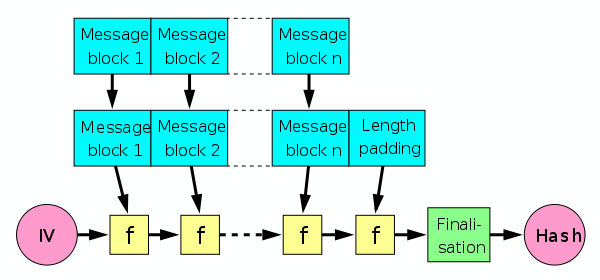
Expressed as a colorful diagram, the Merkle construction looks something like this:

Merkle-Damgård Construction (source: Wikipedia because I’m too lazy to
draw my own diagrams). IV is a fixed value. f is a one-way compression function.

The beauty of Merkle’s proposal is that it’s relatively simple to understand. You simply chop your message into blocks, then feed each block into the function f along with the output of the previous function evaluation. Throw in a finalization stage and you’re done.

Of course there’s a difference between proposing a technique and showing that it actually works. It would take ten more years, but at CRYPTO 1989, Merkle and another cryptographer named Ivan Damgård independently submitted formal analyses of Merkle’s proposal. What they showed is that as long as the function f has certain ideal properties, the resulting hash function is guaranteed to be collision-resistant.  The rest, as they say, is history.

The popularity of Merkle-Damgård can be attributed in part to its security proof. But it also owes something to some major practical advantages:

  1. You can use any secure block cipher as the function f, with just a few tweaks.
  2. M-D hash functions can be pretty darn fast, again depending on f and how you use it.
  3. M-D hashes allow you to digest ‘live’ data streams, where you don’t know in advance how much data you’re going to be hashing. 
Of course, Merkle-Damgård hashes also have serious weaknesses. The most famous is the ‘length extension attack‘ in which an attacker, given only H(M) for some unknown message M, can ‘tack on’ additional blocks of her own choosing. This issue spells big trouble for people who think that H(key || message) is a good Message Authentication CodeWhat’s interesting about the length-extension issue is not that it leads to broken MACs. I mean, that is interesting, and it’s why you should use HMAC. But what’s really interesting is that this flaw doesn’t represent a violation of the collision-resistance guarantee. The two issues are in fact completely orthogonal. And this tells us something fundamental. Namely: collision-resistance is not enough.Today’s implementers do all kinds of crazy things with hash functions, and many of those applications require much more than collision-resistance. To achieve the necessary properties, we first need to figure out what they are. And that requires us to think hard about the following question:

What the heck is a secure hash function?

If you crack a typical security textbook (or visit the Wikipedia page on hash functions), you’ll see a long list of things of things a hash function ‘must’ accomplish. The list usually starts with these:
  1. Collision resistance. It should be hard to find any pair of messages M1, M2 such that H(M1) == H(M2).
  2. Pre-image resistance. Given only h it should be hard to find a ‘pre-image’ M2 such that H(M2) == h.

Now leave aside the technical fact that none of the unkeyed hash functions we use today are ‘truly’ collision-resistant. Or that the above definition of pre-image resistance implies that I can hash my cat’s name (‘fluffy’) and nobody can invert the hash (note: not true. Go ask LinkedIn if you don’t believe me.) The real problem is that these definitions don’t cover the things that people actually do with hash functions.

For example, take the construction of PRNGs. A common PRNG design hashes together large pools of gathered entropy in the hope that the result will be sufficiently uniform for cryptographic work. This is so common that it’s probably happening somewhere on your computer right now. And yet, absolutely nothing in the definitions above implies that this technique is safe!* Similar problems exist for key derivation functions, and even for signature schemes like ECDSA which clearly require hash functions that are more than just collision-resistant.
The more you look into the way that people use hash functions, the more you realize that they really need something that produces ‘random-looking’ output. Unfortunately, this notion is surprisingly hard to formalize. Hash functions are unkeyed, so they’re not pseudo-random functions. What in the world are people asking for?

Random oracles and indifferentiability

The answer, if you dig hard enough, is that people want hash functions to be random oracles.

Random oracles are cryptographers’ conception of what an ‘ideal’ hash function should be. Put succinctly, a random oracle is a perfectly random function that you can evaluate quickly. Random functions are beautiful not just because the output is random-looking (of course), but also because they’re automatically collision-resistant and pre-image resistant. It’s the only requirement you ever need.

The problem with random functions is that you just can’t evaluate them quickly: you need exponential storage space to keep them, and exponential time to evaluate one. Moreover, we know of nothing in the ‘real’ world that can approximate them. When cryptographers try to analyze their schemes with random functions, they have to go off into an imaginary fantasy world that we call the ‘random oracle model.

But ok, this post is not to judge. For the moment, let’s imagine that we are willing to visit this fantasy world. An obvious question is: what would it take to build a random oracle? If we had a compression function that was good enough — itself a random function — could we use a technique like Merkle-Damgård to get the rest of the way?

In 2004, Maurer, Renner and Holenstein gave us a powerful tool for answering this question. What they showed is that it’s always possible to replace functionality A (e.g., a random oracle) with another functionality B (e.g., an ideal compression function) provided that the following rules are satisfied:

  1. There exists a way to ‘construct’ something ‘like’ A out of B.
  2. There exists a way to ‘simulate’ something ‘like’ B using A.
  3. An attacker who interacts with {constructed A-like thing, B} cannot tell the difference (i.e., can’t differentiate it) from {A, simulated B-like thing}

The definition of simulation gets a bit wonky. but expressed in simpler language all this means is: if you can show that your hash function, instantiated with an ‘ideal’ compression function, looks indistinguishable from a random oracle. And you can show that a manufactured compression function, built using a random oracle as an ingredient, looks indistinguishable from an ideal compression function, then you can always replace one with the other. That is, your hash function is ‘good enough’ to be a random oracle.

The following year, Coron, Dodis, Malinaud and Puniya applied this framework to Merkle-Damgård-hash functions. Their first result was immediate: such a proof does not work for Merkle-Damgård. Of course this shouldn’t actually surprise us. We already know that Merkle-Damgård doesn’t behave like a random oracle, since random oracles don’t exhibit length-extension attacks. Still it’s one thing to know this, and another to see a known problem actually turn up and screw up a proof. So far, no problem.

What Coron et al. showed next is much more interesting:
  • They proved formally that Merkle-Damgård can be made indifferentiable from a random oracle, as long as you apply a prefix-free encoding to the input before hashing it. Prefix-free encodings prevent length-extensions by ensuring that no message can ever be a prefix of another.
  • Next, they proved the security of HMAC applied to a Merkle-Damgård hash.
  • Finally, and best of all, they showed that if you simply drop some bits from the last output block — something called a ‘chop’ construction — you can make Merkle-Damgård hashes secure with much less work.

The best part of Coron et al.‘s findings is that the chop construction is already (inadvertently) in place on SHA384, which is constructed by dropping some output bits from its big-brother hash SHA512. The modern hash variants SHA512/224 and SHA512/256 also have this property.** So this theoretical work already has one big payoff: we know that (under certain assumptions) these hashes may be better than some of the others.

And these results have bigger implications. Now that we know how to do this, we can repeat the process for just about every candidate hash function anyone proposes. This lets us immediately weed out obvious bugs, and avoid standardizing another hash with problems like the length extension attack. This process has become so common that all of the SHA3 candidates now sport exactly such an indifferentiability proof.

Of course, in the real world, indifferentiability only takes you so far. It does tell us something, but it doesn’t tell us everything. Sure, if the compression function is perfect, you obtain a strong result about the hash function. But compression functions are never perfect. Real compression functions have glitches and oddities that can make these theoretical results irrelevant. This is why we’ll always need smart people to arm wrestle over which hash we get to use next.

In conclusion

If I had it in me, I’d go on to talk about the SHA3 candidates, and the techniques that each uses to achieve security in this model. But this has already been a long post, so that will have to wait for another time.

I want to say only one final thing.

This is a practical blog, and I admit that I try to avoid theory. What fascinates me about this area is that it’s a great example of a place where theory has directly come to the aid of practice. You may think of hash functions as whizzing little black boxes of ad-hoc machinery, and to some extent they are. But without theoretical analysis like this, they’d be a whole lot more ad-hoc. They might not even work.

Remember this when NIST finally gets around to picking Keccak BLAKE.

Notes:

* For a ridiculous example, imagine that you have a secure (collision-resistant, pre-image resistant) hash function H. Now construct a new hash function H’ such that H'(M) = {“long string of 0s” || H(M)}. This function is as collision-resistant as the original, but won’t be very useful if you’re generating keys with it.

** Thanks to Paulo Barreto for fixing numerous typos and pointing out that SHA512/256 and /224 make excellent candidates for chop hashes!

A bad couple of years for the cryptographic token industry

SafeNet eToken PRO Anywhere

There was a time just a few weeks ago when it seemed like the CRYPTO 2012 accepted papers list might not be posted in time for, well, CRYPTO 2012. Fortunately the list is public now, which means (1) we’ve avoided the longest rump session in the history of cryptography, and (2) I get to tell you about a particularly neat paper.

The paper in question is Efficient Padding Oracle Attacks on Cryptographic Hardware‘ by Bardou, Focardi, Kawamoto, Simionato, Steel and Tsay. This is a typically understated academic title for a surprisingly nifty result.

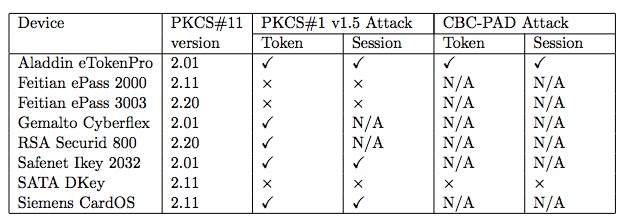
Here’s the postage stamp version: due to a perfect storm of (subtle, but not novel) cryptographic flaws, an attacker can extract sensitive keys from several popular cryptographic token devices. This is obviously not good, and it may have big implications for people who depend on tokens for their day-to-day security. If that describes you, I suggest you take a look at this table:

Tokens affected by the Bardou et al. attacks. A checkmark means “vulnerable”. (source).

That’s the headline news, anyway. The more specific (and important) lesson for cryptographic implementers is: if you’re using PKCS#1v1.5 padding for RSA encryption, cut it out. Really. This is the last warning you’re going to get.

So much for the short version. Keep reading for the long one.

What are cryptographic tokens?

If you’ve ever developed cryptographic software, you know that general-purpose computers aren’t the safest place to store keys. Leaving aside stuff like this, all it takes is one nasty software bug to send all your important key material (e.g., TLS server keys, certificate signing keys, authentication keys) into someone else’s hands.

Since it seems increasingly difficult to harden standard computers, a popular solution is to simply put the keys somewhere else. The most popular ‘somewhere’ is onboard a cryptographic co-processor. When the co-processor is expensive and powerful, we often refer to it as a Hardware Security Module (HSM). When it’s removable and consumer-grade we call it a ‘token‘. Most tokens are used for authentication purposes (think SecurID), but they’re useful for other things like disk encryption. Modern tokens typically look like USB sticks.

Tokens operate under some of the most challenging conditions you can imagine. The computer they’re connected to may be completely pwned. An attacker could steal a token and physically dismember it in an attempt to extract its secrets. None of this is easy to deal with, and manufacturers have invested a lot of time and money getting this right.

Unfortunately, what Bardou et al. are telling us is: maybe they didn’t invest enough. Several popular token brands are still vulnerable to cryptographic attacks that have been well-known since the 1990s. And that is bad news.

But this paper is brand new. Why are you talking about ‘a bad couple of years’?

While this new paper is a bad result for the token industry, it’s not the first bad news we’ve had about these devices.

Let me explain. You see, while tokens won’t let you extract sensitive keys, they make an exception if the sensitive keys are encrypted (aka: ‘wrapped’). This makes a lot of sense. How else are you supposed to import/export/back up keys from a token? In theory, this encryption (wrapping) should keep the keys safe even if an attacker has totally compromised your computer.

An older problem — discovered by a series of researchers in 2009 and 2010 — is that token manufacturers were careless in the way they implemented the PKCS#11 Cryptographic Token Interface Standard. The spec says that encryption keys are to be used for either (a) encryption/decryption of normal data, OR (b) for wrapping sensitive keys. But never both. If you allow users to perform both operations with a given key, you enable the following attack:

  1. Ask the token to encrypt a sensitive key K and export the ciphertext.
  2. Ask the token to decrypt the ciphertext and hand you the result.
  3. Congratulations, you have K!

It’s hard to believe that something this ‘stupid’ actually worked, but for some tokens it did. The whole mess reached a head in 2010 when Bortolozzo, Focardi, Centenaro and Steel automated the process of finding API bugs like this, and were able to ‘break’ a whole bunch of tokens in one go.

(Token manufacturers were not happy with this, by the way. At CCS 2010, Graham Steel described being invited to a major French token manufacturer where the CEO held him captive and berated him gently tried to persuade him not to publish his results. Such are the hazards of responsible disclosure.)

The above issues should be long fixed by now. Still, they raised questions! If token manufacturers can’t implement a secure API, how well are they doing with things like, say, complicated cryptographic algorithms? And that’s the question this new paper tries to answer.

So what’s wrong with the crypto?

What the CRYPTO paper shows is that several commercial tokens (but not all of them!) are vulnerable to practical padding oracle attacks on both symmetric (AES-CBC) and asymmetric (RSA PKCS #1v1.5) encryption. These attacks are a huge problem, since they give an attacker access to keys that otherwise should be safely encrypted outside of the token.

Padding attacks take different forms, but the general intuition is this:

  1. Many encryption schemes apply padding to the plaintext before encryption.
  2. After decrypting a given ciphertext, most implementations check to see if the padding is valid. Some output a recognizable error (or timing differential) when it isn’t.
  3. By mauling a legitimate (intercepted) ciphertext in various ways, the attacker can submit many modified versions of the ciphertext to be decrypted. Some of these will have valid padding, others will produce error results. Suprisingly, just these bits of information can be sufficient to gradually reveal the underlying plaintext.

For tokens, you start with an encrypted key you want to learn, and you submit it to the token for import. Normally the token will just accept it, which isn’t very helpful. So instead, you modify the ciphertext in some way, and send the mangled ciphertext to be imported. If the token responds with something like ‘could not import key: the ciphertext had bad padding’, you may be able to run a padding oracle attack.

(Note that it doesn’t take an explicit error: if decryption is simply faster when the padding is bad, you’ve got everything you need.)

The most famous (and efficient) padding oracle attack is Vaudenay’s attack on padded CBC-mode encryption, proposed back in 2002. (See here for an idea of what the attack looks like.) The first finding of Bardou et al. is that many tokens are vulnerable to Vaudenay’s attack. Yikes.

But what about RSA encryption? This is important, since many tokens only support RSA to import secret keys.

Fortunately (for the researchers) RSA encryption also uses padding, and even better: these tokens use a scheme that’s long been known to have padding oracle problems of its own. That scheme is known as RSA-PKCS#1v1.5, and it was famously broken by Daniel Bleichenbacher in the late 1990s. As long as these implementations produce obvious errors (or timing differences) when they encounter bad padding, there should be an ‘off the shelf’ attack that works against them.

But here the researchers ran into a problem. Bleichenbacher’s attack is beautiful, but it’s too slow to be useful against tokens. When attacking a 1024-bit RSA key, it can require millions of decryption attempts! Your typical consumer-grade token token can only compute a few decryptions per second.

No problem! To make their attack work, Bardou et al. ‘simply’ optimized Bleichenbacher’s attack. The new version requires mere thousands (or tens of thousands) of decryption attempts, which means you can unwrap sensitive keys in just a few minutes on some tokens.

This table tells us how long the attacks actually took to run against real tokens:

Timing results for the optimized Bleichenbacher attacks (on 1024-bit RSA encryptions). ‘Oracle’ indicates the nature of the RSA decryption/padding check implementation. (source)

Is my HSM secure?

If you’re an HSM manufacturer I have ‘good’ news for you. You’re ok. For now.

Oh, not because your HSM is secure or anything. Hilariously, the researchers were unable to run their attacks on a commercial HSM because they couldn’t afford one. (They can costs upwards of EUR20,000.) Don’t get complacent: they’re working on it.

How does the RSA attack work?

For the real details you should see the paper. Here I can offer only the tiniest little intuition.

The Bleichenbacher attack relies on the fact that RSA is homomorphic with respect to multiplication. That means you can multiply a hidden RSA plaintext (the “m” in “m^e mod N”) by some known value “s” of your choosing. What you do is compute “m^e * s^e mod N”. The decryption of this value is “(m*s) mod N”.

Now consider the details of RSA-PKCS#1v1.5. To encrypt a legitimate message, the encryptor first pads it with the following bytes, and treats the padded result as the integer “m” to be RSA encrypted.

0x 00 02 { at least 8 non-zero random bytes } 00 { message }

So you’ve intercepted a valid, PKCS#1v1.5 padded RSA ciphertext, and you have access to a decryptor who knows the secret key. The trick now is to ‘mangle’ the legitimate ciphertext in various clever ways and submit these new results to the decryptor.

The basic approach is to multiply the ciphertext by different chosen values “s^e mod N” (for known “s”) until eventually you find one that does not produce a padding error. This means that the decrypted value “(m*s mod N)” is itself a PKCS-padded message. This seems inconsequential, but actually it tells you quite a lot. Presumably you know “s”, since you chose it. You also know that “m*s mod N” is an integer of a very specific form, one that satisfies the padding checks. By adaptively choosing new “s” values and submitting many, many ciphertexts for decryption, these tiny bits of information will allow you to ‘zero in’ on the underlying plaintext.

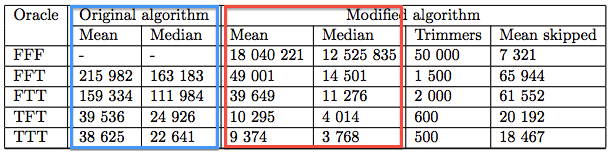
The authors of this paper describe several optimizations to Bleichenbacher’s attack. What I find most interesting is the way they exploited differences in the way that tokens actually implement their padding checks. It turns out that this nature of this implementation makes a huge difference to the efficiency of the attack.

Five possible ‘implementations’ are described below.

  1. FFF: padding is ‘ok’ only if correctly padded and plaintext is of a specific length (e.g., it’s a 128-bit AES key)
  2. FFT: padding is ‘ok’ only if correctly padded, but plaintext can be any length.
  3. FTT: same as above, but also allows 0s in the “non-zero random bytes”.
  4. TFT: same as above, but ‘ok’ even if there are no zeros after the first byte.
  5. TTT: padding is ‘ok’ as long as it starts with ‘0x 00 02’.

These all look quite similar, but have very different practical implications!

You see, intuitively, the Bleichenbacher attack only ‘works’ if sometimes the decryptor says ‘hey, this mauled ciphertext has good padding!’. As a general rule, the more often that happens, the faster the attack works.

It goes without saying that the TTT padding check is a lot more likely to produce ‘good padding’ results than the ‘FFF’, and correspondingly for the intermediate ones. FFF is so challenging that it’s basically impractical. The ‘good’ (uh, ‘bad’) news is that many tokens tend towards the more useful implementations. And as you can see in the table below, little details like this have huge impacts.

Total number of decryption queries required to decrypt an RSA-PKCS#1v1.5-encrypted symmetric (AES) key.  ‘Original algorithm’ (blue box) shows the mean/median performance of the standard Bleichenbacher attack. ‘Modified algorithm’ (red box) is the mean/median performance of the new, optimized algorithm. Note that the specific implementation of the padding check (FFF/TTT etc.) makes a huge difference in the cost. (source) 

What can I do to protect my own code from padding oracle attacks?

If you’re using symmetric encryption, that’s easy. Simply use authenticated encryption, or put a MAC on all of your ciphertexts. Do this correctly and Vaudenay padding oracles will not trouble you.

RSA encryption is more difficult. The ‘best practice’ in implementing RSA is: don’t implement RSA. Other people have done it better than you can. Go find a good implementation of RSA-OAEP and use that. End of story.

Unfortunately, even with RSA-OAEP, this can be difficult. There are attacks on OAEP encryption too (some are mentioned in this paper). And if you’re working in hardware, life is particularly difficult. Even small timing differentials can leak details about your padding check. If this describes your use case: find a professional and be very, very careful.

Are there any broad security lessons, any wisdom, to be drawn from this result?

Usually the lesson I glean from these attacks is: people make mistakes. Which is barely a lesson, and it’s certainly not wisdom. For some of the issues in this paper, namely the symmetric padding oracle attacks, that’s still about what I get. Manufacturers made unforced errors.

But the RSA-PKCS#1v1.5 attacks are, to me, a bit more meaningful. I run into bad implementations of this obsolete standard this all the time. Most of the time when I bring it up, nobody really cares. The typical response is something like: it’s called the ‘million message attack’ for a reason. There’s no way anyone run that thing against our system.

Bruce Schneier says ‘attacks only get better, they never get worse’. In my opinion, the lesson of this paper is that attacks not only get better, but if you go around tempting fate, they’re quite capable of getting better by precisely the amount necessary to break your (high-value) system. You should never use a broken primitive just because the ‘known’ attack seems impractical. 

And while this may not be ‘wisdom’ either, I think it’s advice to live by.

Flame, certificates, collisions. Oh my.

Update 6/6: Microsoft has given us more details on what’s going on here. If these collision attacks are truly novel, this tells us a lot about who worked on Flame and how important it is. 

Update 6/7: Yes, it’s officially a novel MD5 collision attack, with the implication that top cryptographers were involved in Flame’s creation. We truly are living in the future.

See detailed updates (and a timeline) at the bottom of this post.

If you pay attention to these things, you’ve heard that there’s a new piece of government-issued malware making the rounds. It’s called Flame (or sometimes Skywiper), and it’s basically the most sophisticated — or most bloated — piece of malicious software ever devised. Kaspersky gets the credit for identifying Flame, but the task of tearing it to pieces has fallen to a whole bunch of different people.

Normally I don’t get too excited about malware, cause, well, that kind of thing is somebody else’s problem. But Flame is special: if reports are correct, this is the first piece of malware ever to take advantage of an MD5 certificate collision to enable code signing. Actually, it may be the first real anything to use MD5 certificate collisions. Neat stuff.

What we know is pretty sketchy, and is based entirely on the information-sparse updates coming from Microsoft’s security team. Here’s the story so far:

Sometime yesterday (June 3), Microsoft released an urgent security advisory warning administrators to revoke two Intermediate certificates hanging off of the Microsoft root cert. These belong to the Terminal Services Licensing service. Note that while these are real certificates — with keys and everything — they actually have nothing to do with security: their sole purpose was to authorize, say, 20 seats on your Terminal Services machine.

Despite the fact that these certs don’t serve any real security purpose, and shouldn’t be confused with anything that matters, Microsoft hung them off of the same root as the real certificates it uses for, well, important stuff. Stuff like signing Windows Update packages. You see where this is going?

Actually, this shouldn’t have been a real problem, because these licensing certs (and any new certificates beneath them) should have been recognizably different from code-signing certificates. Unfortunately, someone in Product Licensing appears to have really screwed the pooch. These certificates were used to generate Licensing certificates for customers. And each of those certificates had the code signing bit set.

The result? Anyone who paid for a Terminal Services license could (apparently) sign code as if they were Microsoft. If you’re wondering what that looks like, it looks like this.

This is obviously a bad thing. For many reasons. Mikko Hypponen points out that many organizations whitelist software signing by Microsoft, so even if institutions were being paranoid, this malware basically had carte blanche.

Ok, so far this is really bad, but just a garden-variety screwup. I mean, a huge one, to be sure. But nothing really interesting.

Here’s where that changes. Just today, Microsoft released a new update. This is the new piece:

The Flame malware used a cryptographic collision attack in combination with the terminal server licensing service certificates to sign code as if it came from Microsoft. However, code-signing without performing a collision is also possible.

Now, I’m not sure why the ‘collision attack’ is necessary if code-signing is possible without a collision. But who cares! A collision attack! In the wild! On top-secret government-issued Malware! Dan Brown couldn’t hold a candle to this.

If we look at the Licensing certificates in question, we do indeed see that at least one — created in 2009 — uses the MD5 hash function, something everyone knows is a bad idea:

Certificate:    Data:        Version: 3 (0x2)        Serial Number:            3a:ab:11:de:e5:2f:1b:19:d0:56    Signature Algorithm: md5WithRSAEncryption        Issuer: OU=Copyright (c) 1997 Microsoft Corp., OU=Microsoft Corporation, CN=Microsoft Root Authority        Validity            Not Before: Dec 10 01:55:35 2009 GMT            Not After : Oct 23 08:00:00 2016 GMT        Subject: C=US, ST=Washington, L=Redmond, O=Microsoft Corporation, OU=Copyright (c) 1999 Microsoft Corp., CN=Microsoft Enforced Licensing Intermediate PCA        Subject Public Key Info:            Public Key Algorithm: rsaEncryption                Public-Key: (2048 bit)

And so… Well, I don’t really know. That’s where we run out of information. And end up with a lot of questions.

For one thing, why did the Flame authors need a collision? What extra capabilities did it get them? (Update: the best theory I’ve heard comes from Nate Lawson, who theorizes that the collision might have allowed the attackers to hide their identity. Update 6/6: The real reason has to do with certificate extensions and compatibility with more recent Windows versions. See the end of this post.)

More importantly, what kind of resources would it take to find the necessary MD5 collision? That would tell us a lot about the capabilities of the people government contractors who write malware like this. In 2008 it took one day on a supercomputer, i.e., several hundred PS3s linked together.

And just out of curiosity, what in the world was Microsoft doing issuing MD5-based certificates in 2009? I mean, the code signing bit is disastrous, but at least that’s a relatively subtle issue — I can understand how someone might have missed it. But making MD5 certificates one year after they were definitively shown to be insecure, that’s hard to excuse. Lastly, why do licensing certificates even need to involve a Certificate Signing Request at all, which is the vector you’d use for a collision attack?

I hope that we’ll learn the answers to these questions over the next couple of days. In the mean time, it’s a fascinating time to be in security. If not, unfortunately, a very good time for anyone else.

***

Update 6/5: For those who aren’t familiar with certificate collision attacks, I should clear up the basic premise. Most Certificate Authorities sign a Certificate Signing Request (CSR) issued by a possibly untrustworthy customer. The idea of an MD5 collision-finding attack is to come up with two different CSRs that hash to the same thing. One would be legitimate and might contain your Terminal Services licensing number. The other would contain… something else. By signing the first CSR, Microsoft would be implicitly creating a certificate on the second batch of information.

Finding collisions is a tricky process, since it requires you to muck with the bits of the public key embedded in the certificate (see this paper for more details). Also, some CAs embed a random serial number into the certificate, which really messes with the attack. Microsoft did not.

Finally, some have noticed that Microsoft is still using a root certificate based on MD5, one that doesn’t expire until 2020, and hasn’t been revoked. What makes this ok? The simple answer is that it’s not ok. However, Microsoft probably does not sign arbitrary CSRs with that root certificate, meaning that collision attacks are not viable against it. It’s only the Intermediate certs, the ones that actually sign untrusted CSRs you need to worry about — today.

***

Update 6/6: Microsoft has finally given us some red meat. Short summary: the Terminal Services Licensing certs do work to sign code on versions of Windows prior to Vista, with no collision attack needed. All in all, that’s a heck of a bad thing. But it seems that more recent versions of Windows objected to the particular X.509 extensions that were in the TS licensing certs. The government (or their contractors) therefore used a collision attack to make a certificate that did not have these extensions. From what I’m reading on mailing lists, the collision appears to be “new, and of scientific interest”.

If this pans out, it’s a big deal. Normally the government doesn’t blow a truly sophisticated cryptanalytic attack on some minor spying effort. Getting MD5 collisions up and running is a big effort; it’s not something you can do from a cookbook. But developing novel collision techniques is a step beyond that. I take this to mean that Flame’s authors were breaking out the big guns, which tells us something about its importance to our government. It also tells us that the creation of Flame may have involved some of the top mathematicians and cryptographers in (our?) intelligence services. This is an important datapoint.

***

Update 6/7: It looks like it does pan out. Marc Stevens — one of the authors of the earlier MD5 certificate collision papers — confirms that Flame’s certificate uses a novel collision-finding technique.

“Flame uses a completely new variant of a ‘chosen prefix collision attack’ to impersonate a legitimate security update from Microsoft. The design of this new variant required world-class cryptanalysis”

We can only speculate about why this would be necessary, but a good guess is that Flame is old (or, at very least, the crypto techniques are). If the collision technique was in the works prior to 2009 (and why wouldn’t it be?), Stevens et al. wouldn’t have had much relevance. For those who like details, a (very incomplete) timeline looks something like this:

  1. Mid-1990s: MD5 is effectively obsolete. Switch to a better hash function!
  2. August 2004: Wang and Yu present first (‘random’), manually-found collision on MD5.
  3. 2004-2007: Collisions extended to ‘meaningful’ documents. Lots of stuff omitted here.
  4. May 2007: (CWI) Stevens et al. publish a first impractical technique for colliding certificates.
  5. Late 2008: (CWI) Stevens et al. develop a practical certificate collision.
  6. December 2008: Vendors notified.
  7. Feburary 2009: Paper submitted to CRYPTO.
  8. Summer 2009: Source code released.

Even assuming that CWI team had perfect security with their result, conference program committees are hardly built for secrecy — at least, not from goverments. So it’s reasonable to assume that the Stevens et al. technique was known by February 2009, possibly earlier. Which means that the Flame developers may have had their own approach under development sometime before that date.

The really interesting question is: when did secret collision research get ahead of the public, academic stuff? Post-2007? Post-2004? Pre-2004? I doubt we’ll ever know the answer to this question. I sure would love to.

Update 6/12: Alex Sotirov has a great Summercon presentation with many of the details. The word from those who know is: don’t take his $20,000 figure too literally. We know nothing about the techniques used to find this collision.

Posts so far

The problem with blogs is that, well, they’re weblogs. The ‘good’ posts dribble off the bottom, where they get mixed in with the bad, and nobody ever sees them again. The more crap I write, the worse this problem is.

To fight this — and to prevent myself from writing the same post over and over again — I thought it might be helpful to compile a list of a few posts that aren’t too embarassing. If you’re new here, you can treat this as a table of contents to this blog.

(Hey, there are things going on in the world! The CRYPTO list of accepted papers has finally been published! There are neat attacks on cryptographic tokens! I want to write about all of it, but I just don’t have time today. So please accept these re-runs for now, and hopefully I’ll have new content soon.)

On the mess that is our public-key infrastructure:

  1. The Internet is broken, can we please fix it? On Trustwave & MITM attacks.
  2. TACK, a proposal for dynamically ‘pinning’ certificates.
High-level intro posts:
  1. It’s the end of the world as we know it, and I feel fine. Post-quantum crypto from 30,000 feet.
  2. What is the random oracle model and why should I care? An early series, a little embarrassing.
  3. Format preserving encryption. Or: how to encrypt a credit card number with AES.
  4. What’s TLS Snap Start? and So long False Start. On two (now withdrawn) TLS extensions.
  5. The future of electronic currency. On anonymous e-cash.
  6. Offline security through CAPTCHAs. A neat old idea for preventing dictionary attacks.
  7. Poker is hard, especially for cryptographers. All about mental poker.
  8. Fully-Homomorphic Encryption. Unfortunately this is still unfinished…
How to use cryptography (in)securely:
  1. How (not) to use symmetric encryption. A few of the worst pitfalls.
  2. What’s the deal with RC4? A history of attacks on an old stream cipher.
  3. How to choose an authenticated encryption mode. Very important!
  4. Random number generation, an illustrated primer. A look under the hood.
  5. Surviving a bad RNG. What to do if your (P)RNG isn’t carrying its weight.
  6. Circular security. A wonkier, more theoretical subject.
  7. On multiple encryption. Are you safer if you encrypt twice?
Crypto attack(s) of the week:
  1. On the BEAST attackNote: written before the details were made public.
  2. XML Encryption. Why you should authenticate your ciphertexts.
  3. Side-channel attacks on DESFire. Neat.
  4. Datagram TLS. Alfardan & Paterson show that  timing attacks are (still) practical.
  5. 2011 Redux. A quick summary of a whole year.
  6. Satellite phone encryption is terrible. Attacks on two satphone ciphers.
  7. The story of EAX(prime). And why security proofs are like Knight Rider.
  8. A tale of two patches. Analyzing two recent OpenSSL bugs.
Rants:
  1. Digital Fortress: I read it so you don’t have to. Dan Brown embarrasses cryptography.
  2. Bram Cohen corrected. In which I randomly flame Bram Cohen.
  3. Bram Cohen corrects me? Bram turns out to be a good sport.
  4. Why Antisec matters. The security industry is a joke?
When I though this blog was a book:
  1. Introduction
  2. Where things fall apart: PrimitivesProtocols