Attack of the week: 64-bit ciphers in TLS

A few months ago it was starting to seem like you couldn’t go a week without a new attack on TLS. In that context, this summer has been a blessed relief. Sadly, it looks like our vacation is over, and it’s time to go back to school.

Today brings the news that Karthikeyan Bhargavan and Gaëtan Leurent out of INRIA have a new paper that demonstrates a practical attack on legacy ciphersuites in TLS (it’s called “Sweet32”, website here). What they show is that ciphersuites that use 64-bit blocklength ciphers — notably 3DES — are vulnerable to plaintext recovery attacks that work even if the attacker cannot recover the encryption key.

While the principles behind this attack are well known, there’s always a difference between attacks in principle and attacks in practice. What this paper shows is that we really need to start paying attention to the practice.

So what’s the matter with 64-bit block ciphers?

Block ciphers are one of the most widely-used cryptographic primitives. As the nameimplies, these are schemes designed to encipher data in blocks, rather than a single bit at a time.

The two main parameters that define a block cipher are its block size (the number of bits it processes in one go), and its key size. The two parameters need not be related. So for example, DES has a 56-bit key and a 64-bit block. Whereas 3DES (which is built from DES) can use up to a 168-bit key and yet still has the same 64-bit block. More recent ciphers have opted for both larger blocks and larger keys.

When it comes to the security provided by a block cipher, the most important parameter is generally the key size. A cipher like DES, with its tiny 56-bit key, is trivially vulnerable to brute force attacks that attempt decryption with every possible key (often using specialized hardware). A cipher like AES or 3DES is generally not vulnerable to this sort of attack, since the keys are much longer.

However, as they say: key size is not everything. Sometimes the block size matters too.

You see, in practice, we often need to encrypt messages that are longer than a single block. We also tend to want our encryption to be randomized. To accomplish this, most protocols use a block cipher in a scheme called a mode of operation. The most popular mode used in TLS is CBC mode. Encryption in CBC looks like this:
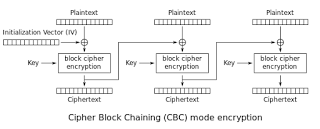
Source: Wikipedia

The nice thing about CBC is that (leaving aside authentication issues) it can be proven (semantically) secure if we make various assumptions about the security of the underlying block cipher. Yet these security proofs have one important requirement. Namely, the attacker must not receive too much data encrypted with a single key.

The reason for this can be illustrated via the following simple attack.

Imagine that an honest encryptor is encrypting a bunch of messages using CBC mode. Following the diagram above, this involves selecting a random Initialization Vector (IV) of size equal to the block size of the cipher, then XORing IV with the first plaintext block (P), and enciphering the result (P \oplus IV). The IV is sent (in the clear) along with the ciphertext.

Most of the time, the resulting ciphertext block will be unique — that is, it won’t match any previous ciphertext block that an attacker may have seen. However, if the encryptor processes enough messages, sooner or later the attacker will see a collision. That is, it will see a ciphertext block that is the same as some previous ciphertext block. Since the cipher is deterministic, this means the cipher’s input (P \oplus IV) must be identical to the cipher’s previous input (P' \oplus IV') that created the previous block.

In other words, we have (P \oplus IV) = (P' \oplus IV'), which can be rearranged as (P \oplus P') = (IV \oplus IV'). Since the IVs are random and known to the attacker, the attacker has (with high probability) learned the XOR of two (unknown) plaintexts!

What can you do with the XOR of two unknown plaintexts? Well, if you happen to know one of those two plaintext blocks — as you might if you were able to choose some of the plaintexts the encryptor was processing — then you can easily recover the other plaintext. Alternatively, there are known techniques that can sometimes recover useful data even when you don’t know both blocks.

The main lesson here is that this entire mess only occurs if the attacker sees a collision. And the probability of such a collision is entirely dependent on the size of the cipher block. Worse, thanks to the (non-intuitive) nature of the birthday bound, this happens much more quickly than you might think it would. Roughly speaking, if the cipher block is b bits long, then we should expect a collision after roughly 2^{b/2} encrypted blocks.

In the case of a 64-bit blocksize cipher like 3DES, this is somewhere in the vicinity of 2^{32}, or around 4 billion enciphered blocks.

(As a note, the collision does not really need to occur in the first block. Since all blocks in CBC are calculated in the same way, it could be a collision anywhere within the messages.)

Whew. I thought this was a practical attack. 4 billion is a big number!

It’s true that 4 billion blocks seems like an awfully large number. In a practical attack, the requirements would be even larger — since the most efficient attack is for the attacker to know a lot of the plaintexts, in the hope that she will be able to recover one unknown plaintext when she learns the value (P ⊕ P’).

However, it’s worth keeping in mind that these traffic numbers aren’t absurd for TLS. In practice, 4 billion 3DES blocks works out to 32GB of raw ciphertext. A lot to be sure, but not impossible. If, as the Sweet32 authors do, we assume that half of the plaintext blocks are known to the attacker, we’d need to increase the amount of ciphertext to about 64GB. This is a lot, but not impossible.

The Sweet32 authors take this one step further. They imagine that the ciphertext consists of many HTTPS connections, consisting of 512 bytes of plaintext, in each of which is embedded the same secret 8-byte cookie — and the rest of the session plaintext is known. Calculating from these values, they obtain a requirement of approximately 256GB of ciphertext needed to recover the cookie with high probability.

That is really a lot.

But keep in mind that TLS connections are being used to encipher increasingly more data. Moreover, a single open browser frame running attacker-controlled Javascript can produce many gigabytes of ciphertext in a single hour. So these attacks are not outside of the realm of what we can run today, and presumably will be very feasible in the future.

How does the TLS attack work?

While the cryptographic community has been largely pushing TLS away from ciphersuites like CBC, in favor of modern authenticated modes of operation, these modes still exist in TLS. And they exist not only for use not only with modern ciphers like AES, but they are often available for older ciphersuites like 3DES. For example, here’s a connection I just made to Google:


Of course, just because a server supports 3DES does not mean that it’s vulnerable to this attack. In order for a particular connection to be vulnerable, both the client and server must satisfy three main requirements:

    1. The client and server must negotiate a 64-bit cipher. This is a relatively rare occurrence, but can happen in cases where one of the two sides is using an out-of-date client. For example, stock Windows XP does not support any of the AES-based ciphersuites. Similarly, SSL3 connections may negotiate 3DES ciphersuites.
    2. The server and client must support long-lived TLS sessions, i.e., encrypting a great deal of data with the same key. Unfortunately, most web browsers place no limit on the length of an HTTPS session if Keep-Alive is used, provided that the server allows the session. The Sweet32 authors scanned and discovered that many servers (including IIS) will allow sessions long enough to run their attack. Across the Internet, the percentage of vulnerable servers is small (less than 1%), but includes some important sites.
    3. The client must encipher a great deal of known data, including a secret session cookie. This is generally achieved by running adversarial Javascript code in the browser, although it could be done using standard HTML as well.
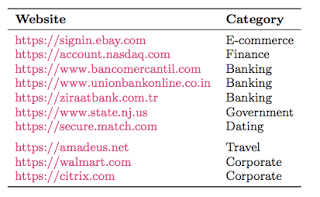
      Sites vulnerable to Sweet32. (source)

These caveats aside, the authors were able to run their attack using Firefox, sending at a rate of about 1500 connections per second. With a few optimizations, they were able to recover a 16-byte secret cookie in about 30 hours (a lucky result, given an expected 38 hour run time).The client must encipher a great deal of known data, including a secret session cookie. This is generally achieved by running adversarial Javascript code in the browser, although it could be done using standard HTML as well.

So what do we do now?

While this is not an earthshaking result, it’s roughly comparable to previous results we’ve seen with legacy ciphers like RC4.

In short, while these are not the easiest attacks to run, it’s a big problem that there even exist semi-practical attacks that undo the encryption used in standard encryption protocols. This is a problem that we should address, and these attack papers help to make those problems more clear.

Is Apple’s Cloud Key Vault a crypto backdoor?

TL;DR: No, it isn’t. If that’s all you wanted to know, you can stop reading.

Still, as you can see there’s been some talk on Twitter about the subject, and I’m afraid it could lead to a misunderstanding. That would be too bad, since Apple’s new technology is kind of a neat experiment.

So while I promise that this blog is not going to become all-Apple-all-the-time, I figured I’d take a minute to explain what I’m talking about. This post is loosely based on an explanation of Apple’s new escrow technology that Ivan Krstic gave at BlackHat. You should read the original for the fascinating details.

What is Cloud Key Vault (and what is iCloud Keychain)?

A few years ago Apple quietly introduced a new service called iCloud Keychain. This service is designed to allow you to back up your passwords and secret keys to the cloud. Now, if backing up your sensitive passwords gives you the willies, you aren’t crazy. Since these probably include things like bank and email passwords, you really want these to be kept extremely secure.

And — at least going by past experience — security is not where iCloud shines:

The problem here is that passwords need to be secured at a much higher assurance level than most types of data backup. But how can Apple ensure this? We can’t simply upload our secret passwords the way we upload photos of our kids. That would create a number of risks, including:

  1. The risk that someone will guess, reset or brute-force your iCloud password. Password resets are a particular problem. Unfortunately these seem necessary for normal iCloud usage, since people do forget their passwords. But that’s a huge risk when you’re talking about someone’s entire password collection.
  2. The risk that someone will break into Apple’s infrastructure. Even if Apple gets their front-end brute-forcing protections right (and removes password resets), the password vaults themselves are a huge target. You want to make sure that even someone who hacks Apple can’t get them out of the system.
  3. The risk that a government will compel Apple to produce data. Maybe you’re thinking of the U.S. government here. But that’s myopic: Apple stores iCloud data all over the world.

So clearly Apple needs a better way to protect these passwords. How do to it?

Why not just encrypt the passwords?

It is certainly possible for an Apple device to encrypt your password vault before sending it to iCloud. The problem here is that Apple doesn’t necessarily have a strong encryption key to do this with. Remember that the point of a backup is to survive the loss of your device, and thus we can’t assume the existence of a strong recovery key stored on your phone.

This leaves us with basically one option: a user password. This could be either the user’s iCloud password or their device passcode. Unfortunately for the typical user, these tend to be lousy. They may be strong enough to use as a login password — in a system that allows only a very limited number of login attempts. But the kinds of passwords typical users choose to enter on mobile devices are rarely strong enough to stand up to an offline dictionary attack, which is the real threat when using passwords as encryption keys.

(Even using a strong memory-hard password hash like scrypt — with crazy huge parameters — probably won’t save a user who chooses a crappy password. Blame phone manufacturers for making it painful to type in complicated passwords by forcing you to type them so often.)

So what’s Apple to do?

So Apple finds itself in a situation where they can’t trust the user to pick a strong password. They can’t trust their own infrastructure. And they can’t trust themselves. That’s a problem. Fundamentally, computer security requires some degree of trust — someone has to be reliable somewhere.

Apple’s solution is clever: they decided to make something more trustworthy than themselves. To create a new trust anchor, Apple purchased a bunch of fancy devices called Hardware Security Modules, or HSMs. These are sophisticated, tamper-resistant specialized computers that store and operate with cryptographic keys, while preventing even malicious users from extracting them. The high-end HSMs Apple uses also allow the owner to include custom programming.

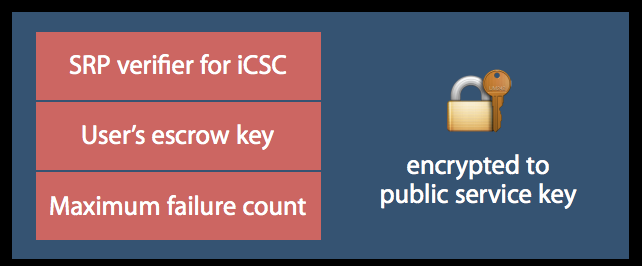
Rather than trusting Apple, your phone encrypts its secrets under a hardcoded 2048-bit RSA public key that belongs to Apple’s HSM. It also encrypts a function of your device passcode, and sends the resulting encrypted blob to iCloud. Critically, only the HSM has a copy of the corresponding RSA decryption key, thus only the HSM can actually view any of this information. Apple’s network sees only an encrypted blob of data, which is essentially useless.

When a user wishes to recover their secrets, they authenticate themselves directly to the HSM. This is done using a user’s “iCloud Security Code” (iCSC), which is almost always your device passcode — something most people remember after typing it every day. This authentication is done using the Secure Remote Password protocol, ensuring that Apple (outside of the HSM) never sees any function of your password.

Now, I said that device passcodes are lousy secrets. That’s true when we’re talking about using them as encryption keys — since offline decryption attacks allow the attacker to make an unlimited number of attempts. However, with the assistance of an HSM, Apple can implement a common-sense countermeasure to such attacks: they limit you to a fixed number of login attempts. This is roughly the same protection that Apple implements on the devices themselves.

The encrypted contents of the data sent to the HSM (source).

The upshot of all these ideas is that — provided that the HSM works as designed, and that it can’t be reprogrammed — even Apple can’t access your stored data except by logging in with a correct passcode. And they only get a limited number of attempts to guess correctly, after which the account locks.

This rules out both malicious insiders and government access, with one big caveat.

What stops Apple from just reprogramming its HSM?

This is probably the biggest weakness of the system, and the part that’s driving the “backdoor’ concerns above. You see, the HSMs Apple uses are programmable. This means that — as long as Apple still has the code signing keys — the company can potentially update the custom code it includes onto the HSM to do all sort sorts of things.

These things might include: programming the HSM to output decrypted escrow keys. Or disabling the maximum login attempt counting mechanism. Or even inserting a program that runs a brute-force dictionary attack on the HSM itself. This would allow Apple to brute-force your passcode and/or recover your passwords.

Fortunately Apple has thought about this problem and taken steps to deal with it. Note that on HSMs like the one Apple is using, the code signing keys live on a special set of admin smartcards. To remove these keys as a concern, once Apple is done programming the HSM, they run these cards through a process that they call a “physical one-way hash function”.

If that sounds complicated, here’s Ivan’s slightly simpler explanation.

So, with the code signing keys destroyed, updating the HSM to allow nefarious actions should not be possible. Pretty much the only action Apple can take is to  wipe the HSM, which would destroy the HSM’s RSA secret keys and thus all of the encrypted records it’s responsible for. To make sure all admin cards are destroyed, the company has developed a complex ceremony for controlling the cards prior to their destruction. This mostly involves people making assertions that they haven’t made copies of the code signing key — which isn’t quite foolproof. But overall it’s pretty impressive.

The downside for Apple, of course, is that there had better not be a bug in any of their programming. Because right now there’s nothing they can do to fix it — except to wipe all of their HSMs and start over.

Couldn’t we use this idea to implement real crypto backdoors?

A key assertion I’ve heard is that if Apple can do this, then surely they can do something similar to escrow your keys for law enforcement. But looking at the system shows isn’t true at all.

To be sure, Apple’s reliance on a Hardware Security Module indicates a great deal of faith in a single hardware/software solution for storing many keys. Only time will tell if that faith is really justified. To be honest, I think it’s an overly-strong assumption. But iCloud Keychain is opt-in, so individuals can decide for themselves whether or not to take the risk. That wouldn’t be true of a mandatory law enforcement backdoor.

But the argument that Apple has enabled a law enforcement backdoor seems to miss what Apple has actually done. Instead of building a system that allows the company to recover your secret information, Apple has devoted enormous resources to locking themselves out. Only customers can access their own information. In other words, Apple has decided that the only way they can hold this information is if they don’t even trust themselves with it.

That’s radically different from what would be required to build a mandatory key escrow system for law enforcement. In fact, one of the big objections to such a backdoor — which my co-authors and I recently outlined in a report — is the danger that any of the numerous actors in such a system could misuse it. By eliminating themselves from the equation, Apple has effectively neutralized that concern.

If Apple can secure your passwords this way, then why don’t they do the same for your backed up photos, videos, and documents?

That’s a good question. Maybe you should ask them?

