A few thoughts on Ray Ozzie’s “Clear” Proposal

Yesterday I happened upon a Wired piece by Steven Levy that covers Ray Ozzie’s proposal for “CLEAR”. I’m quoted at the end of the piece (saying nothing iphone-x-silver-select-2017_AV3much), so I knew the piece was coming. But since many of the things I said to Levy were fairly skeptical — and most didn’t make it into the piece — I figured it might be worthwhile to say a few of them here.
Ozzie’s proposal is effectively a key escrow system for encrypted phones. It’s receiving attention now due to the fact that Ozzie has a stellar reputation in the industry, and due to the fact that it’s been lauded by law enforcement (and some famous people like Bill Gates). Ozzie’s idea is the just the latest bit of news in this second edition of the “Crypto Wars”, in which the FBI and various law enforcement agencies have been arguing for access to end-to-end encryption technologies — like phone storage and messaging — in the face of pretty strenuous opposition by (most of) the tech community.

In this post I’m going to sketch a few thoughts about Ozzie’s proposal, and about the debate in general. Since this is a cryptography blog, I’m mainly going to stick to the technical, and avoid the policy details (which are substantial). Also, since the full details of Ozzie’s proposal aren’t yet public — some are explained in the Levy piece and some in this patent — please forgive me if I get a few details wrong. I’ll gladly correct.

[Note: I’ve updated this post in several places in response to some feedback from Ray Ozzie. For the updated parts, look for the *. Also, Ozzie has posted some slides about his proposal.]

How to Encrypt a Phone

The Ozzie proposal doesn’t try tackle every form of encrypted data. Instead it focuses like a laser on the simple issue of encrypted phone storage. This is something that law enforcement has been extremely concerned about. It also represents the (relatively) low-hanging fruit of the crypto debate, for essentially two reasons: (1) there are only a few phone hardware manufacturers, and (2) access to an encrypted phone generally only takes place after law enforcement has gained physical access to it.

I’ve written about the details of encrypted phone storage in a couple of previous posts. A quick recap: most phone operating systems encrypt a large fraction of the data stored on your device. They do this using an encryption key that is (typically) derived from the user’s passcode. Many recent phones also strengthen this key by “tangling” it with secrets that are stored within the phone itself — typically with the assistance of a secure processor included in the phone. This further strengthens the device against simple password guessing attacks.

The upshot is that the FBI and local law enforcement have not — until very recently (more on that further below) — been able to obtain access to many of the phones they’ve obtained during investigation. This is due the fact that, by making the encryption key a function of the user’s passcode, manufacturers like Apple have effectively rendered themselves unable to assist law enforcement.

The Ozzie Escrow Proposal

Ozzie’s proposal is called “Clear”, and it’s fairly straightforward. Effectively, it calls for manufacturers (e.g., Apple) to deliberately put themselves back in the loop. To do this, Ozzie proposes a simple form of key escrow (or “passcode escrow”). I’m going to use Apple as our example in this discussion, but obviously the proposal will apply to other manufacturers as well.

Ozzie’s proposal works like this:

  1. Prior to manufacturing a phone, Apple will generate a public and secret “keypair” for some public key encryption scheme. They’ll install the public key into the phone, and keep the secret key in a “vault” where hopefully it will never be needed.
  2. When a user sets a new passcode onto their phone, the phone will encrypt a passcode under the Apple-provided public key. This won’t necessarily be the user’s passcode, but it will be an equivalent passcode that can unlock the phone.* It will store the encrypted result in the phone’s storage.
  3. In the unlikely event that the FBI (or police) obtain the phone and need to access its files, they’ll place the phone into some form of law enforcement recovery mode. Ozzie describes doing this with some special gesture, or “twist”. Alternatively, Ozzie says that Apple itself could do something more complicated, such as performing an interactive challenge/response with the phone in order to verify that it’s in the FBI’s possession.
  4. The phone will now hand the encrypted passcode to law enforcement. (In his patent, Ozzie suggests it might be displayed as a barcode on a screen.)
  5. The law enforcement agency will send this data to Apple, who will do a bunch of checks (to make sure this is a real phone and isn’t in the hands of criminals). Apple will access their secret key vault, and decrypt the passcode. They can then send this back to the FBI.
  6. Once the FBI enters this code, the phone will be “bricked”. Let me be more specific: Ozzie proposes that once activated, a secure chip inside the phone will now permanently “blow” several JTAG fuses monitored by the OS, placing the phone into a locked mode. By reading the value of those fuses as having been blown, the OS will never again overwrite its own storage, will never again talk to any network, and will become effectively unable to operate as a normal phone again.

When put into its essential form, this all seems pretty simple. That’s because it is. In fact, with the exception of the fancy “phone bricking” stuff in step (6), Ozzie’s proposal is a straightforward example of key escrow — a proposal that people have been making in various guises for many years. The devil is always in the details.

A vault of secrets

If we picture how the Ozzie proposal will change things for phone manufacturers, the most obvious new element is the key vault. This is not a metaphor. It literally refers to a giant, ultra-secure vault that will have to be maintained individually by different phone manufacturers. The security of this vault is no laughing matter, because it will ultimately store the master encryption key(s) for every single device that manufacturer ever makes. For Apple alone, that’s about a billion active devices.

Does this vault sound like it might become a target for organized criminals and well-funded foreign intelligence agencies? If it sounds that way to you, then you’ve hit on one of the most challenging problems with deploying key escrow systems at this scale. Centralized key repositories — that can decrypt every phone in the world — are basically a magnet for the sort of attackers you absolutely don’t want to be forced to defend yourself against.

So let’s be clear. Ozzie’s proposal relies fundamentally on the ability of manufacturers to secure extremely valuable key material for a massive number of devices against the strongest and most resourceful attackers on the planet. And not just rich companies like Apple. We’re also talking about the companies that make inexpensive phones and have a thinner profit margin. We’re also talking about many foreign-owned companies like ZTE and Samsung. This is key material that will be subject to near-constant access by the manufacturer’s employees, who will have to access these keys regularly in order to satisfy what may be thousands of law enforcement access requests every month.

If ever a single attacker gains access to that vault and is able to extract, a few “master” secret keys (Ozzie says that these master keys will be relatively small in size*) then the attackers will gain unencrypted access to every device in the world. Even better: if the attackers can do this surreptitiously, you’ll never know they did it.

Now in fairness, this element of Ozzie’s proposal isn’t really new. In fact, this key storage issue an inherent aspect of all massive-scale key escrow proposals. In the general case, the people who argue in favor of such proposals typically make two arguments:

  1. We already store lots of secret keys — for example, software signing keys — and things works out fine. So this isn’t really a new thing.
  2. Hardware Security Modules.

Let’s take these one at a time.

It is certainly true that software manufacturers do store secret keys, with varying degrees of success. For example, many software manufacturers (including Apple) store secret keys that they use to sign software updates. These keys are generally locked up in various ways, and are accessed periodically in order to sign new software. In theory they can be stored in hardened vaults, with biometric access controls (as the vaults Ozzie describes would have to be.)

But this is pretty much where the similarity ends. You don’t have to be a technical genius to recognize that there’s a world of difference between a key that gets accessed once every month — and can be revoked if it’s discovered in the wild —  and a key that may be accessed dozens of times per day and will be effectively undetectable if it’s captured by a sophisticated adversary.

Moreover, signing keys leak all the time. The phenomenon is so common that journalists have given it a name: it’s called “Stuxnet-style code signing”. The name derives from the fact that the Stuxnet malware — the nation-state malware used to sabotage Iran’s nuclear program — was authenticated with valid code signing keys, many of which were (presumably) stolen from various software vendors. This practice hasn’t remained with nation states, unfortunately, and has now become common in retail malware.

The folks who argue in favor of key escrow proposals generally propose that these keys can be stored securely in special devices called Hardware Security Modules (HSMs). Many HSMs are quite solid. They are not magic, however, and they are certainly not up to the threat model that a massive-scale key escrow system would expose them to. Rather than being invulnerable, they continue to cough up vulnerabilities like this one. A single such vulnerability could be game-over for any key escrow system that used it.

In some follow up emails, Ozzie suggests that keys could be “rotated” periodically, ensuring that even after a key compromise the system could renew security eventually. He also emphasizes the security mechanisms (such as biometric access controls) that would be present in such a vault. I think that these are certainly valuable and necessary protections, but I’m not convinced that they would be sufficient.

Assume a secure processor

Let’s suppose for a second that an attacker does get access to the Apple (or Samsung, or ZTE) key vault. In the section above I addressed the likelihood of such an attack. Now let’s talk about the impact.

Ozzie’s proposal has one significant countermeasure against an attacker who wants to use these stolen keys to illegally spy on (access) your phone. Specifically, should an attacker attempt to illegally access your phone, the phone will be effectively destroyed. This doesn’t protect you from having your files read — that horse has fled the stable — but it should alert you to the fact that something fishy is going on. This is better than nothing.

This measure is pretty important, not only because it protects you against evil maid attacks. As far as I can tell, this protection is pretty much the only measure by which theft of the master decryption keys might ever be detected. So it had better work well.

The details on how this might work aren’t very clear in Ozzie’s patent, but the Wired article describes it as follows. This quote to repeat Ozzie’s presentation at Columbia University:

DbptcOuX4AIR3vy

What Ozzie appears to describe here is a secure processor contained within every phone. This processor would be capable if securely and irreversibly enforcing that once law enforcement has accessed a phone, that phone could no longer be placed into an operational state.

My concern with this part of Ozzie’s proposal is fairly simple: this processor does not currently exist. To explain why this, let me tell a story.

Back in 2013, Apple began installing a secure processor in each of their phones. While this secure processor (called the Secure Enclave Processor, or SEP) is not exactly the same as the one Ozzie proposes, the overall security architecture seems very similar.

One main goal of Apple’s SEP was to limit the number of passcode guessing attempts that a user could make against a locked iPhone. In short, it was designed to keep track of each (failed) login attempt and keep a counter. If the number of attempts got too high, the SEP would make the user wait a while — in the best case — or actively destroy the phone’s keys. This last protection is effectively identical to Ozzie’s proposal. (With some modest differences: Ozzie proposes to “blow fuses” in the phone, rather than erasing a key; and he suggests that this event would triggered by entry of a recovery passcode.*)

For several years, the SEP appeared to do its job fairly effectively. Then in 2017, everything went wrong. Two firms, Cellebrite and Grayshift, announced that they had products that effectively unlocked every single Apple phone, without any need to dismantle the phone. Digging into the details of this exploit, it seems very clear that both firms — working independently — have found software exploits that somehow disable the protections that are supposed to be offered by the SEP.

The cost of this exploit (to police and other law enforcement)? About $3,000-$5,000 per phone. Or (if you like to buy rather than rent) about $15,000. Aso, just to add an element of comedy to the situation, the GrayKey source code appears to have recently been stolen. The attackers are extorting the company for two Bitcoin. Because 2018. (🤡👞)

Let me sum this up my point in case I’m not beating you about the head quite enough:

The richest and most sophisticated phone manufacturer in the entire world tried to build a processor that achieved goals similar to those Ozzie requires. And as of April 2018, after five years of trying, they have been unable to achieve this goala goal that is critical to the security of the Ozzie proposal as I understand it.

Now obviously the lack of a secure processor today doesn’t mean such a processor will never exist. However, let me propose a general rule: if your proposal fundamentally relies on a secure lock that nobody can ever break, then it’s on you to show me how to build that lock.

Conclusion

While this mainly concludes my notes about on Ozzie’s proposal, I want to conclude this post with a side note, a response to something I routinely hear from folks in the law enforcement community. This is the criticism that cryptographers are a bunch of naysayers who aren’t trying to solve “one of the most fundamental problems of our time”, and are instead just rejecting the problem with lazy claims that it “can’t work”.

As a researcher, my response to this is: phooey.

Cryptographers — myself most definitely included — love to solve crazy problems. We do this all the time. You want us to deploy a new cryptocurrency? No problem! Want us to build a system that conducts a sugar-beet auction using advanced multiparty computation techniques? Awesome. We’re there. No problem at all.

But there’s crazy and there’s crazy.

The reason so few of us are willing to bet on massive-scale key escrow systems is that we’ve thought about it and we don’t think it will work. We’ve looked at the threat model, the usage model, and the quality of hardware and software that exists today. Our informed opinion is that there’s no detection system for key theft, there’s no renewability system, HSMs are terrifically vulnerable (and the companies largely staffed with ex-intelligence employees), and insiders can be suborned. We’re not going to put the data of a few billion people on the line an environment where we believe with high probability that the system will fail.

Maybe that’s unreasonable. If so, I can live with that.

Wonk post: chosen ciphertext security in public-key encryption (Part 1)

In general I try to limit this blog to posts that focus on generally-applicable techniques in cryptography. That is, I don’t focus on the deeply wonky. But this post is going to be an exception. Today, I’m going to talk about a topic that most “typical” implementers don’t — and shouldn’t — think about.

Specifically: I’m going to talk about various techniques for making public key encryption schemes chosen ciphertext secure. I see this as the kind of post that would have saved me ages of reading when I was a grad student, so I figured it wouldn’t hurt to write it all down (even though this absolutely shouldn’t serve as a replacement for just reading the original papers!)

Background: CCA(1/2) security

Early (classical) ciphers used a relatively weak model of security, if they used one at all. That is, the typical security model for an encryption scheme was something like the following:

  1. I generate an encryption key (or keypair for public-key encryption)
  2. I give you the encryption of some message of my choice
  3. You “win” if you can decrypt it

This is obviously not a great model in the real world, for several reasons. First off, in some cases the attacker knows a lot about the message to be decrypted. For example: it may come from a small space (like a set of playing cards). For this reason we require a stronger definition like “semantic security” that assumes the attacker can choose the plaintext distribution, and can also obtain the encryption of messages of his/her own choice. I’ve written more about this here.

More relevant to this post, another limitation of the above game is that — in some real-world examples — the attacker has even more power. That is: in addition to obtaining the encryption of chosen plaintexts, they may be able to convince the secret keyholder to decrypt chosen ciphertexts of their choice.

The latter attack is called a chosen-ciphertext (CCA) attack.

At first blush this seems like a really stupid model. If you can ask the keyholder to decrypt chosen ciphertexts, then isn’t the scheme just obviously broken? Can’t you just decrypt anything you want?

The answer, it turns out, is that there are many real-life examples where the attacker has decryption capability, but the scheme isn’t obviously broken. For example:

  1. Sometimes an attacker can decrypt a limited set of ciphertexts (for example, because someone leaves the decryption machine unattended at lunchtime.) The question then is whether they can learn enough from this access to decrypt other ciphertexts that are generated after she loses access to the decryption machine — for example, messages that are encrypted after the operator comes back from lunch.
  2. Sometimes an attacker can submit any ciphertext she wants — but will only obtain a partial decryption of the ciphertext. For example, she might learn only a single bit of information such as “did this ciphertext decrypt correctly”. The question, then, is whether she can leverage this tiny amount of data to fully decrypt some ciphertext of her choosing.

The first example is generally called a “non-adaptive” chosen ciphertext attack, or a CCA1 attack (and sometimes, historically, a “lunchtime” attack). There are a few encryption schemes that totally fall apart under this attack — the most famous textbook example is Rabin’s public key encryption scheme, which allows you to recover the full secret key from just a single chosen-ciphertext decryption.

The more powerful second example is generally referred to as an “adaptive” chosen ciphertext attack, or a CCA2 attack. The term refers to the idea that the attacker can select the ciphertexts they try to decrypt based on seeing a specific ciphertext that they want to attack, and by seeing the answers to specific decryption queries.

In this article we’re going to use the more powerful “adaptive” (CCA2) definition, because that subsumes the CCA1 definition. We’re also going to focus primarily on public-key encryption.

With this in mind, here is the intuitive definition of the experiment we want a CCA2 public-key encryption scheme to be able to survive:

  1. I generate an encryption keypair for a public-key scheme and give you the public key.
  2. You can send me (sequentially and adaptively) many ciphertexts, which I will decrypt with my secret key. I’ll give you the result of each decryption.
  3. Eventually you’ll send me a pair of messages (of equal length) M_0, M_1 and I’ll pick a bit b at random, and return to you the encryption of M_b, which I will denote as C^* \leftarrow {\sf Encrypt}(pk, M_b).
  4. You’ll repeat step (2), sending me ciphertexts to decrypt. If you send me C^* I’ll reject your attempt. But I’ll decrypt any other ciphertext you send me, even if it’s only slightly different from C^*.
  5. The attacker outputs their guess b'. They “win” the game if b'=b.

We say that our scheme is secure if the attacker wins only with a significantly greater probability than they would win with if they simply guessed b' at random. Since they can win this game with probability 1/2 just by guessing randomly, that means we want (Probability attacker wins the game) – 1/2 to be “very small” (typically a negligible function of the security parameter).

You should notice two things about this definition. First, it gives the attacker the full decryption of any ciphertext they send me. This is obviously much more powerful than just giving the attacker a single bit of information, as we mentioned in the example further above. But note that powerful is good. If our scheme can remain secure in this powerful experiment, then clearly it will be secure in a setting where the attacker gets strictly less information from each decryption query.

The second thing you should notice is that we impose a single extra condition in step (4), namely that the attacker cannot ask us to decrypt C^*. We do this only to prevent the game from being “trivial” — if we did not impose this requirement, the attacker could always just hand us back C^* to decrypt, and they would always learn the value of b.

(Notice as well that we do not give the attacker the ability to request encryptions of chosen plaintexts. We don’t need to do that in the public key encryption version of this game, because we’re focusing exclusively on public-key encryption here — since the attacker has the public key, she can encrypt anything she wants without my help.)

With definitions out of the way, let’s talk a bit about how we achieve CCA2 security in real schemes.

A quick detour: symmetric encryption

This post is mainly going to focus on public-key encryption, because that’s actually the problem that’s challenging and interesting to solve. It turns out that achieving CCA2 for symmetric-key encryption is really easy. Let me briefly explain why this is, and why the same ideas don’t work for public-key encryption.

(To explain this, we’ll need to slightly tweak the CCA2 definition above to make it work in the symmetric setting. The changes here are small: we won’t give the attacker a public key in step (1), and at steps (2) and (4) we will allow the attacker to request the encryption of chosen plaintexts as well as the decryption.)

The first observation is that many common encryption schemes — particularly, the widely-used cipher modes of operation like CBC and CTR — are semantically secure in a model where the attacker does not have the ability to decrypt chosen ciphertexts. However, these same schemes break completely in the CCA2 model.

The simple reason for this is ciphertext malleability. Take CTR mode, which is particularly easy to mess with. Let’s say we’ve obtained a ciphertext C^* at step (4) (recall that C^* is the encryption of M_b), it’s trivially easy to “maul” the ciphertext — simply by flipping, say, a bit of the message (i.e., XORing it with “1”). This gives us a new ciphertext C' = C^* \oplus 1 that we are now allowed to submit for decryption. We are now allowed (by the rules of the game) to submit this ciphertext, and obtain M_b \oplus 1, which we can use to figure out b.

(A related, but “real world” variant of this attack is Vaudenay’s Padding Oracle Attack, which breaks actual implementations of symmetric-key cryptosystems. Here’s one we did against Apple iMessage. Here’s an older one on XML encryption.)

So how do we fix this problem? The straightforward observation is that we need to prevent the attacker from mauling the ciphertext C^*. The generic approach to doing this is to modify the encryption scheme so that it includes a Message Authentication Code (MAC) tag computed over every CTR-mode ciphertext. The key for this MAC scheme is generated by the encrypting party (me) and kept with the encryption key. When asked to decrypt a ciphertext, the decryptor first checks whether the MAC is valid. If it’s not, the decryption routine will output “ERROR”. Assuming an appropriate MAC scheme, the attacker can’t modify the ciphertext (including the MAC) without causing the decryption to fail and produce a useless result.

So in short: in the symmetric encryption setting, the answer to CCA2 security is simply for the encrypting parties to authenticate each ciphertext using a secret authentication (MAC) key they generate. Since we’re talking about symmetric encryption, that extra (secret) authentication key can be generated and stored with the decryption key. (Some more efficient schemes make this all work with a single key, but that’s just an engineering convenience.) Everything works out fine.

So now we get to the big question.

CCA security is easy in symmetric encryption. Why can’t we just do the same thing for public-key encryption?

As we saw above, it turns out that strong authenticated encryption is sufficient to get CCA(2) security in the world of symmetric encryption. Sadly, when you try this same idea generically in public key encryption, it doesn’t always work. There’s a short reason for this, and a long one. The short version is: it matters who is doing the encryption.

Let’s focus on the critical difference. In the symmetric CCA2 game above, there is exactly one person who is able to (legitimately) encrypt ciphertexts. That person is me. To put it more clearly: the person who performs the legitimate encryption operations (and has the secret key) is also the same person who is performing decryption.

Even if the encryptor and decryptor aren’t literally the same person, the encryptor still has to be honest. (To see why this has to be the case, remember that the encryptor has shared secret key! If that party was a bad guy, then the whole scheme would be broken, since they could just output the secret key to the bad guys.) And once you’ve made the stipulation that the encryptor is honest, then you’re almost all the way there. It suffices simply to add some kind of authentication (a MAC or a signature) to any ciphertext she encrypts. At that point the decryptor only needs to determine whether any given ciphertexts actually came from the (honest) encryptor, and avoid decrypting the bad ones. You’re done.

Public key encryption (PKE) fundamentally breaks all these assumptions.

In a public-key encryption scheme, the main idea is that anyone can encrypt a message to you, once they get a copy of your public key. The encryption algorithm may sometimes be run by good, honest people. But it can also be run by malicious people. It can be run by parties who are adversarial. The decryptor has to be able to deal with all of those cases. One can’t simply assume that the “real” encryptor is honest.

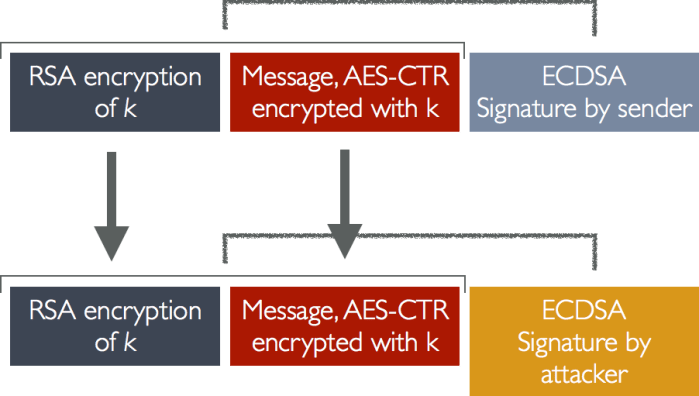
Let me give a concrete example of how this can hurt you. A couple of years ago I wrote a post about flaws in Apple iMessage, which (at the time) used simple authenticated (public key) encryption scheme. The basic iMessage encryption algorithm used public key encryption (actually a combination of RSA with some AES thrown in for efficiency) so that anyone could encrypt a message to my key. For authenticity, it required that every message be signed with an ECDSA signature by the sender.

53266-encdiagram

When I received a message, I would look up the sender’s public key and first make sure the signature was valid. This would prevent bad guys from tampering with the message in flight — e.g., executing nasty stuff like adaptive chosen ciphertext attacks. If you squint a little, this is almost exactly a direct translation of the symmetric crypto approach we discussed above. We’re simply swapping the MAC for a digital signature.

The problems with this scheme start to become apparent when we consider that there might be multiple people sending me ciphertexts. Let’s say the adversary is on the communication path and intercepts a signed message from you to me. They want to change (i.e., maul) the message so that they can execute some kind of clever attack. Well, it turns out this is simple. They simply rip off the honest signature and replace it one they make themselves:

d87e2-attackencryption


The new message is identical, but now appears to come from a different person (the attacker). Since the attacker has their own signing key, they can maul the encrypted message as much as they want, and sign new versions of that message. If you plug this attack into (a version) of the public-key CCA2 game up top, you see they’ll win quite easily. All they have to do is modify the challenge ciphertext C^* at step (4) to be signed with their own signing key, then they can change it by munging with the CTR mode encryption, and request the decryption of that ciphertext.

Of course if I only accept messages from signed by some original (guaranteed-to-be-honest) sender, this scheme might work out fine. But that’s not the point of public key encryption. In a real public-key scheme — like the one Apple iMessage was trying to build — I should be able to (safely) decrypt messages from anyone, and in that setting this naive scheme breaks down pretty badly.

Whew.

Ok, this post has gotten a bit long, and so far I haven’t actually gotten to the various “tricks” for adding chosen ciphertext security to real public key encryption schemes. That will have to wait until the next post, to come shortly.

Click here for Part 2.

Hash-based Signatures: An illustrated Primer

Over the past several years I’ve been privileged to observe two contradictory and fascinating trends. The first is that we’re finally starting to use the cryptographyWinternitz that researchers have spent the past forty years designing. We see this every day in examples ranging from encrypted messaging to phone security to cryptocurrencies.

The second trend is that cryptographers are getting ready for all these good times to end.

But before I get to all of that — much further below — let me stress that this is not a post about the quantum computing apocalypse, nor is it about the success of cryptography in the 21st century. Instead I’m going to talk about something much more wonky. This post will be about one of the simplest (and coolest!) cryptographic technologies ever developed: hash-based signatures.

Hash-based signature schemes were first invented in the late 1970s by Leslie Lamport, and significantly improved by Ralph Merkle and others. For many years they were largely viewed as an interesting cryptographic backwater, mostly because they produce relatively large signatures (among other complications). However in recent years these constructions have enjoyed something of a renaissance, largely because — unlike signatures based on RSA or the discrete logarithm assumption — they’re largely viewed as resistant to serious quantum attacks like Shor’s algorithm.

First some background.

Background: Hash functions and signature schemes

In order to understand hash-based signatures, it’s important that you have some familiarity with cryptographic hash functions. These functions take some input string (typically or an arbitrary length) and produce a fixed-size “digest” as output. Common cryptographic hash functions like SHA2, SHA3 or Blake2 produce digests ranging from 256 bits to 512 bits.

In order for a function H(\cdot) to be considered a ‘cryptographic’ hash, it must achieve some specific security requirements. There are a number of these, but here we’ll just focus on three common ones:

1. Pre-image resistance (sometimes known as “one-wayness”): given some output Y = H(X), it should be time-consuming to find an input X such that H(X) = Y. (There are many caveats to this, of course, but ideally the best such attack should require a time comparable to a brute-force search of whatever distribution X is drawn from.)

2. Second-preimage resistance: This is subtly different than pre-image resistance. Given some input X, it should be hard for an attacker to find a different input X' such that H(X) = H(X').

3. Collision resistance: It should be hard to find any two values X_1, X_2 such that H(X_1) = H(X_2). Note that this is a much stronger assumption than second-preimage resistance, since the attacker has complete freedom to find any two messages of its choice.


The example hash functions I mentioned above are believed to provide all of these properties. That is, nobody has articulated a meaningful (or even conceptual) attack that breaks any of them. That could always change, of course, in which case we’d almost certainly stop using them. (We’ll discuss the special case of quantum attacks a bit further below.)

Since our goal is to use hash functions to construct signature schemes, it’s also helpful to briefly review that primitive.

A digital signature scheme is a public key primitive in which a user (or “signer”) generates a pair of keys, called the public key and private key. The user retains the private key, and can use this to “sign” arbitrary messages — producing a resulting digital signature. Anyone who has possession of the public key can verify the correctness of a message and its associated signature.

From a security perspective, the main property we want from a signature scheme is unforgeability, or “existential unforgeability“. This requirement means that an attacker (someone who does not possess the private key) should not be able to forge a valid signature on a message that you did not sign. For more on the formal definitions of signature security, see this page.

The Lamport One-Time Signature

The first hash-based signature schemes was invented in 1979 by a mathematician named Leslie Lamport. Lamport observed that given only simple hash function — or really, a one-way function — it was possible to build an extremely powerful signature scheme.

Powerful that is, provided that you only need to sign one message! More on this below.

For the purposes of this discussion, let’s suppose we have the following ingredient: a hash function that takes in, say, 256-bit inputs and produces 256-bit outputs. SHA256 would be a perfect example of such a function. We’ll also need some way to generate random bits.

Let’s imagine that our goal is to sign 256 bit messages. To generate our secret key, the first thing we need to do is generate a series of  512 separate random bitstrings, each of 256 bits in length. For convenience, we’ll arrange those strings into two separate lists and refer to each one by an index as follows:

{\bf sk_0} = sk^{0}_1, sk^{0}_2, \dots,  sk^{0}_{256}
{\bf sk_1} = sk^{1}_1, sk^{1}_2, \dots,  sk^{1}_{256}

The lists ({\bf sk_0}, {\bf sk_1}) represent the secret key that we’ll use for signing. To generate the public key, we now simply hash every one of those random strings using our function H(\cdot). This produces a second pair of lists:

{\bf pk_0} = H(sk^{0}_1), H(sk^{0}_2), \dots, H(sk^{0}_{256})
{\bf pk_1} = H(sk^{1}_1), H(sk^{1}_2), \dots, H(sk^{1}_{256})

We can now hand out our public key ({\bf pk_0}, {\bf pk_1}) to the entire world. For example, we can send it to our friends, embed it into a certificate, or post it on Keybase.

Now let’s say we want to sign a 256-bit message M using our secret key. The very first thing we do is break up and represent M as a sequence of 256 individual bits:

M_1, \dots, M_{256} \in \{0,1\}

The rest of the signing algorithm is blindingly simple. We simply work through the message from the first bit to the last bit, and select a string from one of the two secret key list. The list we choose from depends on value of the message bit we’re trying to sign.

Concretely, for i=1 to 256: if the i^{th} message bit M_i =0, we grab the i^{th} secret key string (sk^{0}_i) from the {\bf sk_0} list, and output that string as part of our signature. If the message bit M_i = 1 we copy the appropriate string (sk^{1}_i) from the {\bf sk_1} list. Having done this for each of the message bits, we concatenate all of the strings we selected. This forms our signature.

Here’s a toy illustration of the process, where (for simplicity) the secret key and message are only eight bits long. Notice that each colored box below represents a different 256-bit random string:

LamportIllustration

When a user — who already has the public key ({\bf pk_0}, {\bf pk_1}) — receives a message M and a signature, she can verify the signature easily. Let s_i represent the i^{th} component of the signature: for each such string. She simply checks the corresponding message bit M_i and computes hash H(s_i). If M_i = 0 the result should match the corresponding element from {\bf pk_0}. If M_i = 1 the result should match the element in {\bf pk_1}.

The signature is valid if every single element of the signature, when hashed, matches the correct portion of the public key. Here’s an (admittedly) sketchy illustration of the verification process, for at least one signature component:

LamportVerify

If your initial impression of Lamport’s scheme is that it’s kind of insane, you’re both a bit right and a bit wrong.

Let’s start with the negative. First, it’s easy to see that Lamport signatures and keys are be quite large: on the order of thousands of bits. Moreover — and much more critically — there is a serious security limitation on this scheme: each key can only be used to sign one message. This makes Lamport’s scheme an example of what’s called a “one time signature”.

To understand why this restriction exists, recall that every Lamport signature reveals exactly one of the two possible secret key values at each position. If I only sign one message, the signature scheme works well. However, if I ever sign two messages that differ at any bit position i, then I’m going to end up handing out both secret key values for that position. This can be a problem.
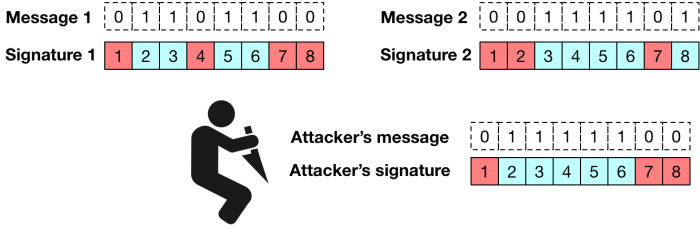
Imagine that an attacker sees two valid signatures on different messages. She may be able to perform a simple “mix and match” forgery attack that allows her to sign a third message that I never actually signed. Here’s how that might look in our toy example:

Forgery

The degree to which this hurts you really depends on how different the messages are  and how many of them you’ve given the attacker to play with. But it’s rarely good news.

So to sum up our observations about the Lamport signature scheme. It’s simple. It’s fast. And yet for various practical reasons it kind of sucks. Maybe we can do a little better.

From one-time to many-time signatures: Merkle’s tree-based signature

While the Lamport scheme is a good start, our inability to sign many messages with a single key is a huge drawback. Nobody was more inspired by this than Martin Hellman’s student Ralph Merkle. He quickly came up with a clever way to address this problem.

While we can’t exactly retrace Merkle’s steps, let’s see if we can recover some of the obvious ideas.

Let’s say our goal is to use Lamport’s signature to sign many messages — say N of them. The most obvious approach is to simply generate N different keypairs for the original Lamport scheme, then concatenate all the public keys together into one mega-key.

(Mega-key is a technical term I just invented).

If the signer holds on to all N secret key components, she can now sign N different messages by using exactly one secret Lamport key per message. This seems to solve the problem without ever requiring her to re-use a secret key. The verifier has all the public keys, and can verify all the received messages. No Lamport keys are ever used to sign twice.

Obviously this approach sucks big time.

Specifically, in this naive approach, signing N times requires the signer to distribute a public key that is N times as large as a normal Lamport public key. (She’ll also need to hang on to a similar pile of secret keys.) At some point people will get fed up with this, and probably N won’t every get to be very large. Enter Merkle.

What Merkle proposed was a way to retain the ability to sign N different messages, but without the linear-cost blowup of public keys. Merkle’s idea worked like this:

  1. First, generate N separate Lamport keypairs. We can call those (PK_1, SK_1), \dots, (PK_N, SK_N).
  2. Next, place each public key at one leaf of a Merkle hash tree (see below), and compute the root of the tree. This root will become the “master” public key of the new Merkle signature scheme.
  3. The signer retains all of the Lamport public and secret keys for use in signing.

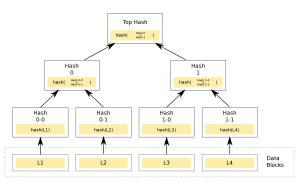
Merkle trees are described here. Roughly speaking, what they provide is a way to collect many different values such that they can be represented by a single “root” hash (of length 256 bits, using the hash function in our example). Given this hash, it’s possible to produce a simple “proof” that an element is in a given hash tree. Moreover, this proof has size that is logarithmic in the number of leaves in the tree.

2200px-hash_tree-svg
Merkle tree, illustration from Wikipedia. Lamport public keys go in the leaves of this tree, and the root becomes the master public key.

To sign the i^{th} message, the signer simply selects the i^{th} public key from the tree, and signs the message using the corresponding Lamport secret key. Next, she concatenates the resulting signature to the Lamport public key and tacks on a “Merkle proof” that shows that this specific Lamport public key is contained within the tree identified by the root (i.e., the public key of the entire scheme). She then transmits this whole collection as the signature of the message.

(To verify a signature of this form, the verifier simply unpacks this “signature” as a Lamport signature, Lamport public key, and Merkle Proof. She verifies the Lamport signature against the given Lamport public key, and uses the Merkle Proof to verify that the Lamport public key is really in the tree. With these three objectives achieved, she can trust the signature as valid.)

This approach has the disadvantage of increasing the “signature” size by more than a factor of two. However, the master public key for the scheme is now just a single hash value, which makes this approach scale much more cleanly than the naive solution above.

As a final optimization, the secret key data can itself be “compressed” by generating all of the various secret keys using the output of a cryptographic pseudorandom number generator, which allows for the generation of a huge number of (apparently random) bits from a single short ‘seed’.

Whew.

Making signatures and keys (a little bit) more efficient

Merkle’s approach allows any one-time signature to be converted into an N-time signature. However, his construction still requires us to use some underlying one-time signature like Lamport’s scheme. Unfortunately the (bandwidth) costs of Lamport’s scheme are still relatively high.

There are two major optimizations that can help to bring down these costs. The first was also proposed by Merkle. We’ll cover this simple technique first, mainly because it helps to explain the more powerful approach.

If you recall Lamport’s scheme, in order sign a 256-bit message we required a vector consisting of 512 separate secret key (and public key) bitstrings. The signature itself was a collection of 256 of the secret bitstrings. (These numbers were motivated by the fact that each bit of the message to be signed could be either a “0” or a “1”, and thus the appropriate secret key element would need to be drawn from one of two different secret key lists.)

But here’s a thought: what if we don’t sign all of the message bits?

Let’s be a bit more clear. In Lamport’s scheme we sign every bit of the message — regardless of its value — by outputting one secret string. What if, instead of signing both zero values and one values in the message, we signed only the message bits were equal to one? This would cut the public and secret key sizes in half, since we could get rid of the {\bf sk_0} list entirely.

We would now have only a single list of bitstrings sk_1, \dots, sk_{256} in our secret key. For each bit position of the message where M_i = 1 we would output a string sk_i. For every position where M_i = 0 we would output… zilch. (This would also tend to reduce the size of signatures, since many messages contain a bunch of zero bits, and those would now ‘cost’ us nothing!)

An obvious problem with this approach is that it’s horrendously insecure. Please do not implement this scheme!

As an example, let’s say an attacker observes a (signed) message that begins with “1111…”, and she want to edit the message so it reads “0000…” — without breaking the signature. All she has to do to accomplish this is to delete several components of the signature! In short, while it’s very difficult to “flip” a zero bit into a one bit, it’s catastrophically easy to do the reverse.

But it turns out there’s a fix, and it’s quite elegant.

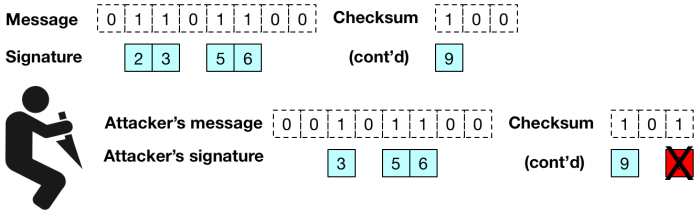
You see, while we can’t prevent an attacker from editing our message by turning one bits into zero bits, we can catch them. To do this, we tack on a simple “checksum” to the message, then sign the combination of the original message and the checksum. The signature verifier must verify the entire signature over both values, and also ensure that the received checksum is correct.

The checksum we use is trivial: it consists of a simple binary integer that represents the total number of zero bits in the original message.

If the attacker tries to modify the content of the message (excluding the checksum) in order to turn some one bit into a zero bit, the signature scheme won’t stop her. But this attack have the effect of increasing the number of zero bits in the message. This will immediately make the checksum invalid, and the verifier will reject the signature.

Of course, a clever attacker might also try to mess with the checksum (which is also signed along with the message) in order to “fix it up” by increasing the integer value of the checksum. However — and this is critical — since the checksum is a binary integer, in order to increase the value of the checksum, she would always need to turn some zero bit of the checksum into a one bit. But since the checksum is also signed, and the signature scheme prevents this kind of change, the attacker has nowhere to go.

ChecksumForgery

(If you’re keeping track at home, this does somewhat increase the size of the ‘message’ to be signed. In our 256-bit message example, the checksum will require an additional eight bits and corresponding signature cost. However, if the message has many zero bits, the reduced signature size will typically still be a win.)

Winternitz: Trading space for time

The trick above reduces the public key size by half, and reduces the size of (some) signatures by a similar amount. That’s nice, but not really revolutionary. It still gives keys and signatures that are thousands of bits long.

It would be nice if we could make a bigger dent in those numbers.

The final optimization we’ll talk about was proposed by Robert Winternitz as a further optimization of Merkle’s technique above. In practical use it gives a 4-8x reduction in the size of signatures and public keys — at a cost of increasing both signing and verification time.

Winternitz’s idea is an example of a technique called a “time-space tradeoff“. This term refers to a class of solutions in which space is reduced at the cost of adding more computation time (or vice versa). To explain Winternitz’s approach, it helps to ask the following question:

What if, instead of signing messages composed of bits (0 or 1), we treated our messages as though they were encoded using larger symbol alphabets? For example, what if we signed four-bit ‘nibbles’? Or eight-bit bytes?

In Lamport’s original scheme, we had two lists of bitstrings as part of the signing (and public) key. One was for signing zero message bits, and the other was for one bits.

Now let’s say we want to sign bytes rather than bits. An obvious idea would be to increase the number of secret key lists (and public key) from two such list to 256 such lists — one list for each possible value of a message byte. The signer could work through the message one byte at a time, and pick from the much larger menu of key values.

Unfortunately, this solution really stinks. It reduces the size of the signature by a factor of eight, at a cost of increasing the public and secret key size by a factor of 256. Even this might be fine if the public keys could be used for many signatures, but they can’t — when it comes to key re-use, this “byte signing version of Lamport” suffers from the same limitations as the original Lamport signature.

All of which brings us to Winternitz’s idea.

Since it’s too expensive to store and distribute 256 truly random lists, what if we generated those lists programatically only when we needed them?

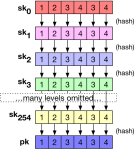
Winternitz’s idea was to generate single list of random seeds {\bf sk_0} = (sk^0_1, \dots, sk^0_{256}) for our initial secret key. Rather than generating additional lists randomly, he proposed to use the hash function H() on each element of that initial secret key, in order to derive the next such list for the secret key: {\bf sk_1} = (sk^{1}_1, \dots, sk^{1}_{256}) = (H(sk^{0}_1), \dots, H(sk^{0}_{256})). And similarly, one can use the hash function again on that list to get the next list {\bf sk_2}. And so on for many possible lists.

This is helpful in that we now only need to store a single list of secret key values {\bf sk_0}, and we can derive all the others lists on-demand just by applying the hash function.

But what about the public key? This is where Winternitz gets clever.

Specifically, Winternitz proposed that the public key could be derived by applying the hash function one more time to the final secret key list. This would produce a single public key list {\bf pk}. (In practice we only need 255 secret key lists, since we can treat the final secret key list as the public key.) The elegance of this approach is that given any one of the possible secret key values it’s always possible to check it against the public key, simply by hashing forward multiple times and seeing if we reach a public key element.
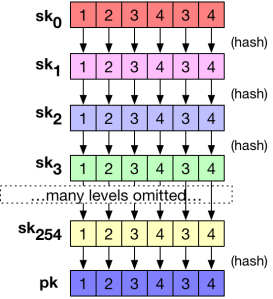
The whole process of key generation is illustrated below:

Winternitz
Note that to “sign” bytes we only need 255 secret key lists, not 256 of them. The final secret list is equivalent to the public key.

To sign the first byte of a message, we would pick a value from the appropriate list. For example, if the message byte was “0”, we would output a value from {\bf sk_0} in our signature. If the message byte was “20”, we would output a value from {\bf sk_{20}}. For bytes with the maximal value “255” we don’t have a secret key list. That’s ok: in this case we can output an empty string, or we can output the appropriate element of {\bf pk}.

Note as well that in practice we don’t really need to store each of these secret key lists. We can derive any secret key value on demand given only the original list {\bf sk}_0. The verifier only holds the public key vector and (as mentioned above) simply hashes forward an appropriate number of times — depending on the message byte — to see whether the result is equal to the appropriate component of the public key.

Like the Merkle optimization discussion in the previous section, the scheme as presented so far has a glaring vulnerability. Since the secret keys are related (i.e., sk^{1}_{1} = H(sk^{0}_1)), anyone who sees a message that signs the message “0” can easily change the corresponding byte of the message to a “1”, and update the signature to match. In fact, an attacker can increment the value of any byte(s) in the message. Without some check on this capability, this would allow very powerful forgery attacks.
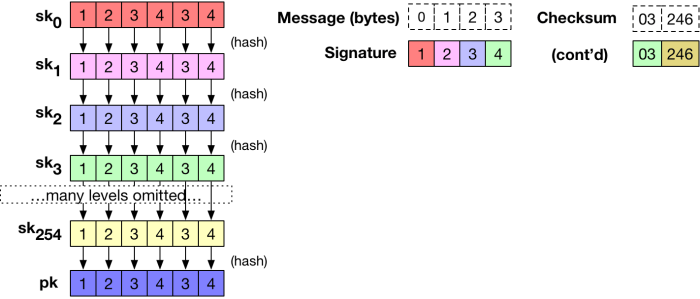
The solution to this problem is similar to the we discussed just above. To prevent an attacker from modifying the signature, the signer calculates and also signs a checksum of the original message bytes. The structure of this checksum is designed to prevent the attacker from incrementing any of the bytes, without invalidating the checksum. I won’t go into the gory details right now, but you can find them here.

It goes without saying that getting this checksum right is critical. Screw it up, even a little bit, and some very bad things can happen to you. This would be particularly unpleasant if you deployed these signatures in a production system.

Illustrated in one terrible picture, a 4-byte toy example of the Winternitz scheme looks like this:

WinternitzComplete
Note that the Message in this case consists of bytes, not bits. I’m pretty sure I calculated the checksum correctly, but I did it by hand and that doesn’t always go so well.

What are hash-based signatures good for?

Throughout this entire discussion, we’ve mainly been talking about the how of hash-based signatures rather than the why of them. It’s time we addressed this. What’s the point of these strange constructions?

One early argument in favor of hash-based signatures is that they’re remarkably fast and simple. Since they only require only the evaluation of a hash function and some data copying, from a purely computational cost perspective they’re highly competitive with schemes like ECDSA and RSA. This could hypothetically be important for lightweight devices. Of course, this efficiency comes at a huge tradeoff in bandwidth efficiency.

However, there is more complicated reason for the (recent) uptick in attention to hash-based signature constructions. This stems from the fact that all of our public-key crypto is about to be broken.

More concretely: the imminent arrival of quantum computers is going to have a huge impact on the security of nearly all of our practical signature schemes, ranging from RSA to ECDSA and so on. This is due to the fact that Shor’s algorithm (and its many variants) provides us with a polynomial-time algorithm for solving the discrete logarithm and factoring problems, which is likely to render most of these schemes insecure.

Most implementations of hash-based signatures are not vulnerable to Shor’s algorithm. That doesn’t mean they’re completely immune to quantum computers, of course. The best general quantum attacks on hash functions are based on a search technique called Grover’s algorithm, which reduces the effective security of a hash function. However, the reduction in effective security is nowhere near as severe as Shor’s algorithm (it ranges between the square root and cube root), and so security can be retained by simply increasing the internal capacity and output size of the hash function. Hash functions like SHA3 were explicitly developed with large digest sizes to provide resilience against such attacks.

So at least in theory, hash-based signatures are interesting because they provide us with a line of defense against future quantum computers — for the moment, anyway.

What about the future?

Note that so far I’ve only discussed some of the “classical” hash-based signature schemes. All of the schemes I described above were developed in the 1970s or early 1980s. This hardly brings us up to present day.

After I wrote the initial draft of this article, a few people asked for pointers on more recent developments in the field. I can’t possibly give an exhaustive list here, but let me describe just a couple of the more recent ideas that others brought up (thanks to Zooko and Claudio Orlandi):

Signatures without state. A limitation of all the signature schemes above is that they require the signer to keep state between signatures. In the case of one-time signatures the reasoning is obvious: you have to avoid using any key more than once. But even in the multi-time Merkle signature, you have to remember which leaf public key you’re using, so you can avoid using any leaf twice. Even worse, the Merkle scheme requires the signer to construct all the keypairs up front, so the total number of signatures is bounded.

In the 1980s, Oded Goldreich pointed out that one can build signatures without these limitations. The idea is as follows: rather than generate all signatures up front, one can generate a short “certification tree” of one-time public keys. Each of these keys can be used to sign additional one-time public keys at a lower layer of the tree, and so on and so forth. Provided all of the private keys are generated deterministically using a single seed, this means that the full tree need not exist in full at key generation time, but can be built on-demand whenever a new key is generated. Each signature contains a “certificate chain” of signatures and public keys starting from the root and going down to a real signing keypair at the bottom of the tree.

This technique allows for the construction of extremely “deep” trees with a vast (exponential) number of possible signing keys. This allows us to construct so many one-time public keys that if we pick a signing key randomly (or pseudorandomly), then with high probability the same signing will never be used twice. This is intuition, of course. For a highly optimized and specific instantiation of this idea, see the SPHINCS proposal by Bernstein et alThe concrete SPHINCS-256 instantiation gives signatures that are approximately 41KB in size.

Picnic: post-quantum zero-knowledge based signatures. In a completely different direction lies Picnic. Picnic is based on a new non-interactive zero-knowledge proof system called ZKBoo. ZKBoo is a new ZK proof system that works on the basis of a technique called “MPC in the head”, where the prover uses multi-party computation to calculate a function with the prover himself. This is too complicated to explain in a lot of detail, but the end result is that one can then prove complicated statements using only hash functions.

The long and short of it is that Picnic and similar ZK proof systems provide a second direction for building signatures out of hash functions. The cost of these signatures is still quite large — hundreds of kilobytes. But future improvements in the technique could substantially reduce this size.

Epilogue: the boring security details

If you recall a bit earlier in this article, I spent some time describing the security properties of hash functions. This wasn’t just for show. You see, the security of a hash-based signature depends strongly on which properties a hash function is able to provide.

(And by implication, the insecurity of a hash-based signature depends on which properties of a hash function an attacker has managed to defeat.)

Most original papers discussing hash-based signatures generally hang their security arguments on the preimage-resistance of the hash function. Intuitively, this seems pretty straightforward. Let’s take the Lamport signature as an example. Given a public key element pk^{0}_1 = H(sk^{0}_1), an attacker who is able to compute hash preimages can easily recover a valid secret key for that component of the signature. This attack obviously renders the scheme insecure.

However, this argument considers only the case where an attacker has the public key but has not yet seen a valid signature. In this case the attacker has a bit more information. They now have (for example) both the public key and a portion of the secret key: pk^{0}_1 = H(sk^{0}_1) and sk^{0}_1. If such an attacker can find a second pre-image for the public key pk^{0}_1 she can’t sign a different message. But she has produced a new signature. In the strong definition of signature security (SUF-CMA) this is actually considered a valid attack. So SUF-CMA requires the slightly stronger property of second-preimage resistance.

Of course, there’s a final issue that crops up in most practical uses of hash-based signature schemes. You’ll notice that the description above assumes that we’re signing 256-bit messages. The problem with this is that in real applications, many messages are longer than 256 bits. As a consequence, most people use the hash function H() to first hash the message as D = H(M) and then the sign the resulting value D instead of the message.

This leads to a final attack on the resulting signature scheme, since the existential unforgeability of the scheme now depends on the collision-resistance of the hash function. An attacker who can find two different messages M_1 \ne M_2 such that H(M_1) = H(M_2) has now found a valid signature on two different messages. This leads to a trivial break of EUF-CMA security.