A bit more on Twitter/X’s new encrypted messaging

A bit more on Twitter/X’s new encrypted messaging

Update 6/10: Based on a short conversation with an engineering lead at X, some of the devices used at X are claimed to be using HSMs. See more further below.

Matthew Garrett has a nice post about Twitter (uh, X)’s new end-to-end encryption messaging protocol, which is now called XChat. The TL;DR of Matthew’s post is that from a cryptographic perspective, XChat isn’t great. The details are all contained within Matthew’s post, but here’s a quick TL;DR:

  • There’s no forward secrecy. Unlike Signal protocol, which uses a double-ratchet to continuously update the user’s secret keys, the XChat cryptography just encrypts each message under a recipient’s long-term public key. The actual encryption mechanism is based on an encryption scheme from libsodium.
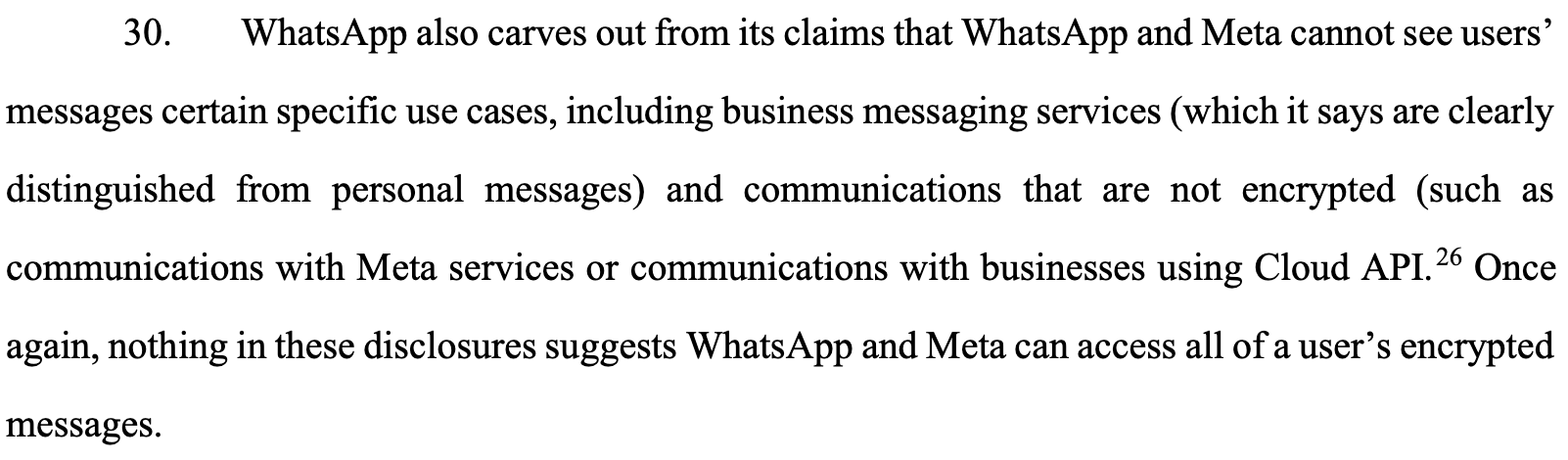
  • User private keys are stored at X. XChat stores user private keys at its own servers. To obtain your private keys, you first log into X’s key-storage system using a password such as PIN. This is needed to support stateless clients like web browsers, and in fairness it’s not dissimilar to what Meta has done with its encryption for Facebook Messenger and Instagram. Of course, those services use Hardware Security Modules (HSMs.)
  • X’s key storage is based on “Juicebox.” To implement their secret-storage system, XChat uses a protocol called Juicebox. Juicebox “shards” your key material across three servers, so that in principle the loss or compromise of one server won’t hurt you.

Matthew’s post correctly identifies that the major vulnerability in X’s system is this key storage approach. If decryption keys live in three non-HSM servers that are all under X’s control, then X could probably obtain anyone’s key and decrypt their messages. X could do this for their own internal purposes: for example because their famously chill owner got angry at some user. Or they could do it because a warrant or subpoena compels them to. If we judge XChat as an end-to-end encryption scheme, this seems like a pretty game-over type of vulnerability.

So in a sense, everything comes down to the security of Juicebox and the specific deployment choices that X made. Since Matthew wrote his post, I’ve learned a bit more about both of these things. In this post I’d like to go on a slightly deeper dive into the Juicebox portion of X’s system. This will hopefully shed some light on what X is up to, and why you shouldn’t use XChat.

What’s Juicebox even for?

Many end-to-end encryption (E2E) apps have run into a specific problem: these systems require users to store their own secret keys. Unfortunately, users are just plain bad at this.

Sometimes we forget keys because we lose our devices. Often we have more than one device, which means our keys end up in the wrong place. A much worse situation occurs when apps want to work in ordinary web browsers: this means that secret keys have to be airlifted into that context as well.

The obvious remedy for this problem is just to store secret keys with the service provider itself. This is convenient, but completely misses the whole point of end-to-end encryption, which is that service providers should not have access to your secrets! Storing decryption keys — in an accessible form — on the provider’s servers is absolutely a no-go.

One way out of this conundrum is for the user to encrypt their secret key, then upload the encrypted value to the service provider. In theory, they can download their secret keys anytime they want and they should know that their secrets are safe. But of course there’s a problem: what secret key are you going to use to encrypt your secret key!? Answering this question quickly leads you into an infinite pile of turtles.

Source: XKCD.

Rather than descend into paradox, systems like Juicebox, Signal SVR, and iCloud Key Vault offer an alternative. Their observation is that while cryptographic keys are hard to hang on to, users generally do remember simple passwords like PINs, particularly if they’re asked to re-enter them periodically. What if we use the user’s PIN/password to encrypt the stronger cryptographic key that we upload to the server?

While this is better than nothing, it isn’t good. Most human-selected passwords and PINs make for terrible cryptographic keys. In particular, short PINs (like the 6-digit decimal pins many people use for their phone passcode) are vulnerable to efficient brute-force guessing attacks. A six-digit PIN provides at most 220 security, which is what cryptographers call “a pretty small number.” Even if you use a “hard” key derivation function like scrypt or Argon2 with insane difficulty settings, you’re still probably still going to lose your data.

Fortunately there is another way.

For many years, cryptographers have considered the problem of turning “weak secrets” into strong ones. The problem is sometimes known as password hardening, and doing it well usually requires additional components. First, you need to have some strong cryptographic secret that can be “mixed” into the user’s password to make a produce a truly strong encryption key. Second, you need some mechanism to limit the number of guessing attempts that the user makes, so an attacker can’t simply run an online attack to work through the PIN-space. This cannot be enforced using cryptography alone: you must add a server (or servers) to enforce these checks. Critically, the server will place limits on how many incorrect passwords the user can enter: e.g., after ten incorrect attempts, the user’s account gets locked or erased.

In one sense, we’re right back where we started: someone needs to operate a a server. If that server is under the control of the service provider, then they can disable the guessing limits and/or extract the server’s secret key material, at which point you’re back to square one.

Many services have engineered some reasonable solutions to this problem, however. They boil down to the following alternatives, which can be implemented separately or together:

  1. The server can be implemented inside of a specialized Hardware Security Module, which is set up so that the provider cannot reprogram it or access its key material (at least, after it’s been configured.) This approach was pioneered by Apple, and is now in use by iCloud Key Vault, Signal SVR, WhatsApp and Facebook Messenger.
  2. Alternatively, the server can be “split up” into multiple pieces that are each run by different parties. The idea here is that the user must contact T out of N different servers in order to obtain the correct key (a common example is 2-of-3.) As long as an attacker cannot compromise T different servers, the combined system will still be able to enforce the guessing limits and prevent attackers from getting the key. Naturally this idea fundamentally depends on the assumption that the servers are not run by the same party!

And at last, we come to Juicebox.

Juicebox is an software-based distributed key hardening service that can be implemented across multiple servers. Users can “enroll” their account into the system, at which point the Juicebox servers will convert their PIN/password into a strong cryptographic key (by mixing it with a secret stored on the Juicebox servers.) Later on, they can contact the Juicebox servers and — assuming they enter the right password, and don’t try too many incorrect guesses — they can obtain that same cryptographic key from the system. Users can specify the number of servers (N) and the threshold (T), and the goal is that the system can survive the loss (or unavailability) of N-T servers, and it should retain its security even if an attacker compromises A<T of them. Most critically, Juicebox enforces limits: if too many incorrect passwords are entered, Juicebox will lock or destroy the user’s account.

In principle, Juicebox servers (called “realms” in the project’s lingo) can be either “software based” or they can be deployed inside of HSMs. However, to the best of my knowledge the HSM capability is not fully supported outside of Juicebox’s one test deployment, and has not been used in deployments (at X or anywhere else.) Update 6/10: but see further below! This means the security of XChat’s version of Juicebox probably comes down to a question of who runs the servers.

So who runs X’s Juicebox servers, and do they use HSMs?

To the best of my knowledge, all of the XChat servers are run in software by Twitter/X itself. If this turns out to be incorrect, I will be thrilled to update this post.

Update: this tweet by an engineering lead claims that they are actually HSMs, and Twitter has just not publicized this or published the key ceremonies that were used to set them up. I am very confused by this because it seems extremely backwards! The problem with this late claim is that there’s really no way to verify this fact other than one or two tweets from someone at X.

To put this more explicitly, without any protections like the verifiable use of HSMs and/or distributing Juicebox servers across mutually-distrustful operators, having three servers does relatively little to protect users’ secrets against the service operator. And even if X is secretly implementing these protections, implementing them in secret is stupid. As a wise man once said:

Verifying that the XChat Juicebox servers are software-only is more complicated. Digging around in the Juicebox Github, you’ll find a software-only as well as an HSM-specific implementation of their “realms.” Specifically, there is an entire repository dedicated to supporting Juicebox on Entrust nShield Solo XC HSMs (see here for instructions) although this same code can also be deployed outside of HSMs. There is even a cool “ceremony” document that a group of administrators can perform to certify that they set the HSM up correctly, and that they destroyed all of the cards that could allow it to be re-programmed!

Just one step from the Juicebox HSM ceremony document. I love this stuff!

However, after speaking to Juicebox’s protocol designer Nora Trapp, I’m doubtful that any of this is in use at X. Nora told me that the Juicebox project shut down over a year ago and the engineers moved on, and what code there is now open source and not actively maintained (this matches with project commits I can see.) Nora also looked at XChat’s Juicebox deployment and sent me the following commentary:

From what I’ve seen, there are four realms currently in use by Twitter: realm-a.x.com, realm-b.x.com, realm-east1.x.com, and realm-west1.x.com.

  • realm-a and realm-b are definitely software realms. They don’t use Noise (only true of software realms) and rely solely on TLS. In contrast, HSM-backed realms use Noise within TLS, with TLS terminated at the LB and Noise inside the HSM.
  • realm-east1 and realm-west1 appear to run code from juicebox-hsm-realm. For example, hitting https://realm-east1.x.com/livez shows they’re likely using the repo unmodified from main. However, this doesn’t mean they’re HSM-backed. The repo includes a “software HSM” for testing, which is insecure and doesn’t provide actual HSM properties.

Timing analysis (e.g. via the convenient x-exec-time response header X left in place) suggests these are indeed using the software HSM. Real HSMs are typically significantly slower. And even if by some chance they’re running real HSMs, no ceremony has been published, so there’s no reason to trust they’re secure or that the key material isn’t exfiltrated.

Nora also wrote a post very recently warning deployers to stop placing all servers under the control of a single service provider, which seems very applicable to what Twitter/X is doing.

Obviously this doesn’t prove that X isn’t using HSMs. Though, obviously, there’s no reason that you should hope something is secure when the deployer is going out of their way not to tell you it is. When it comes to XChat, my advice is that you should assume this deployment is (1) entirely in software, and (2) all Juicebox “realms” are run by the same organization. This means you should assume that your decryption keys could be recovered by X’s server administrators with at most a little fuss, unless you use a very strong password.

That’s bad, but let’s talk more about the Juicebox protocol anyway!

If all you came for was a bit of discussion about the security posture of XChat, then Matthew’s post and the additional notes above are all you need. Unless and until X proves that they’re using HSMs (and have destroyed all programming cards) you should just assume that their Juicebox instantiation is based on software realms under X’s control, and that means it is likely vulnerable to brute-force password-guessing attacks.

The rest of this post is going to look past X.

Let’s assume that a deployer has configured Juicebox intelligently: meaning that some/all realms will be deployed inside of HSMs, and/or realms are spread across multiple organizational trust boundaries — such that no single organization can easily demand recovery of anyone’s password. The question we want to ask now is: what guarantees does Juicebox provide in this setting, and how does the protocol work?

Threshold OPRFs. The core cryptographic primitive inside of Juicebox is called a threshold oblivious pseudorandom function, or t-OPRF. I’ve written about OPRFs before, specifically in the context of Password-Authenticated Key Agreement (PAKE schemes.) Nonetheless, I think it’s helpful to start from the top.

Let’s leave aside the “oblivious” part for a minute. PRFs are functions that take in a key K and a string P (for example, a password), and output a string of bits. We might write as:

O = PRF(K, P)

Provided that an attacker does not know the key, the resulting string O should look random, meaning that the output of a PRF makes for excellent cryptographic keys. In many practical implementations, PRFs are realized using functions like HMAC or CBC-MAC; however, there are many different ways to build them.

An oblivious PRF (OPRF) is a two-party cryptographic protocol that helps a client and server jointly compute the output of a PRF. It works like this:

  1. Imagine a server has the cryptographic key K.
  2. The client has their string P (such as a password.)
  3. At the end of a successful protocol run, the client should obtain O = PRF(K, P). The server gets no output at all.
  4. Critically: neither party should learn the other party’s input, and the server should not learn the client’s result, either.

With this tool in hand, it’s easy to build a very simple password-hardening protocol. Simply configure the server with a key K (preferably a different key for every user account), and then have the client run the OPRF protocol with the server to obtain O = PRF(K, P). The resulting value O will make for an excellent encryption key, which the client can use to encrypt any secret values it wants. The best part of this arrangement is that the OPRF protocol ensures that the server never learns the user’s password P, so no information leaks even if the server is fully malicious!

This basic design has some limitations, of course. It does not allow the server to limit the number password guesses, nor does it allow us to spread the process over many different servers.

Addressing the first problem is easy. When the client first registers their account with the server, they can run the OPRF protocol to obtain O = PRF(K, P). Next, they compute some “authenticator tag” T that’s derived in some way from the secret O. They can then store that tag T on the server. When a user returns to log back into the system, the client and server can run the OPRF protocol, and then conduct some process to verify that the O received by the client is consistent with the tag T stored at the server. (The exact process for doing this is important, and I’ll discuss it further below.) If this is unsuccessful, then the server can increment a counter to indicate an incorrect password guess on that user’s account. If the protocol completes successfully, then the server should reset that counter back to zero.1

Critically, when the counter reaches some maximum (usually ten incorrect attempts), the server must lock the user’s account — or much better, delete the account-specific key K. This is what prevents attackers from systematically guessing their way through every possible PIN.

Splitting up the PRF into multiple servers is only slightly more complicated. The basic idea relies on the fact that the specific OPRF used by Juicebox is based on elliptic curves, and this makes it very amenable to threshold implementations. I’m going to put the details into a separate page right here since it’s a little boring. But you should just take away that (1) the service operator can split up the key K across multiple servers, and (2) a client can talk to any T of them and eventually obtain PRF(K, P).

How does the client prove it got the right key, and what attacks are there?

You’ll notice that these “incorrect attempt” counters are a big part of the protection inside of a system like Juicebox. As long as an attacker can only make, say, a maximum of ten incorrect guessing attempts, then even a relatively weak password like 234984 is probably not too bad. If an attacker can make many possible guesses, then the whole system is fairly weak.

Note that in most of these attacks we are going to make the very strong assumption that the server operator is the attacker and that they’ve deployed Juicebox in such a way that they can’t just read the secrets out of their own instance (e.g., in this hypothetical scenario, they have deployed Juicebox using HSMs or distributed trust.) Since the whole point of end-to-end encryption is that users’ secret keys should not be known to a server operator, this isn’t too strong of an assumption. Moreover, we’ve recently seen governments make secret requests to companies like Apple to force them to bypass their end-to-end encrypted services. This means that both hacking and legal compulsion are real concerns.

Within this setting there exist a handful of attacks that could come up in a system like Juicebox. Some are easier than others to prevent:

  1. An attacker could try to enter a few password guesses, then wait for the real user to log in. As long as the real user enters the correct password, the attempt counter on the server(s) will drop back to zero. This attack could allow you to make up to, say, nine invalid guesses for each genuine user login.2

    The existence of this attack is kind of unavoidable in systems like Juicebox. Fortunately it’s probably not a very efficient attack. Unless the user is logging on constantly (say, because a web browser caches the user’s password and runs the protocol automatically), the rate of attacker guesses is going to be very low. Moreover: this attack can be mitigated by having the server inform the client of the number of incorrect guesses it’s seen since the last time the user logged in, which should help the user to detect the fact that they’re under attack.
  2. If the servers don’t coordinate with each other, a smart attacker could try to guess passwords against different subsets of the Juicebox servers: for example if 2-of-10 servers are needed to recover the key, then an attacker actually could actually obtain many more than ten guesses. This is because the attacker could make at least ten attempts with each subset comprising two servers, before all the necessary servers locked them out. Juicebox’s HSM implementation actually goes to some lengths to prevent this (as SVR did before them) by having servers share the current password counter values with each other using a consensus protocol.

Another possibility is that a malicious (software) server operator could try to attack the protocol directly. Just for fun, I thought it might be interesting to conclude with one possible attack I noticed while perusing the protocol description. I’m almost certain this won’t work in practice — and the Juicebox developers agree, but I thought it was a fun illustration of the types of vulnerabilities that show up in these systems.

Recall that whenever a Juicebox client successfully completes the protocol with a set of T servers, it must somehow convince those servers that it obtained the right key. This is necessary because a correct password entry should reset those servers’ attempt counters back to zero, whereas an incorrect guess will increase the attempt counter. (Without a mechanism to reset the counter, the counter will keep rising until the user’s account gets permanently locked.)

The client deals with this by first computing a value called the unlockKey from the t-OPRF output, and then calculating a set of “tags” called the unlockKeyTags, one for each server (realm) in the system:

The calculation of each unlockKeyTags[i] value is customized to include the “realm ID” of the server, which means that the tag for server i is specific only to that server. It cannot be extracted from a malicious server i and replayed against server j, which would be very bad. The client then sends each value unlockKeyTags[i] to the appropriate server. The servers can verify the received tag against a copy they stored during the account registration process. If it matches, they reset their counter back to zero as follows:

However, the only thing that differentiates these tags from one another is the notion that realm IDs for different servers will always be different. What if this assumption isn’t correct?

The attack I’m concerned about is pretty bizarre, but it looks like this. Imagine a user has previously registered its key into several real HSM-based servers. Now someone hacks into the service provider. This hacker “tricks” clients into sending subsequent login requests to a new set of malicious servers that the attacker spins up using software (i.e., no HSM protections.)

Ordinarily this attack wouldn’t be a disaster, since the OPRF should prevent those new servers from learning the user’s password inputs. But let’s imagine that the hacker sets the “realm ID” of these new servers to be identical to the realm ID of the real (HSM) servers. In this case, the value of unlockKeyTag[i] sent to the malicious servers will be identical to the value that would have been stored within the HSM-based servers. Once the attacker learns this value, they can make an unlimited number of guesses against the HSM server with the same realm ID: this is because the stolen unlockKeyTags[i] value will reset the HSM server’s counter.

I ran this past Nora and she pointed out a number of practical issues that will probably make this sort of attack much less likely to work, but it’s still fun to find this sort of thing. More importantly, I think it shows how delicate distributed protocols like this can be, and how sometimes one’s assumptions may not always be valid.

Post image: Noah Berger/AP Photo

Notes:

  1. Obviously this can be dangerous. An attacker who just wants to deny service to the user can enter deliberately-incorrect guesses until the user’s account becomes permanently locked. To prevent this, most services require that you log In using a traditional password first, then you can access the password strengthening server second. Some systems also add time delays, to ensure that an attacker cannot quickly exhaust the counter.
  2. The “try N attempts and then let the client log in normally” attack was outlined to me by Ian Miers.

Dear Apple: add “Disappearing Messages” to iMessage right now

Dear Apple: add “Disappearing Messages” to iMessage right now

This is a cryptography blog and I always feel the need to apologize for any post that isn’t “straight cryptography.” I’m actually getting a little tired of apologizing for it (though if you want some hard-core cryptography content, there’s plenty here and here.)

Sometimes I have to remind my colleagues that out in the real world, our job is not to solve exciting mathematical problems: it’s to help people communicate securely. And people, at this very moment, need a lot of help. Many of my friends are Federal employees or work for contractors, and they’re terrified that they’re going to lose their job based on speech they post online. Unfortunately, “online” to many people includes thoughts sent over private text messages — so even private conversations are becoming chilled. And while this is hardly the worst thing happening to people in this world, it’s something that’s happening to my friends and neighbors.

(And just in case you think this is partisan: many of the folks I’m talking about are Republicans, and some are military veterans who work for the agencies that keep Americans safe. They’re afraid for their jobs and their kids, and that stuff transcends politics.)

So let me get to the point of this relatively short post.

Apple iMessage is encrypted, but is it “secure”?

A huge majority of my “normie” friends are iPhone users, and while some have started downloading Signal app (and you should too!) — many of them favor one communications protocol: Apple iMessage. This is mostly because iMessage is just the built-in messaging app used on Apple phones. If you don’t know the branding, all you need to know is that iMessage is “blue bubbles” you get when talking to other Apple users.

Apple boasts that the iMessage app encrypts your messages end-to-end, and that it has done so since 2011. This means that all your messages and attachments are encrypted under keys that Apple does not know. The company has been extremely consistent about this, discusses it in their platform security guide, and in recent years they’ve even extended their protocol to provide post-quantum security. (A few years ago my students and I found a bug in the protocol, but Apple fixed it quickly — so I am very personally confident in their encryption.)

This is nice. And it’s all true.

But encryption in transit is only one part of the story. After delivering your messages with its uncompromising post-quantum security, Apple allows two things that aren’t so great:

  1. iMessages stick around your phone forever unless you manually delete them (a process that may need to happen on both sides, and is painfully annoying.)
  2. iMessages are automatically backed up to Apple’s iCloud backup service, if you have that feature on — and since Apple sets this up as the default during iPhone setup, most ordinary people do.

The combination of these two features turn iMessage into a Star-Trek style Captain’s Log of your entire life. Searching around right now, I can find messages from 2015. Even though my brain tells me this was three years ago, I’m reliably informed that this is a whole decade in the past.

Now, while the messages above are harmless, I want to convince you that this is often a very bad thing. People want to have private conversations. They deserve to have private conversations. And their technology should make them feel safe doing so. That means they should know that their messaging software has their back and will make sure those embarrassing or political or risque text messages are not stored forever on someone’s phone or inside a backup.

We know exactly how to fix this, and every other messenger did so long ago

If you install WhatsApp, Facebook Messenger, Signal, Snap or even Telegram (please don’t!) you’ll encounter a simple feature that addresses this problem. It’s usually called “disappearing messages“, but sometimes goes by other names.

I’m almost embarrassed to explain what this feature does, since it’s like explaining how a steering wheel works. Nevertheless. When you start a chat, you can decide how long the messages should stick around for. If your answer is forever, you don’t need to do anything. However, if it’s a sensitive conversation and you want it to be ephemeral in the same way that a phone call is, you can pick a time, typically ranging from 5 minutes to 90 days. When that time expires, your messages just get erased — on both your phone and the phones of the people you’re talking to.

A separate feature of disappearing messages is that some platforms will omit these conversations from device backups, or at least they’ll make sure expired messages can’t be restored. This makes sense because those conversations are supposed to be ephemeral: people are clearly not expecting those text messages to be around in the future, so they’re not as angry if they lose them a few days early.

Beyond the basic technical functionality, a disappearing messages feature says something. It announces to your users that a conversation is actually intended to be private and short-lived, that its blast radius will be contained. You won’t have to think about it years or months down the line when it’s embarrassing. This is valuable not just for what it does technically but for the confidence it gives to users, who are already plenty insecure after years of abuse by tech companies.

Why won’t Apple add a disappearing messages feature?

I don’t know. I honestly cannot tell you. It is baffling and weird and wrong, and completely out of step with the industry they’re embedded in. It is particularly bizarre for a company that has formed its entire brand image around stuff like this:

To recap, nearly every single other messaging product that people use in large numbers (at least here in the US) has some kind of disappearing messages feature. Apple’s omission is starting to be very unique.

I do have some friends who work for Apple Security and I’ve tried to talk to them about this. They usually try to avoid me when I do stuff like this — sometimes they mention lawyers — but when I’m annoying enough (and I catch them in situations where exit is impossible) I can occasionally get them to answer my questions. For example, when I ask “why don’t you turn on end-to-end encrypted iCloud backup by default,” they give me thoughtful answers. They’ll tell me how users are afraid of losing data, and they’ll tell me sad stories of how difficult it is to make those features as usable as unencrypted backup. (I half believe them.)

When I ask about disappearing messages, I get embarrassed sighs and crickets. Nobody can explain why Apple is so far behind on this basic feature even as an option, long after it became standard in every other messenger. Hence the best I can do is speculate. Maybe the Apple executives are afraid that governments will pressure them if they activate a security feature like this? Maybe the Messages app is written in some obsolete language and they can’t update it? Maybe the iMessage servers have become sentient and now control Tim Cook like a puppet? These are not great answers, but they are better than anything the company has offered — and everyone at Apple Security kind of knows it.

In a monument to misaligned priorities, Apple even spent time adding post-quantum encryption to its iMessage protocol — this means Apple users are now safe from quantum computers that don’t exist. And yet users’ most intensely private secrets can still be read off their phone or from a backup by anyone who can guess their passcode and use a search box. This is not a good place to be in 2025, and Apple needs to do better.

A couple of technical notes

Since this is a technical blog I feel compelled to say a few things that are just a tad more detailed than the plea above.

First off, Gene Hoffman points me to a small feature in the Settings of your phone called “Keep Messages” (buried under “Messages” in Settings, and then scrolling way down.) This determines how long your messages will be kept around on your own phone. You cannot set this per conversation, but you can set it to something shorter than “Forever”, say, one year. This is a big decision for some people to make, however, since it will immediately delete any old messages you actually cared about.

More importantly (as mentioned in comments) this only affects your phone. Messages erased via this process will remain on the phones of your conversation partners.

Second, if you really want to secure your iMessages, you should turn on Apple’s Advanced Data Protection feature. This will activate end-to-end encryption for your iCloud backups, and will ensure that nobody but you can access those messages.

This is not the same thing as disappearing messages, because all it protects is backups. Your messages will still exist on your phone and in your encrypted backups. But it at least protects your backups better.

Third, Apple advertises a feature called Messages in iCloud, which is designed to back up and sync your messages between devices. Apple even advertises that this feature is end-to-end encrypted!

I hate this phrasing because it is disastrously misleading. Messages in iCloud may be encrypted, however… If you use iCloud Backup without ADP (which is the default for new iPhones) the Messages in iCloud encryption key itself will be backed up to Apple’s servers in a form that Apple itself can access. And so the content of the Messages in iCloud database will be completely available to Apple, or anyone who can guess your Apple account password.

None of this has anything to do with disappearing messages. However: that feature, with proper anti-backup protections, would go a long way to make these backup concerns obsolete.

Three questions about Apple, encryption, and the U.K.

Three questions about Apple, encryption, and the U.K.

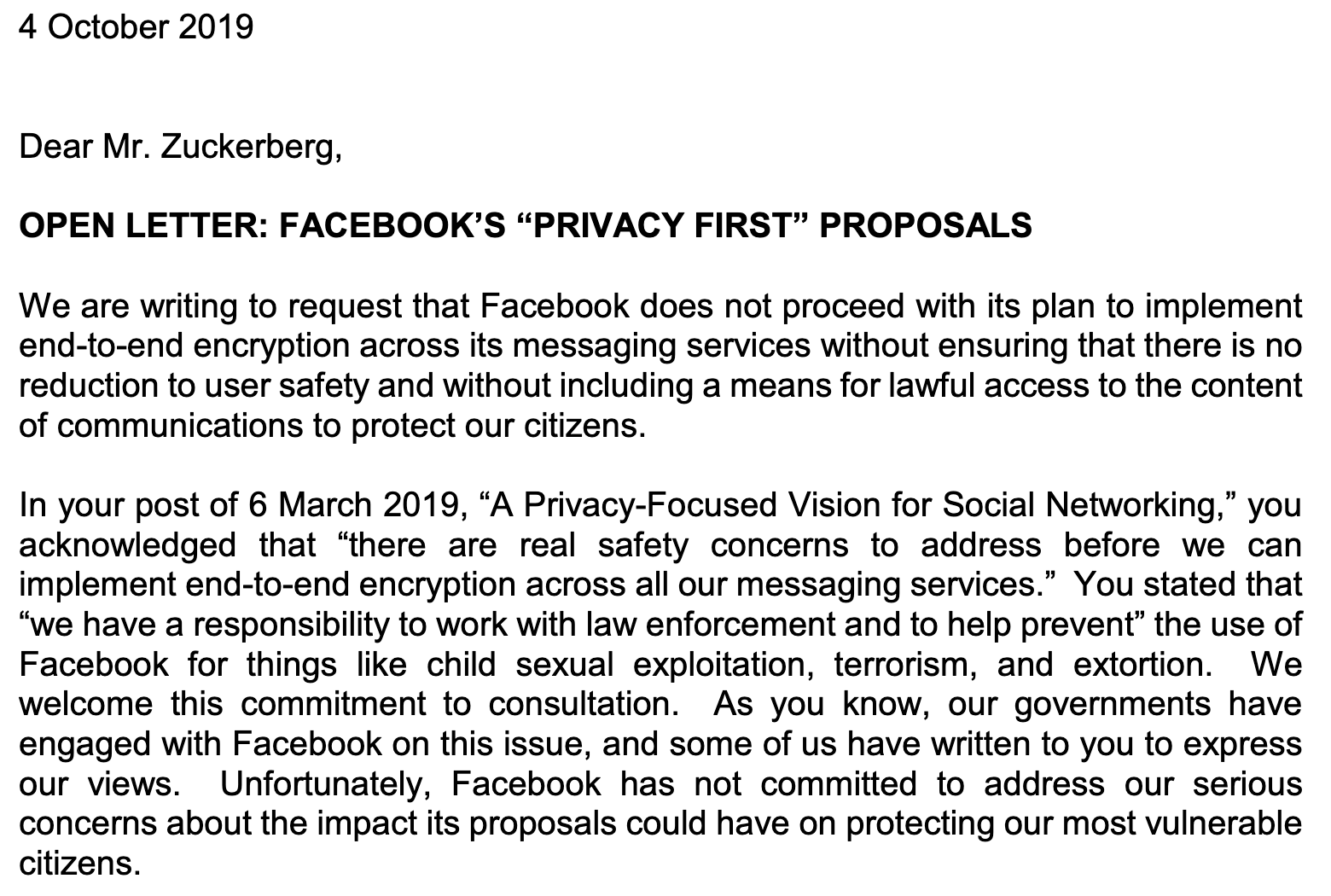
Two weeks ago, the Washington Post reported that the U.K. government had issued a secret order to Apple demanding that the company include a “backdoor” into the company’s end-to-end encrypted iCloud Backup feature. From the article:

The British government’s undisclosed order, issued last month, requires blanket capability to view fully encrypted material, not merely assistance in cracking a specific account, and has no known precedent in major democracies. Its application would mark a significant defeat for tech companies in their decades-long battle to avoid being wielded as government tools against their users, the people said, speaking under the condition of anonymity to discuss legally and politically sensitive issues.

That same report predicted that Apple would soon be disabling their end-to-end encrypted iCloud backup feature (called Advanced Data Protection) for all U.K. users. On Friday, this prediction was confirmed:

Apple’s decision to disable their encrypted cloud backup feature has triggered many reactions, including a few angry takes by Apple critics, accusing Apple of selling out its users:

With all this in mind, I think it’s time to take a sober look at what might really happening here. This will require some speculation and educated guesswork. But I think that exercise will be a lot more helpful to us if we want to find out what’s really going on.

Question 1: does Apple really care about encryption?

Encryption is a tool that protects user data by processing it using a key, so that only the holder of the appropriate key can read it. A variant called end-to-end encryption (E2EE) uses keys that only the user (or users) knows. The benefit of this approach is that data is protected from many threats that face centralized repositories: theft, cyber attacks, and even access by sophisticated state-sponsored attackers. One downside of this encryption is that it can also block governments and law enforcement agencies from accessing the same data.

Navigating this tradeoff has been a thorny problem for Apple. Nevertheless, Apple has mostly opted to err on the side of aggressive deployment of (end-to-end) encryption. For some examples:

  1. In 2008, the company began encrypting all iPhone internal data storage by default. This is why you can feel safe (about your data) if you ever leave your iPhone in a cab.
  2. In 2011, the company launched iMessage, a built-in messaging service with default end-to-end encryption for all users. This was the first widely-deployed end-to-end encrypted messaging service. Today these systems are recommended even by the FBI.
  3. In 2013, Apple launched iCloud Key Vault, which encrypts your backed-up passwords and browser history using encryption that even Apple can’t access.

Apple faced law enforcement backlash on each of these moves. But perhaps the most famous example of Apple’s aggressive stance on encryption occurred during the 2016 Apple v. FBI case, where the company actively fought U.S. government’s demands to bypass encryption mechanisms on an iPhone belonging to an alleged terrorist. Apple argued that satisfying the government’s demand would have required Apple to weaken encryption on all of the company’s phones. Tim Cook even took the unusual step of signing a public letter defending the company’s use of encryption:

I wouldn’t be telling you the truth if I failed to mention that Apple has also made some big mistakes. In 2021, the company announced a plan to implement client-side scanning of iCloud Photos to search for evidence of illicit material in private photo libraries. This would have opened the door for many different types of government-enforced data scanning, scanning that would work even if data was backed up in an end-to-end encrypted form. In that instance, technical experts quickly found flaws in Apple’s proposal and it was first paused, then completely abandoned in 2022.

This is not intended to be a hagiography for Apple. I’m simply pointing out that the company has, in the past, taken major public risks to deploy and promote encryption. Based on this history, I’m going to give Apple the benefit of the doubt and assume that the company is not racing to sell out its users.

Question 2: what was the U.K. really asking for?

Way back in 2016, the U.K. passed a bill called the Investigatory Powers Act, sometimes called the “Snooper’s Charter.” At the time the law was enacted, many critics argued that it could be used to secretly weaken security systems, potentially making them much more vulnerable to hacking.

This was due to a critical feature of the new law: it enables the U.K. government to issue secret “Technical Capability Notices” that can force a provider, such as Apple, to secretly change the operation of their system — for example, altering an end-to-end encrypted system so that Apple would be forced to hold a copy of the user’s key. With this modification in place, the U.K. government could then demand access to any user’s data on demand.

By far the most concerning part of the U.K. law is that it does not clearly distinguish between U.K. customers and non-U.K. customers, such as those of us in the U.S. or other European nations. Apple’s lawyers called this out in a 2024 filing to Parliament:

In the worst-case interpretation of the law, the U.K. might now be the arbiter of all cybersecurity defense measures globally. Her Majesty’s Government could effectively “cap” the amount of digital security that customers anywhere in the world can depend on, without users even knowing that cap was in place. This could expose vast amounts of data to state-sponsored attackers, such as the ones who recently compromised the entire U.S. telecom industry. Worse, because the U.K.’s Technical Capability Notices are secret, companies like Apple would be effectively forced to lie to their customers — convincing them that their devices are secure, when in fact they are not.

It goes without saying that this is a very dangerous road to start down.

Question 3: how might Apple respond to a broad global demand from the U.K.?

Let us imagine, hypothetically, that this worst-case demand is exactly what Apple is faced with. The U.K. government asks Apple to secretly modify their system for all users globally, so that it is no longer end-to-end encrypted anywhere in the world.

(And if you think about it practically: that flavor of demand seems almost unavoidable in practice. Even if you imagine that Apple is only being asked only to target users in the U.K., the company would either need to build this capability globally, or it would need to deploy a new version or “zone”1 for U.K. users that would work differently from the version for, say, U.S. users. From a technical perspective, this would be tantamount to admitting that the U.K.’s version is somehow operationally distinct from the U.S. version. That would invite reverse-engineers to ask very pointed questions and the secret would almost certainly be out.)

But if you’re Apple, you absolutely cannot entertain, or even engage with this possibility. The minute you engage with it, you’re dead. One single nation — the U.K. — becomes the governor of all of your security products, and will now dictate how they work globally. Worse, engage with this demand would open a hell-mouth of unfortunate possibilities. Do you tell China and Europe and the U.S. that you’ve given the U.K. a backdoor into their data? What if they object? What if they want one too?

There is nothing down that road but catastrophe.

So if you’re Apple and faced with this demand from the U.K., engaging with the demand is not really an option. You have a relatively small number of choices available to you. In order of increasing destructiveness:

  1. Hire a bunch of very expensive lawyers and hope you can convince the U.K. to back down.
  2. Shut down iCloud end-to-end encryption in the U.K. and hope that this renders the issue moot.
  3. ???
  4. Exit the U.K. market entirely.

If we can believe the reporting so far, I think it’s safe to say that Apple has almost certainly tried the legal route. I can’t even imagine what the secret court process in the U.K. looks like (does it involve wigs?) but if it’s anything like the U.S.’s FISA courts, I would tend to assume that it is unlikely to be a fair fight for a target company, particularly a foreign one.

In this model, Apple’s decision to disable end-to-end encrypted iCloud Backup means we have now reached Stage 2. U.K. users will no longer be able to sign up for Apple’s end-to-end encrypted backup as of February 21. (We aren’t told how existing users will be handled, but I imagine they’ll be forced to voluntarily downgrade to unencrypted service, or else lose their data.) Any request for a backdoor for U.K. users is now completely moot, because effectively the system no longer exists for U.K. users.

At this point I suppose it remains to see what happens next. Perhaps the U.K. government blinks, and relaxes its demands for access to Apple’s keys. In that case, I suppose this story will sink beneath the waves, and we’ll never hear anything about it ever again, at least until next time.

In another world, the U.K. government keeps pushing. If that happens, I imagine we’ll be hearing quite a bit more about this in the future.

Top photo due to Rian (Ree) Saunders.

Notes:

  1. Apple already deploys a separate “zone” for many of its iCloud security products in China. This is due to Chinese laws that mandate domestic hosting of Apple server hardware and keys. We have been assured by Apple (in various reporting) that Apple does not violate its end-to-end encryption for the Chinese government. The various people I’d expect to quit — if that claim was not true — all seem to be still working there.

U.K. asks to backdoor iCloud Backup encryption

U.K. asks to backdoor iCloud Backup encryption

I’m supposed to be finishing a wonky series on proof systems (here and here) and I promise I will do that this week. In the midst of this I’ve been a bit distracted by world events.

Last week the Washington Post published a bombshell story announcing that the U.K. had filed “technical capability notices” demanding that Apple modify the encryption used in their Advanced Data Protection (ADP) system for iCloud. For those who don’t know about ADP, it’s a system that enables full “end-to-end” encryption for iCloud backups, including photos and other data. This means that your backup data should be encrypted under your phone’s passcode — and critically, neither Apple nor hackers can access it. The U.K. request would secretly weaken that feature for at least some users.

Along with Alex Stamos, I wrote a short opinion piece (version without paywall) at the Wall Street Journal and I wanted to elaborate on the news a bit more here.

What’s iCloud and what’s ADP?

Most Apple phones and tablets are configured to automatically back their contents up to a service called iCloud Backup, which maintains a nearly-mirror copy of every file on your phone. This includes your private notes, contacts, private iMessage conversations, personal photos, and so on. So far I doubt I’m saying anything too surprising to the typical Apple user.

What many people don’t know is that in normal operation, this backup is not end-to-end encrypted. That is, Apple is given a decryption key that can access all your data. This is good in some ways — if you lose your phone and also forget your password, Apple might still be able to help you access your data. But it also creates a huge weakness. Two different types of “bad guys” can walk through the hole created by this vulnerability: one type includes hackers and criminals, including sophisticated state-sponsored cyber-intrusion groups. The other is national governments: typically, law enforcement and national intelligence agencies.

Since Apple’s servers hold the decryption key, the company can be asked (or their servers can be hacked) to provide a complete backup copy of your phone at any moment. Notably, since this all happens on the server side, you’ll never even know it happened. Every night your phone sends up a copy of its contents, and then you just have to hope that nobody else obtains them.

This is a bad situation, and Apple has been somewhat slow to remedy it. This is surprising, since Google has enabled end-to-end encrypted backup since 2018. Usually Apple is the company leading the way on privacy and security, but in this case they’re trailing? Why?

In the past we’ve seen various hints about this. For example, in 2020, Reuters published a story claiming that the FBI had convinced Apple to drop its plans for encrypted backups as a result of agency pressure. This is bad! Of course, Apple never confirmed this, but Apple never confirms anything.

In 2021, Apple proposed a byzantine new system for performing client-side scanning of iCloud Photos, in order to detect child sexual abuse material (CSAM). Technical experts pointed out that this was a bizarre architecture, since client-side scanning is something you do when you can’t scan photos on the server — usually because that data is encrypted. However at that time Apple refused to countenance the notion that they were considering end-to-end encryption for backup data.

Then, at the end of 2022, Apple finally dropped the other shoe. The new feature they were deploying was called Advanced Data Protection (ADP), and it would finally enable end-to-end encryption for iCloud Backup and iCloud Photos. This was an opt-in mode and so you’d have to turn it on manually. But if you did this, your backups would be encrypted securely under your phone’s passcode — something you should remember because you have to type it in every day — and even Apple would not be able to access them.

The FBI found this very upsetting. But, in a country with a Fourth and First Amendment, at least in principle, there wasn’t much they could do if a U.S. firm wanted to deploy software that enabled users to encrypt their own data.

Go into “Settings”, type “Advanced data” and turn it on.

But… what about other countries?

Apple operates in hundreds of different countries, and not all of them have laws similar to the United States. I’ve written before about Apple’s stance in China — which, surprisingly, does not appear to involve any encryption backdoors. But of course, this story involves countries that are closer to the US, both geographically and politically.

In 2016, the U.K. passed the Investigatory Powers Act (IPA), sometimes known as the “Snooper’s Charter.” The IPA includes a clause that allows His Majesty’s government to submit Technical Capabiilty Notices to technology firms like Apple. A Technical Capability Notice (TCN) under U.K. law is a secret request in which the government demands that a technical provider quietly modify the operation of its systems so that they no longer provide the security feature advertised to users. In this case, presumably, that would involve weakening the end-to-end encryption system built into iCloud/ADP so that the U.K. could request downloads of encrypted user backups even without access to the user’s passcode or device.

The secrecy implicit in the TCN process is a massive problem here, since it effectively requires that Apple lie to its users. To comply with U.K. law, they must swear that a product is safe and works one way — and this lying must be directed to both civilian users and U.S. government users, commercial users, and so on — while Apple is forced to actively re-design their products to work differently. The dangers here should be obvious, along with the enormous risks to Apple’s reputation as a trustworthy provider. I will reiterate that this is not something that even China has demanded of Apple, as far as we know, so it is quite alarming.

The second risk here is that the U.K. law does not obviously limit these requests to U.K. customers. In a filing that Apple submitted back in 2024, the company’s lawyers make this point explicitly:

And when you think about it — this part I am admittedly speculating about — it seems really surprising that the U.K. would make these requests of a U.S. company without at least speaking to their counterparts in the United States. After all, the U.K. and the U.S. are part of an intelligence alliance known as Five Eyes. They work together on this stuff! There are at least two possibilities here:

  1. The U.K. is operating alone in a manner that poses serious cybersecurity and business risks to U.S. companies.
  2. The U.S. and the U.K. intelligence (and perhaps some law enforcement agencies) have discussed the request, and both see significant benefit from the U.K. possessing this capability.

We can’t really know what’s going on here, but both options should make us uncomfortable. The first implies that the U.K. is going rogue and possibly harming U.S. security and business, while the latter implies that some level of U.S. agencies are at tacitly signing off on a capability that could be used illegally against U.S. users.

What we do know from the recent Post article is that Apple was allegedly so uncomfortable with the recent U.K. request that they are “likely to stop offering encrypted storage in the U.K.“, i.e., they were at least going to turn off Advanced Data Protection in the U.K. This might or might not have resolved the controversy with the U.K. government, but it at least it indicated that Apple is not going to quietly entertain these requests.

What about other countries?

There are about 68 million people in the U.K., which is not a small number. But compared to other markets Apple sells in, it’s not a big place.

In the past, U.S. firms like WhatsApp and Signal have in the past made plausible threats to exit the U.K. market if the U.K. government makes good on threats to demand encryption backdoors. I have no doubt that Apple is willing to go to the mat for this as well if they’re forced to — as long as we’re only talking about the U.K. This is really sad for U.K. users, who deserve to have nice things and secure devices.

But there are bigger markets than the U.K. The European Union has 449.2 million customers and has been debating laws that would demand some access to encrypted messaging. China has somewhere between two to three times that. These are big markets to risk over encryption! Moreover, Apple builds a lot of its phones (and phone parts) in China. While I’m an optimist about human ethics — even within big companies — I doubt that Apple can convince its shareholders that their relationship with China is worth risking, over something abstract like the value of trust, or over end-to-end encrypted messages or iCloud.

And that’s what’s at stake if Apple gives in to the U.K. demands. If Apple gives in here, there’s zero reason for China not to ask for the same thing, perhaps this time applied to Apple’s popular iMessage service. And honestly, they’re not wrong? Agreeing to the U.K.’s request might allow the U.K. and Five Eyes to do things that would harm China’s own users. In short, abandoning Apple’s principles one place means they ultimately have to give in anywhere (or worse), or — and this is a realistic alternative — Apple is forced to leave many parts of the world. Both are bad for the United States, and both are bad for people in all countries.

So what should we do legally?

If you read the editorial, it has a simple recommendation. The U.S. should pass laws that forbid U.S. companies from installing encryption backdoors at the request of foreign countries. This would put companies like Apple in a bind. But it would be a good bind! To satisfy the laws of one nation, Apple would have to break the laws of their home country. This creates a “conflict of laws” situation where, at very least, simple, quiet compliance against the interest of U.S. citizens and customers is no longer an option for Apple — even if the shareholders might theoretically prefer it.

I hope this is a policy that many people could agree on, regardless of where they stand politically.

So what should we do technically?

I am going to make one more point here that can’t fit in an editorial, but deserves to be said anyway. We wouldn’t be in this jam if Apple had sucked it up and deployed end-to-end encrypted backup more broadly, and much earlier in the game.

Over the past decade I’ve watched various governments make a strong push to stop device encryption, add “warrant” capability to end-to-end encrypted messaging, and then install scanning systems to monitor for illicit content. Nearly all of these attempts failed. The biggest contributor to the failure was widespread deployment and adoption of encryption.

Once a system is widely deployed and people realize it’s adding value and safety to a system, they are loath to mess with that system. You see this pattern first with on-device encryption, and then with messaging. A technology is at first controversial, at first untenable, and then suddenly it’s mandatory for digital security. Even law enforcement agencies eventually start begging people to turn it on:

A key ingredient for this transition to occur is that lots of people must be leaning on that technology. If 1-2% of the customer base uses optional iCloud encryption, then it’s easy to turn the feature off. Annoying for a small subset of the population, maybe, but probably politically viable for governments to risk it. The same thing is less true at 25% adoption, and it is not true at 50% or 100% adoption.

Apple built the technology to deploy iCloud end-to-end encryption way back in 2016. They then fiddled around, not deploying it even as an option, for more than six years. Finally at the end of 2022 they allowed people to opt-in to Advanced Data Protection. But even then they didn’t make it a default, they don’t ask you if you want to turn it on during setup. They barely even advertise it to anyone.

If someone built an encryption feature but nobody heard about it, would it still exist?

This news from the U.K. is a wake up call to Apple that they need to move more quickly. They may feel intimidated due to blowback from Five Eyes nations, and that might be driving their reticence. But it’s too late, the cat is out of the bag. People are noticing their failure to turn this feature on and — while I’m certain there are excellent reasons for them to go slow — the silence and slow-rolling is starting to look like weakness, or even collaboration with foreign governments.

Hell, even Google offers this feature, on by default!

So what I would like, as a technologist, is for Apple to act serious about this technology. It’s important, and the ball is very much in Apple’s court to start pushing those numbers up. The world is not a safe place, and it’s not getting safer. Apple should do the right thing here because they want to. But if not, they should do it because doing otherwise is too much of a liability.

How to prove false statements? (Part 2)

How to prove false statements? (Part 2)

This is the second part of a two three four-part series, which covers some recent results on “verifiable computation” and possible pitfalls that could occur there. This post won’t make much sense on its own, so I urge you to start with the first part.

In the previous post we introduced a handful of concepts, including (1) the notion of “verifiable computation” proof systems (sometimes inaccurately called “ZK” by the Ethereum community), (2) hash functions, and (3) some ideal models that we use for our security proofs, and (4) the idea that these “ideal models” are bogus — and sometimes they can make us confident in schemes that are totally insecure in the real world.

Today I want to move forward and (get closer) to actually talking about the recent result alluded to in the title: the recent paper by Khovratovich, Rothblum and Soukhanov entitled “How to Prove False Statements: Practical Attacks on Fiat-Shamir” (henceforth: KRS.) This paper shows that a proving scheme that appears to be secure in one setting, might not actually be secure.

One approach to discussing this paper would be to start at the beginning of the paper and then move towards the end. We will not do that. Instead, I plan to pursue an approach that involves a lot of jumping around. There is a method to my madness.

Before we can get there, we need to cover a bit more essential background.

Background Part One: Interactive proof systems

I have introduced these posts by reiterating a critique of something called the random oracle model paradigm, in which we pretend that hash functions are actually random functions. Thoughtful cryptographers will no doubt be upset with me about this, since in fact the KRS paper is not about random oracles at all! Instead it demonstrates a problem with a different “heuristic” that cryptographers use everywhere: this is called the Fiat-Shamir heuristic.

While Fiat-Shamir is not the same as the random oracle model, the two live in the same neighborhood and send their kids to the same school. What I mean is: Fiat-Shamir can (in some very limited theoretical senses) live without the random oracle model, but in practice the two are usually interdependent.

To explain this new result I therefore need to explain what Fiat-Shamir does. And before I can do that, I need to explain what interactive proofs are. (Feel free to skip forward if you already know this part.)

Many of the verifiable computation “proof systems” we use today are members of a class of protocols called interactive proofs. These are protocols in which two parties, a Prover and a Verifier, exchange messages so that the Prover can convince a Verifier of the truth of a given statement (such as “I know an input x that makes this particular program happy.”, and maybe a witness w to help me prove that) In many cases, these protocols obey a pattern of interaction that takes the following form:

  1. The Prover sends a message that “commits” to the input and witness, and maybe some other things. This commitment message is sent to the Verifier.
  2. The Verifier then generates one or more challenges that the Prover must respond to. The exact nature of what happens here can change from scheme to scheme.
  3. The Prover then computes responses to each of the challenges, and the Verifier checks that each response is valid (again, in a manner that is highly specific to the proving scheme.) It rejects the proof if any of the responses don’t check out.
  4. The pair may repeat the above steps many times — either sequentially or in parallel.

Yes I know that I’m being incredibly vague about what’s happening with these challenges and responses! The truth is that, for the moment, we don’t care. All you need to know is that the challenge/response bits should be easy for the Prover to respond to if it is being honest, that is — that is, if the witness (input) really satisfies the program. It should be unlikely that the Prover can correctly respond to a random challenge if it’s cheating, i.e., if it does not have a proper witness.

(Note that we don’t demand that the challenges be impossible for a cheating Prover to sneak past! This is why proving systems often repeat the challenge/response phase many times: even if there’s a small chance that a cheating Prover could cheat their way through one challenge, we’d argue that they have a much lower probability of cheating many times.)

What you may notice about this entire setup is that (1) interactive proofs require lots of (duh) interaction. What might not be so obvious is that (2) they assume an honest Verifier who formulates “good” challenges.

This need for interaction is pretty annoying in many applications. It is particularly aggravating for systems like blockchains, where there can be thousands (or millions) of computers who will all need to verify that a given statement (say, a transaction) is correct. It would be much, much easier if the Prover could run the proof just once time with a single Verifier, then the pair could just publish the transcript of their interaction. Anyone could just check the transcript to make sure the Prover answered all the challenges correctly!

Unfortunately, there is a critical problem with that idea! The security of these protocols rides on the idea that the Verifier’s challenges are random, or at least highly unpredictable to the Prover. If the Prover can somehow anticipate which values it will be challenged on before it commits to its inputs in step (1), it can often cheat by altering its approach in the first message. To be more concrete: a dishonest Verifier can “collude” with the Prover to help it prove a false statement, by sneakily letting it know the challenges in advance. For this reason it is: critically important that the Verifier must be honest, and not colluding with the Prover.

But the whole point of these systems is that we shouldn’t need to trust individual parties at all! If we’re just going to trust that people are behaving honestly, what’s the point of any of this?

More background: Fiat-Shamir

Now I want to take you way back in time. All the way back to the mid-1980s.

Back in 1986, two cryptographers named Amos Fiat and Adi Shamir (pictured above) were stuck on a problem very much like this one. They had an interactive proof system — a much simpler one, since it was the 1980s after all — and they wanted to turn their interactive proofs into non-interactive proofs that any party could verify. They thought about the transcript idea described above, and they realized it wouldn’t work — a Verifier could simply collude with the Prover to help it cheat. To address this, they came up with an ingenious solution that was elegant, simple, and also would open up a yawning chasm of theory that we are still trying to dig out of today.

Fiat turned to Shamir (I imagine) and outlined the overall problem. Fiat (or Shamir) said: “Perhaps we could find a way for a Verifier to select the challenges in some random but reproducible way — one that would allow anyone to ensure that the challenges were actually random and unpredictable.” And then one of them said: that sounds a lot like a hash function.

And thus was born the Fiat-Shamir heuristic.

Instead of choosing the challenge values at random, Fiat and Shamir proposed that the “Verifier” would select the challenge values by hashing the “commitment” message sent by the Prover, perhaps along with other junk (such as the “program” or circuit being proved.) The Prover would then respond to these challenge messages, and output a transcript of the whole proof.

And that’s it. That’s the entire trick.

Despite its simplicity, there are some obvious attractive features to this Fiat-Shamir approach:

  1. Good hash functions typically output stuff that looks pretty “random”, which is what we want for challenges.
  2. Any third party can easily check a transcript, simply by verifying that the challenge values match the hash of the Prover’s “commitment” message. (In other words, there’s no more room for the Verifier to collude or cheat, since it is now fully deterministic.

Critically, there is a cool “circular” paradox in here. A cheating Prover might try the following trick to predict the values it will be challenged on. Specifically, it might (1) pick a commitment message and then (2) hash that message to find the challenges. Once it knows the challenge values, it might try to change its inputs to step (1) so it can more easily cheat on those specific challenge points. But critically that approach creates a paradox! if the Prover changes its inputs to step (1), that will result in a whole new “commitment” message! Once hashed, that new commitment message will produce a very different set of challenge messages, and our cheater is locked in an infinite time-loop that it can never escape!1

The great thing about Fiat-Shamir is that once your (challenge-generating) Verifier is fully deterministic, there’s no more reason to even have that code run by a separate party. The Prover can run the deterministic challenge-generation code all by itself, i.e., performing all necessary hashing to make the challenges, and then outputting the final transcript. So the Prover and (original) “Verifier” code collapse into a single party (that we will now just call the Prover), and the new Verifier is an algorithm that checks the transcript — performing all the necessary hashes and challenge/response checks to make sure everything is kosher.

The resulting proofs (“transcripts”) do not require any interaction to verify, and so we can even post them on blockchains. They can be verified by thousands or millions of people, and we are now set to hang big piles of money off of them.

Starknet is just one of the cryptocurrency systems hanging real money off of Fiat-Shamir-style proof systems. There are others!

I bet you’re going to yammer on about the provable security of Fiat-Shamir now, right?

Wait, how did you know that’s what I was going to talk about? Oh that’s right: “you” are me, and so I’m just answering my own questions. (Wasn’t that a cute illustration of the paradox that Fiat-Shamir helps to solve!)

I am going to make this as quick and painless as I can, but here’s the deal. Fiat-Shamir seems like a nutty trick. We even call it a heuristic, which is literally an admission of this. And yet. Literally hundreds of papers have been written about the provable security of Fiat-Shamir and schemes that use it.

The general TL;DR is that Fiat-Shamir can often be proven secure (for various definitions of “secure”) if we make one helpful assumption. Specifically: that the hash function we use is actually a random oracle (please see this footnote for more pedantic stuff!2) I’m not going to get very deep into the argument, but I just want you to remember how random oracles work:

  1. In the random oracle model, the hash function is a random function. Phrased imprecisely, this means that (when queried on some fresh value) it outputs random bits that are completely uncorrelated with the input.
  2. The hash function “lives” inside a totally separate party called an oracle. You send things to be hashed, if the input has not been hashed before, you get back unpredictable random values.

This clearly looks a lot like the interactive proof setting! Put succinctly (no pun): if an appropriate scheme can be proven secure in an interactive setting where the Prover interacts with an honest Verifier (who picks random challenges), then it seems likely that the Fiat-Shamir version of that protocol should also work with a random oracle. The random oracle is essentially acting like the Verifier in the original interactive scheme: it is generating random challenges that everyone can “trust” to be truly random, and yet any third party can also ask it to reproduce the same challenges later on, when they want to check a transcript!

And for many purposes, this random oracle approach usually works ok. Some folks have come up with crazy theoretical counterexamples (meaning, contrived interactive protocols that are secure in the random oracle model, yet blow apart when used with real hash functions.) But mostly practitioners just ignore these because they’re so obviously full of weird nonsense.

Out in the real world where applied cryptographers design new proving systems on a daily basis, we’ve adopted a pretty standard pattern. A new proof system will be specified as an interactive protocol first. Ultimately everyone knows this proof system won’t be used interactively, it will be Fiat-Shamir flattened and used on a blockchain. Yet the authors won’t spend a lot of time arguing about the Fiat-Shamir part. They’ll simply describe an interactive protocol with the right structure, then they say something like “of course this can be flattened using Fiat-Shamir, if we assume a random oracle or something” and everyone nods and deposits a billion dollars onto it.

But there’s a catch, isn’t there?

Indeed, there is a major asterisk (*) about this whole strategy that I must now raise.

Even though we can sometimes prove Fiat-Shamir protocols secure, usually in the ROM, a critical feature of these ROM proofs is that we (the participants in the protocol) do not know a compact description of the hash function. This is inevitable, since the hash function used in the random oracle model is a giant random function that cannot possibly expressed in a compact form.

In the real world we will naturally replace the random oracle with something like SHA-3 or an even more exciting hash function like Poseidon. Suddenly, everyone in the protocol will know a compact description of the hash function. As I mentioned above, this can lead to theoretical problems. Way back in 2004, Goldwasser and Tauman (now Kalai) designed a specific interactive protocol that exploded when the hash was instantiated with any concrete hash function.

But the Goldwasser/Tauman protocol was very artificial. It did silly things you could see in the protocol description. So obviously as long as we don’t do those things, we were fine, maybe?

The problem now is that we are deploying proof systems that can prove the satisfaction of literally any reasonable program (or “NP-relation”.) These programs might contain an implementation of the Fiat-Shamir hash function. In the random oracle model, this is literally impossible — so we just assume it cannot happen. In the real world it’s eminently possible, and we kind of have to assume it can and will happen.

In fact it is extremely likely that some circuits really will contain an implementation of the Fiat-Shamir hash function! The reason is because of those recursive proofs I mentioned in the previous post.

Let’s say we want to build a recursive proof system that works to verify one of our flattened Fiat-Shamir proofs. Recall that to do this, we have to take the Verify algorithm that checks a Fiat-Shamir transcript, and implement it within a program (or circuit.) We then need to run that program and generate a proof that we ran that program successfully! And to make all this work, we really do need to include a copy of the Fiat-Shamir hash function inside our programs — this is not optional at all.

The crazy thing is that we can’t even prove these recursive Fiat-Shamir-based proofs secure in the random oracle model! In the random oracle model there is no compact description of the hash function, and so no there is no compact recursive Verify program/circuit that we could write. Recursion of this sort is totally impossible. Indeed, recursive Fiat-Shamir proofs can only exist outside of the random oracle model, where we use something like SHA-3 to implement the hash function. But of course, outside of the ROM we can’t prove anything about their security. As a result: anytime you see a recursive Fiat-Shamir proof we’re just basically tossing provable security out the window and full-on YOLOing it.

This situation is very bad and many theoreticians have died (inside) thinking about it.

I have now written an entire second post and I have not yet gotten to the KRS result I came here to talk about! Is anyone still reading? Is this thing still on? I sure hope so.

We are now ready to talk about KRS, and I am going to do that immediately in the next post. Before I close this post and get ready for the big one I will tackle next, allow me recap where we are.

  1. We know that Fiat-Shamir can be proven secure, but generally (for full-on SNARKs) only in the random oracle model.2
  2. Once we actually instantiate Fiat-Shamir with real hash functions, any weird thing could happen: especially if the same hash function is implemented within the programs/circuits we want to prove things about.
  3. Recursive (Fiat-Shamir) proofs actually require us to implement the hash function inside of the programs we’re going to prove things about, so that’s ultra-worrying.

What remains, however, is to demonstrate that Fiat-Shamir can actually be insecure in practice. Or more concretely: that there exist “evil” programs/circuits that can somehow break a perfectly good proof system that uses Fiat-Shamir.

In the next post I’m finally going to talk about that.

Notes:

  1. The Fiat-Shamir technique isn’t immune to a few obvious attacks, of course. For example: a cheating Prover (who is typically also the “Verifier”) can “grind” the proof — by trying many different inputs to the first message and then, for each one, testing the resulting challenges to see if they’re amenable to cheating. If there is a small probability of cheating, this “try the game many times” approach can significantly boost a cheater’s probability of getting lucky at cheating on a challenge/response, since they now have millions (or billions!) of attempts to find a lucky challenge.

    However, a realistic assumption here is that real-world cheating Provers only have so much computing power. Even if a Prover can try a huge number of hashing attempts (say 250) you can easily set up your scheme so that the probability they succeed is still arbitrarily small. Not everyone does this perfectly, of course: my PhD student Pratyush recently co-authored a nice paper about the parameter choices made by some real-world blockchain Proving systems.
  2. When I say that the provable security of Fiat-Shamir depends on the random oracle model, I am being slightly imprecise. The random oracle model is usually sufficient to prove claims about Fiat-Shamir. But in fact there are some (relatively) recent results that show how to construct Fiat-Shamir for very specific interactive protocols using hash functions that are not random oracles: these are called correlation intractable functions. To the best of my knowledge, it is not possible to prove Fiat-Shamir-based SNARKs that work with arbitrary (adaptively-chosen) programs/circuits using these functions. But I am open to being wrong on this detail.

Let’s talk about AI and end-to-end encryption

Let’s talk about AI and end-to-end encryption

Recently I came across a fantastic new paper by a group of NYU and Cornell researchers entitled “How to think about end-to-end encryption and AI.” I’m extremely grateful to see this paper, because while I don’t agree with every one of its conclusions, it’s a good first stab at an incredibly important set of questions.

I was particularly happy to see people thinking about this topic, since it’s been on my mind in a half-formed state this past few months. On the one hand, my interest in the topic was piqued by the deployment of new AI assistant systems like Google’s scam call protection and Apple Intelligence, both of which aim to put AI basically everywhere on your phone — even, critically, right in the middle of your private messages. On the other hand, I’ve been thinking about the negative privacy implications of AI due to the recent European debate over “mandatory content scanning” laws that would require machine learning systems to scan virtually every private message you send.

While these two subjects arrive from very different directions, I’ve come to believe that they’re going to end up in the same place. And as someone who has been worrying about encryption — and debating the “crypto wars” for over a decade — this has forced me to ask some uncomfortable questions about what the future of end-to-end encrypted privacy will look like. Maybe, even, whether it actually has a future.

But let’s start from an easier place.

What is end-to-end encryption, and what does AI have to do with it?

From a privacy perspective, the most important story of the past decade or so has been the rise of end-to-end encrypted communications platforms. Prior to 2011, most cloud-connected devices simply uploaded their data in plaintext. For many people this meant their private data was exposed to hackers, civil subpoenas, government warrants, or business exploitation by the platforms themselves. Unless you were an advanced user who used tools like PGP and OTR, most end-users had to suffer the consequences.

And (spoiler alert) oh boy, did those consequences turn out to be terrible.

Headline about the Salt Typhoon group, an APT threat that has essentially owned US telecom infrastructure by compromising “wiretapping” systems. Oh how the worm has turned.

Around 2011 our approach to data storage began to evolve. This began with messaging apps like Signal, Apple iMessage and WhatsApp, all of which began to roll out default end-to-end encryption for private messaging. This technology changed the way that keys are managed, to ensure that servers would never see the plaintext content of your messages. Shortly afterwards, phone (OS) designers like Google, Samsung and Apple began encrypting the data stored locally on your phone, a move that occasioned some famous arguments with law enforcement. More recently, Google introduced default end-to-end encryption for phone backups, and (somewhat belatedly) Apple has begun to follow.

Now I don’t want to minimize the engineering effort required here, which was massive. But these projects were also relatively simple. By this I mean: all of the data encrypted in these projects shared a common feature, which is that none of it needed to be processed by a server.

The obvious limitation of end-to-end encryption is that while it can hide content from servers, it can also make it very difficult for servers to compute on that data.1 This is basically fine for data like cloud backups and private messages, since that content is mostly interesting to clients. For data that actually requires serious processing, the options are much more limited. Wherever this is the case — for example, consider a phone that applies text recognition to the photos in your camera roll — designers typically get forced into a binary choice. On the one hand they can (1) send plaintext off to a server, in the process resurrecting many of the earlier vulnerabilities that end-to-end encryption sought to close. Or else (2) they can limit their processing to whatever can be performed on the device itself.

The problem with the second solution is that your typical phone only has a limited amount of processing power, not to mention RAM and battery capacity. Even the top-end iPhone will typically perform photo processing while it’s plugged in at night, just to avoid burning through your battery when you might need it. Moreover, there is a huge amount of variation in phone hardware. Some flagship phones will run you $1400 or more, and contain onboard GPUs and neural engines. But these phones aren’t typical, in the US and particularly around the world. Even in the US it’s still possible to buy a decent Android phone for a couple hundred bucks, and a lousy one for much less. There is going to be a vast world of difference between these devices in terms of what they can process.

So now we’re finally ready to talk about AI.

Unless you’ve been living under a rock, you’ve probably noticed the explosion of powerful new AI models with amazing capabilities. These include Large Language Models (LLMs) which can generate and understand complex human text, as well as new image processing models that can do amazing things in that medium. You’ve probably also noticed Silicon Valley’s enthusiasm to find applications for this tech. And since phone and messaging companies are Silicon Valley, your phone and its apps are no exception. Even if these firms don’t quite know how AI will be useful to their customers, they’ve already decided that models are the future. In practice this has already manifested in the deployment of applications such as text message summarization, systems that listen to and detect scam phone calls, models that detect offensive images, as well as new systems that help you compose text.

And these are obviously just the beginning.

If you believe the AI futurists — and in this case, I actually think you should — all these toys are really just a palate cleanser for the main entrée still to come: the deployment of “AI agents,” aka, Your Plastic Pal Who’s Fun To Be With.

In theory these new agent systems will remove your need to ever bother messing with your phone again. They’ll read your email and text messages and they’ll answer for you. They’ll order your food and find the best deals on shopping, swipe your dating profile, negotiate with your lenders, and generally anticipate your every want or need. The only ingredient they’ll need to realize this blissful future is virtually unrestricted access to all your private data, plus a whole gob of computing power to process it.

Which finally brings us to the sticky part.

Since most phones currently don’t have the compute to run very powerful models, and since models keep getting better and in some cases more proprietary, it is likely that much of this processing (and the data you need processed) will have to be offloaded to remote servers.

And that’s the first reason that I would say that AI is going to be the biggest privacy story of the decade. Not only will we soon be doing more of our compute off-device, but we’ll be sending a lot more of our private data. This data will be examined and summarized by increasingly powerful systems, producing relatively compact but valuable summaries of our lives. In principle those systems will eventually know everything about us and about our friends. They’ll read our most intimate private conversations, maybe they’ll even intuit our deepest innermost thoughts. We are about to face many hard questions about these systems, including some difficult questions about whether they will actually be working for us at all.

But I’ve gone about two steps farther than I intended to. Let’s start with the easier questions.

What does AI mean for end-to-end encrypted messaging?

Modern end-to-end encrypted messaging systems provide a very specific set of technical guarantees. Concretely, an end-to-end encrypted system is designed to ensure that plaintext message content in transit is not available anywhere except for the end-devices of the participants and (here comes the Big Asterisk) anyone the participants or their devices choose to share it with.

The last part of that sentence is very important, and it’s obvious that non-technical users get pretty confused about it. End-to-end encrypted messaging systems are intended to deliver data securely. They don’t dictate what happens to it next. If you take screenshots of your messages, back them up in plaintext, copy/paste your data onto Twitter, or hand over your device in response to a civil lawsuit — well, that has really nothing to do with end-to-end encryption. Once the data has been delivered from one end to the other, end-to-end encryption washes its hands and goes home

Of course there’s a difference between technical guarantees and the promises that individual service providers make to their customers. For example, Apple says this about its iMessage service:

I can see how these promises might get a little bit confusing! For example, imagine that Apple keeps its promise to deliver messages securely, but then your (Apple) phone goes ahead and uploads (the plaintext) message content to a different set of servers where Apple really can decrypt it. Apple is absolutely using end-to-end encryption in the dullest technical sense… yet is the statement above really accurate? Is Apple keeping its broader promise that it “can’t decrypt the data”?

Note: I am not picking on Apple here! This is just one paragraph from a security overview. In a separate legal document, Apple’s lawyers have written a zillion words to cover their asses. My point here is just to point out that a technical guarantee is different from a user promise.

Making things more complicated, this might not be a question about your own actions. Consider the promise you receive every time you start a WhatsApp group chat (at right.) Now imagine that some other member of the group — not you, but one of your idiot friends — decides to turn on some service that uploads (your) received plaintext messages to WhatsApp. Would you still say the message you received still accurately describes how WhatsApp treats your data? If not, how should it change?

In general, what we’re asking here is a question about informed consent. Consent is complicated because it’s both a moral concept and also a legal one, and because the law is different in every corner of the world. The NYU/Cornell paper does an excellent job giving an overview of the legal bits, but — and sorry to be a bummer here — I really don’t want you to expect the law to protect you. I imagine that some companies will do a good job informing their users, as a way to earn trust. Other companies, won’t. Here in the US, they’ll bury your consent inside of an inscrutable “terms of service” document you never read. In the EU they’ll probably just invent a new type of cookie banner.

This is obviously a joke. But, like, maybe not?

So to summarize: in the near term we’re headed to a world where we should expect increasing amounts of our data to be processed by AI, and a lot of that processing will (very likely) be off-device. Good end-to-end encrypted services will actively inform you that this is happening, so maybe you’ll have the chance to opt-in or opt-out. But if it’s truly ubiquitous (as our futurist friends tell us it will be) then probably your options will be end up being pretty limited.

Some ideas for avoiding AI inference on your private messages (cribbed from Mickens.)

Fortunately all is not lost. In the short term, a few people have been thinking hard about this problem.

Trusted Hardware and Apple’s “Private Cloud Compute”

The good news is that our coming AI future isn’t going to be a total privacy disaster. And in large part that’s because a few privacy-focused companies like Apple have anticipated the problems that ML inference will create (namely the need to outsource processing to better hardware) and have tried to do something about it. This something is essentially a new type of cloud-based computer that Apple believes is trustworthy enough to hold your private data.

Quick reminder: as we already discussed, Apple can’t rely on every device possessing enough power to perform inference locally. This means inference will be outsourced to a remote cloud machine. Now the connection from your phone to the server can be encrypted, but the remote machine will still receive confidential data that it must see in cleartext. This poses a huge risk at that machine. It could be compromised and the data stolen by hackers, or worse, Apple’s business development executives could find out about it.

Apple’s approach to this problem is called “Private Cloud Compute” and it involves the use of special trusted hardware devices that run in Apple’s data centers. A “trusted hardware device” is a kind of computer that is locked-down in both the physical and logical sense. Apple’s devices are house-made, and use custom silicon and software features. One of these is Apple’s Secure Boot, which ensures that only “allowed” operating system software is loaded. The OS then uses code-signing to verify that only permitted software images can run. Apple ensures that no long-term state is stored on these machines, and also load-balances your request to a different random server every time you connect. The machines “attest” to the application software they run, meaning that they announce a hash of the software image (which must itself be stored in a verifiable transparency log to prevent any new software from surreptitiously being added.) Apple even says it will publish its software images (though unfortunately not [update: all of] the source code) so that security researchers can check them over for bugs.

The goal of this system is to make it hard for both attackers and Apple employees to exfiltrate data from these devices. I won’t say I’m thrilled about this. It goes without saying that Apple’s approach is a vastly weaker guarantee than encryption — it still centralizes a huge amount of valuable data, and its security relies on Apple getting a bunch of complicated software and hardware security features right, rather than the mathematics of an encryption algorithm. Yet this approach is obviously much better than what’s being done at companies like OpenAI, where the data is processed by servers that employees (presumably) can log into and access.

Although PCC is currently unique to Apple, we can hope that other privacy-focused services will soon crib the idea — after all, imitation is the best form of flattery. In this world, if we absolutely must have AI everywhere, at least the result will be a bit more secure than it might otherwise be.

Who does your AI agent actually work for?

There are so many important questions that I haven’t discussed in this post, and I feel guilty because I’m not going to get to them. I have not, for example, discussed the very important problem of the data used to train (and fine-tune) future AI models, something that opens entire oceans of privacy questions. If you’re interested, these problems are discussed in the NYU/Cornell paper.

But rather than go into that, I want to turn this discussion towards a different question: namely, who are these models actually going to be working for?

As I mentioned above, over the past couple of years I’ve been watching the UK and EU debate new laws that would mandate automated “scanning” of private, encrypted messages. The EU’s proposal is focused on detecting both existing and novel child sexual abuse material (CSAM); it has at various points also included proposals to detect audio and textual conversations that represent “grooming behavior.” The UK’s proposal is a bit wilder and covers many different types of illegal content, including hate speech, terrorism content and fraud — one proposed amendment even covered “images of immigrants crossing the Channel in small boats.”

While scanning for known CSAM does not require AI/ML, detecting nearly every one of the other types of content would require powerful ML inference that can operate on your private data. (Consider, for example, what is involved in detecting novel CSAM content.) Plans to detect audio or textual “grooming behavior” and hate speech will require even more powerful capabilities: not just speech-to-text capabilities, but also some ability to truly understand the topic of human conversations without false positives. It is hard to believe that politicians even understand what they’re asking for. And yet some of them are asking for it, in a few cases very eagerly.

These proposals haven’t been implemented yet. But to some degree this is because ML systems that securely process private data are very challenging to build, and technical platforms have been resistant to building them. Now I invite you to imagine a world where we voluntarily go ahead and build general-purpose agents that are capable of all of these tasks and more. You might do everything in your technical power to keep them under the user’s control, but can you guarantee that they will remain that way?

Or put differently: would you even blame governments for demanding access to a resource like this? And how would you stop them? After all, think about how much time and money a law enforcement agency could save by asking your agent sophisticated questions about your behavior and data, questions like: “does this user have any potential CSAM,” or “have they written anything that could potentially be hate speech in their private notes,” or “do you think maybe they’re cheating on their taxes?” You might even convince yourself that these questions are “privacy preserving,” since no human police officer would ever rummage through your papers, and law enforcement would only learn the answer if you were (probably) doing something illegal.

This future worries me because it doesn’t really matter what technical choices we make around privacy. It does not matter if your model is running locally, or if it uses trusted cloud hardware — once a sufficiently-powerful general-purpose agent has been deployed on your phone, the only question that remains is who is given access to talk to it. Will it be only you? Or will we prioritize the government’s interest in monitoring its citizens over various fuddy-duddy notions of individual privacy.

And while I’d like to hope that we, as a society, will make the right political choice in this instance, frankly I’m just not that confident.

Notes:

  1. (A quick note: some will suggest that Apple should use fully-homomorphic encryption [FHE] for this calculation, so the private data can remain encrypted. This is theoretically possible, but unlikely to be practical. The best FHE schemes we have today really only work for evaluating very tiny ML models, of the sort that would be practical to run on a weak client device. While schemes will get better and hardware will too, I suspect this barrier will exist for a long time to come.)