How to paint yourself into a corner (Lenovo edition)

The information security news today is all about Lenovo’s default installation of a piece of adware called “Superfish” on a number of laptops shipped before February 2015. The Superfish system is essentially a tiny TLS/SSL “man in the middle” proxy that attacks secure connections by making them insecure — so that the proxy can insert ads in order to, oh, I don’t know, let’s just let Lenovo tell it:

“To be clear, Superfish comes with Lenovo consumer products only and is a technology that helps users find and discover products visually,” the representative continued. “The technology instantly analyses images on the web and presents identical and similar product offers that may have lower prices, helping users search for images without knowing exactly what an item is called or how to describe it in a typical text-based search engine.”

Whatever.

The problem here is not just that this is a lousy idea. It’s that Lenovo used the same certificate on every single Laptop it shipped with Superfish. And since the proxy software also requires the corresponding private key to decrypt and modify your web sessions, that private key was also shipped on every laptop. It took all of a day for a number of researchers to find that key and turn themselves into Lenovo-eating interception proxies. This sucks for Lenovo users.

If you’re a Lenovo owner in the affected time period, go to this site to find out if you’re vulnerable and (hopefully) what to do about it. But this isn’t what I want to talk about in this post.

Instead, what I’d like to discuss is some of the options for large-scale automated fixes to this kind of vulnerability. It’s quite possible that Lenovo will do this by themselves — pushing an automated patch to all of their customers to remove the product — but I’m not holding my breath. If Lenovo does not do this, there are roughly three options:

  1. Lenovo users live with this and/or manually patch. If the patch requires manual effort, I’d estimate it’ll be applied to about 30% of Lenovo laptops. Beware: the current uninstall package does not remove the certificate from the root store!
  2. Microsoft drops the bomb. Microsoft has a nuclear option themselves in terms of cleaning up nasty software — they can use the Windows Update mechanism or (less universally) the Windows Defender tool to remove spyware/adware. Unfortunately not everyone uses Defender, and Microsoft is probably loath to push out updates like this without massive testing and a lot of advice from the lawyers.
  3. Google and Mozilla fix internally. This seems like a more promising option. Google Chrome in particular is well known for quickly pushing out security updates that revoke keys, add public key pins, and generally make your browsing experience more secure.

It seems unlikely that #1 and #2 will happen anytime soon, so the final option looks initially like the most promising. Unfortunately it’s not that easy. To understand why, I’m going to sum up some reasoning given to me (on Twitter) by a couple of members of the Chrome security team.

The obvious solution to fixing things at the Browser level is to have Chrome and/or Mozilla push out an update to their browsers that simply revokes the Superfish certificate. There’s plenty of precedent for that, and since the private key is now out in the world, anyone can use it to build their own interception proxy. Sadly, this won’t work! If Google does this, they’ll instantly break every Lenovo laptop with Superfish still installed and running. That’s not nice, or smart business for Google.

A more promising option is to have Chrome at least throw up a warning whenever a vulnerable Lenovo user visits a page that’s obviously been compromised by a Superfish certificate. This would include most (secure) sites any Superfish-enabled Lenovo user visits — which would be annoying — and just a few pages for those users who have uninstalled Superfish but still have the certificate in their list of trusted roots.

This seems much nicer, but runs into two problems. First, someone has to write this code — and in a hurry, because attacks may begin happening immediately. Second, what action item are these warnings going to give people? Manually uninstalling certificates is hard, and until a very nice tool becomes available a warning will just be an irritation for most users.

One option for Google is to find a way to deal with these issues systemically — that is, provide an option for their browser to tunnel traffic through some alternative (secure) protocol to a proxy, where it can then go securely to its location without being molested by Superfish attackers of any flavor. This would obviously require consent by the user — nobody wants their traffic being routed through Google otherwise. But it’s at least technically feasible.

Google even has an extension for Android/iOS that works something like this: it’s a compressing proxy extension that you can install in Chrome. It will shrink your traffic down and send it to a proxy (presumably at Google). Unfortunately this proxy won’t work even if it was available for Windows machines — because Superfish will likely just intercept its connections too 😦

So that’s out too, and with it the last obvious idea I have for dealing with this in a clean, automated way. Hopefully the Google team will keep going until they find a better solution.

The moral of this story, if you choose to take one, is that you should never compromise security for the sake of a few bucks — because security is so terribly, awfully difficult to get back.

Another update on the Truecrypt audit

There’s a story on Hacker News asking what the hell is going on with the Truecrypt audit. I think that’s a fair question, since we have been awfully quiet lately. To everyone who donated to the project, first accept my apologies for the slow pace. I want to promise you that we’re not spending your money on tropical vacations (as appealing as that would be). In this post I’d like to offer you some news, including an explanation of why this has moved slowly.

For those of you who don’t know what the Truecrypt audit is: in late 2013 Kenn White, myself, and a group of advisors started a project to undertake a crowdfunded audit of the Truecrypt disk encryption program. To the best of my knowledge, this is the first time anyone’s tried this. The motivation for the audit is that lots of people use Truecrypt and depend on it for their security and safety — yet the authors of the program are anonymous and somewhat mysterious to boot. Being anonymous and mysterious is not a crime, but it still seemed like a nice idea to take a look at their code.

We had an amazing response, collecting upwards of $70,000 in donations from a huge and diverse group of donors. We then went ahead and retained iSEC Partners to evaluate the bootloader and other vulnerability-prone areas of Truecrypt. The initial report was published here.

That initial effort was Part 1 of a two-part project. The second — and much more challenging part — involves a detailed look at the cryptography of Truecrypt, ranging from the symmetric encryption to the random number generator. We had some nice plans for this, and were well on our way to implementing them. (More on those in a second.)

Then in late Spring of 2014, something bizarre happened. The Truecrypt developers pulled the plug on the entire product — in their typical, mysterious way.

This threw our plans for a loop. We had been planning a crowdsourced audit to be run by Thomas Ptacek and some others. However in the wake of TC pulling the plug, there were questions. Was this a good use of folks’ time and resources? What about applying those resources to the new ‘Truecrypt forks’ that have sprung up (or are being developed?) There were a few other wrinkles as well, which Thomas talks about here — although he takes on too much of the blame.

It took us a while to recover from this and come up with a plan B that works within our budget and makes sense. We’re now implementing this. A few weeks ago we signed a contract with the newly formed NCC Group’s Cryptography Services practice (which grew out of iSEC, Matasano and Intrepidus Group). The project will evaluate the original Truecrypt 7.1a which serves as a baseline for the newer forks, and it will begin shortly. However to minimize price — and make your donations stretch farther — we allowed the start date to be a bit flexible, which is why we don’t have results yet.

In our copious spare time we’ve also been looking manually at some portions of the code, including the Truecrypt RNG and other parts of the cryptographic implementation. This will hopefully complement the NCC/iSEC work and offer a bit more confidence in the implementation.

I don’t really have much more to say — except to thank all of the donors for their contributions and their patience. This project has been a bit slower than any of us would like, but results are coming. Personally, my hope is that they’ll be completely boring.

How do we pay for privacy?


If you haven’t read Julia Angwin’s excellent profile of GnuPG’s lead developer Werner Koch, now would be a great time to check it out. Koch, who single-handedly wrote GnuPG in 1997, has been doggedly maintaining the codebase ever since — and not getting paid very well for it. Despite good intentions on all sides, Koch has been essentially going broke.

The news is not all bad. In response to Angwin’s piece, ‘the Internet’ rallied to GnuPG’s aid. So far individual and corporate donors have coughed up over EU 200,000 to pay Koch and even hire him some help. It looks like GnuPG is saved, and so are its users — for the moment.

But is this model really sustainable? I’m pretty skeptical.

Sooner or later this money will run out. And next time this happens, the Internet might not have a quarter million in spare change to fork over. In fact, that’s already the normal state of affairs for most privacy tools — software ranging from GPGTools to OTR — most of which subsist on meager donations and volunteer time. The scary part is that thousands of people depend on these tools for their privacy and even their physical safety.

This raises a question: how can we support the long-term development and maintenance of privacy tools? It turns out that nobody really knows the answer to this — but a few people are groping towards a solution. In this (entirely non-technical) post I’m going to talk a bit about what people are doing today — and how we might do better in the future.NB: I should mention that most of the smart ideas in this post come from Meredith Whittaker, who leads Google’s Open Source Research Group, and helped found Simply Secure. The dumb ideas are all mine.

How we support privacy tools today

If you’re developing, or are interested in developing privacy tools in 2015, there are a handful of funding sources for you to choose from. They include:

  1. Self-funding. The vast majority of privacy tools come from engineers working in their spare time. This is a great way to develop prototypes and simple tools, but it tends not to be very sustainable — particularly when developers have to choose between family and code maintenance.
  2. Donations, charges and crowd-funding. A few major projects pull in some cash through donations, but this seems to work well only during a catastrophe or when the spotlight is on a particular project. GnuPG, for example, made a ton of money following their recent publicity, but before that they averaged a minuscule $20k per year — and this is for one of the most widely used privacy tools on the Internet! Projects like GPG Tools recently began charging for their software, which may work a bit better. Unfortunately this is anathema for young projects that rely on network effect for their success.
  3. Industry grants. From time to time major corporations give out modest chunks of money to tool developers, particularly when those companies use tools internally. Case in point: Google Stripe and Facebook just gave $50k each to GnuPG, and the Linux Foundation Core Infrastructure Initiative (essentially an industry funding group*) kicked in an additional $60k. Unfortunately this money is tragically difficult to come by — for the average developer it might as well not exist.
  4. Government and NGOs. Perhaps the most promising source of money comes from the U.S. government, and a set of NGOs that have sprung up to disburse it. The State Dept. directly funds the Tor Project, and the government also provides block grants to groups such as the Open Technology Fund (via Radio Free Asia) and the — confusingly similar — Open Technology Institute (at New America Foundation). OTF in particular has done a phenomenal job at funding both development and audit of privacy tools.
  5. Internal industry funding. Once in a blue moon a company proposes to internally develop a privacy tool like Google/Yahoo End-to-End. I’ll believe this works when I see it.
  6. Academic research funding. A few academic tools have managed to slip into this space, most notably OTR and Tor. But this model is awfully hard to sustain, mostly because academics don’t get paid to do things. We get paid to teach and write papers. It’s hard to sustain software development this way.
  7. Bitcoin wallet theft. This is mostly a joke.
Of these funding sources, the U.S. government is by far the heaviest hitter — responsible for funding many well-known projects such as Tor and TextSecure. While I tend to think any money is good money in the hands of right people, I should point out that this view is not universally shared. In part this is because we, admittedly, don’t have much of a process to validate code and convince non-experts that this process isn’t producing compromised code.

As Jillian York points out, US government funding also comes with some political baggage, and sadly, tends to attract more than its fair share of paranoia.

Developers need more than just money!

If you give a starving privacy tool a million bucks, you get a well-fed privacy tool. Unfortunately it may not actually be a better privacy tool. That’s not because people are trying to waste your cash. It turns out that software development, crypto, and security are just plain hard.

So yes, people need to eat — that’s a baseline. But beyond that what developers also need are things like expert guidance, security audits, analysis tools, and collaboration with other developers. They also really need help with the hardest problem in computer science, which is turning a pile of code into a product that people want to use.

A few groups like OTF (in case you’re not getting the hint, I really like them*) are trying to help with some of this. They fund professional code audits through groups like iSEC Partners. They fund usability resources and provide communications help. They host regular meetings where project members can get together and dork out about how to handle encrypted spam. A friend calls this a ‘dog park for developers who haven’t been outside for a while.’ This sounds silly, but it really, really helps.

Beyond those things, there’s still an awful problem of coordinating all of this technical stuff so that auditing results adhere to some consistent standard and produce knowledge that gets retained within the organization, as well as seeing that tools get proper academic analysis where necessary. And finally, there are useful services such as connecting developers with UI designers and helping them to turn their tools into real, usable products.

A few groups have done well at this all on their own. Moxie’s Open Whisper Systems not only launched a popular messaging app, but managed to get TextSecure (the protocol) into 600 million WhatsApp clients. Unfortunately this kind of success doesn’t come easy to people and requires a lot of assistance. Institutions can really help.

How can we do better?

There are a lot of answers to this question. But since this is a blog post, let’s swing for the fences. What’s really needed is a privacy incubator. A place that provides both funding (or at least, guides funding) as well as in-house technical staff and researchers, non-technical help such a communications, infrastructure, a great advisory board, and access to tools and engineers.

In essence this center would combine all the best parts of NGOs, academic institutions, and corporate research into one center. It would help with projects ranging from research to development, and would also provide infrastructure for developers — helping to keep them from re-inventing the wheel with each new idea, and perhaps even helping projects to merge when one has strengths. Connecting them with corporations who could conceivably deploy their tool.

This organization could also provide resources ranging from legal advice to marketing, two areas that software developers are notoriously bad at. It might even provide important, but miscellaneous resources like healthcare.

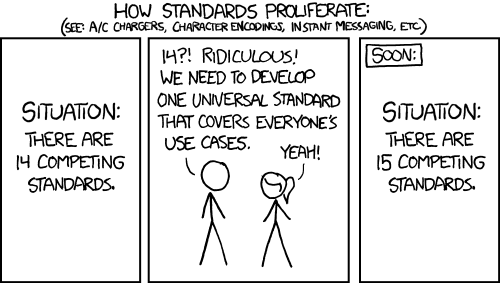
Please keep in mind I’m not advocating the creation of an entirely new organization — god forbid, we have enough of those already (the XKCD cartoon at right comes to mind). Instead, the goal should be to identify organizations that are already working and either connect that, or build up their capabilities with a large infusion of cash.

Anyway, we can all dream. But this is a dream that would actually make some difference.

So will this happen?

I guess it depends on the will and the money. It also depends on us: that is, on the willingness of the technically focused privacy/security community to accept that many of the elements we need to succeed are outside of our personal realm of expertise, and we need help with them.

Friends of mine also keep telling me that there are major philanthropic organizations out there looking to make a difference in this area. I’m still waiting to see it happen, but wheels turn slowly. One thing I can tell you: it wouldn’t take much to do better than what we have today.

* Full disclosure: I’m on the advisory board for Linux Foundation’s Core Infrastructure Initiative. I also once sat in on an advisory board meeting for OTF. Nobody paid me — but they did feed me lunch.

Hopefully the last post I’ll ever write on Dual EC DRBG

I’ve been working on some other blog posts, including a conclusion of (or at least an installment in) this exciting series on zero knowledge proofs. That’s coming soon, but first I wanted to take a minute to, well, rant.

The subject of my rant is this fascinating letter authored by NSA cryptologist Michael Wertheimer in February’s Notices of the American Mathematical Society. Dr. Wertheimer is currently the Director of Research at NSA, and formerly held the position of Assistant Deputy Director and CTO of the Office of the Director of National Intelligence for Analysis.

In other words, this is a guy who should know what he’s talking about.

The subject of Dr. Wertheimer’s letter is near and dear to my heart: the alleged subversion of NIST’s standards for random number generation — a subversion that was long suspected and apparently confirmed by classified documents leaked by Edward Snowden. The specific algorithm in question is called Dual EC DRBG, and it very likely contains an NSA backdoor. Those who’ve read this blog should know that I think it’s as suspicious as a three dollar bill.

Reading Dr. Wertheimer’s letter, you might wonder what I’m so upset about. On the face of it, the letter appears to express regret. To quote (with my emphasis):

With hindsight, NSA should have ceased supporting the Dual_EC_DRBG algorithm immediately after security researchers discovered the potential for a trapdoor. In truth, I can think of no better way to describe our failure to drop support for the Dual_EC_DRBG algorithm as anything other than regrettable. The costs to the Defense Department to deploy a new algorithm were not an adequate reason to sustain our support for a questionable algorithm. Indeed, we support NIST’s April 2014 decision to remove the algorithm. Furthermore, we realize that our advocacy for the Dual_EC_DRBG casts suspicion on the broader body of work NSA has done to promote secure standards. 

I agree with all that. The trouble is that on closer examination, the letter doesn’t express regret for the inclusion of Dual EC DRBG in national standards. The transgression Dr. Wertheimer identifies is merely that NSA continued to support the algorithm after major questions were raised. That’s bizarre.

Even worse, Dr. Wertheimer reserves a substantial section of his letter for a defense of the decision to deploy Dual EC. It’s those points that I’d like to address in this post.

Let’s take them one at a time.

1: The Dual_EC_DRBG was one of four random number generators in the NIST standard; it is neither required nor the default.

It’s absolutely true that Dual EC was only one of four generators in the NIST standard. It was not required for implementers to use it, and in fact they’d be nuts to use it — given that overall it’s at least two orders of magnitude slower than the other proposed generators.

The bizarre thing is that people did indeed adopt Dual EC in major commercial software packages. Specifically, RSA Security included it as the default generator in their popular BSAFE software library. Much worse, there’s evidence that RSA was asked to do this by NSA, and were compensated for their compliance.

This is the danger with standards. Once NIST puts its seal on an algorithm, it’s considered “safe”. If the NSA came to a company and asked it to use some strange, non-standard algorithm, the request would be considered deeply suspicious by company and customers alike. But how can you refuse to use a standard if your biggest client asks you to? Apparently RSA couldn’t.

2: The NSA-generated elliptic curve points were necessary for accreditation of the Dual_EC_DRBG but only had to be implemented for actual use in certain DoD applications.

This is a somewhat misleading statement, one that really needs to be unpacked.

First, the original NSA proposal of Dual EC DRBG contained no option for alternate curve points. This is an important point, since its the selection of curve points that give Dual EC its potential for a “back door”. By generating two default points (P, Q) in a specific way, the NSA may have been able to create a master key that would allow them to very efficiently decrypt SSL/TLS connections.

If you like conspiracy theories, here’s what NIST’s John Kelsey was told when he asked how the NSA’s points were generated:

In 2004-2005, several participants on the ANSI X9 tools committee pointed out the potential danger of this backdoor. One of them even went so far as to file a patent on using the idea to implement key escrow for SSL/TLS connections. (It doesn’t get more passive aggressive than that.)

In response to the discovery of such an obvious flaw, the ANSI X9 committee immediately stopped recommending the NSA’s points — and relegated them to be simply an option, one to be used by the niche set of government users who required them.

I’m only kidding! Actually the committee did no such thing.

Instead, at the NSA’s urging, the ANSI committee retained the original NSA points as the recommended parameters for the standard. It then added an optional procedure for generating alternative points. When NIST later adopted the generator in its SP800-90A standard, it mirrored the ANSI decision. But even worse, NIST didn’t even bother to publish the alternative point generation algorithm. To actually implement it, you’d need to go buy the (expensive) non-public-domain ANSI standard and figure it out to implement it yourself:

This is, to paraphrase Douglas Adams, the standards committee equivalent of putting the details in the bottom of a locked filing cabinet stuck in a disused lavatory with a sign on the door saying ‘Beware of the Leopard’.

To the best of our knowledge, nobody has ever used ANSI’s alternative generation procedure in a single one of the many implementations of Dual EC DRBG in commercial software.  It’s not even clear how you could have used that procedure in a FIPS-certified product, since the FIPS evaluation process (conducted by CMVP) still requires you to test against the NSA-generated points.

3. The trapdoor concerns were openly studied by ANSI X9F1, NIST, and by the public in 2007. 

This statement has the benefit of being literally true, while also being pretty damned misleading.

It is true that in 2007 — after Dual EC had been standardized — two Microsoft researchers, Dan Shumow and Neils Ferguson openly raised the alarm about Dual EC. The problem here is that the flaws in Dual EC were not first discovered in 2007. They were discovered much earlier in the standardization process and nobody ever heard about them.

As I noted above, the ANSI X9 committee detected the flaws in Dual EC as early as 2004, and in close consultation with NSA agreed to address them — in a manner that was highly beneficial to the NSA. But perhaps that’s understandable, given that the committee was anything but ‘open’.

In fact, this is an important aspect of the controversy that even NIST has criticized. The standardization of these algorithms was conducted through ANSI. And the closed ANSI committee consisted of representatives from a few select companies, NIST and the NSA. No public notice was given of the potential vulnerabilities discovered in the RNG. Moreover, a patent application that might have shone light on the backdoor was mired in NSA pre-publication review for over two years.

This timeline issue might seem academic, but bear this in mind: we now know that RSA Security began using the Dual EC DRBG random number generator in BSAFE — as the default, I remind you — way back in 2004. That means for three years this generator was widely deployed, yet serious concerns were not communicated to the public.

To state that the trapdoor concerns were ‘openly’ studied in 2007 is absolutely true. It’s just completely irrelevant.

In conclusion

I’m not a mathematician, but like anyone who works in a mathematical area, I find there are aspects of the discipline that I love. For me it’s the precision of mathematical statements, and the fact that the truth or falsity of a statement can — ideally — be evaluated from the statement itself, without resorting to differing opinions or understandings of the context.

While Dr. Wertheimer’s letter is hardly a mathematical work, it troubles me to see such confusing statements in a publication of the AMS. As a record of history, Dr. Wertheimer’s letter leaves much to be desired, and could easily lead people to the wrong understanding.

Given the stakes, we deserve a more exact accounting of what happened with Dual EC DRBG. I hope someday we’ll see that.