
Attack of the Week: Unpicking PLAID

A few years ago I came across an amusing Slashdot story: ‘Australian Gov’t offers $560k Cryptographic Protocol for Free‘. The story concerned a protocol developed by Australia’s Centrelink, the equivalent of our Health and Human Services department, that was wonderfully named the Protocol for Lightweight Authentication of ID, or (I kid you not), ‘PLAID‘.

Now to me this headline did not inspire a lot of confidence. I’m a great believer in TANSTAAFL — in cryptographic protocol design and in life. I figure if someone has to use ‘free’ to lure you in the door, there’s a good chance they’re waiting in the other side with a hammer and a bottle of chloroform, or whatever the cryptographic equivalent might be.

A quick look at PLAID didn’t disappoint. The designers used ECB like it was going out of style; did unadvisable things with RSA encryption, and that was only the beginning.

What PLAID was not, I thought at the time, was bad to the point of being exploitable. Moreover, I got the idea that nobody would use the thing. It appears I was badly wrong on both counts.

This is apropos of a new paper authored by Degabriele, Fehr, Fischlin, Gagliardoni, Günther, Marson, Mittelbach and Paterson entitled ‘Unpicking Plaid: A Cryptographic Analysis of an ISO-standards-track Authentication Protocol‘. Not to be cute about it, but this paper shows that PLAID is, well, bad.

As is typical for this kind of post, I’m going to tackle the rest of the content in a ‘fun’ question and answer format.

What is PLAID?

In researching this blog post I was somewhat amazed to find that Australians not only have universal healthcare, but that they even occasionally require healthcare. That this surprised me is likely due to the fact that my knowledge of Australia mainly comes from the first two Crocodile Dundee movies.
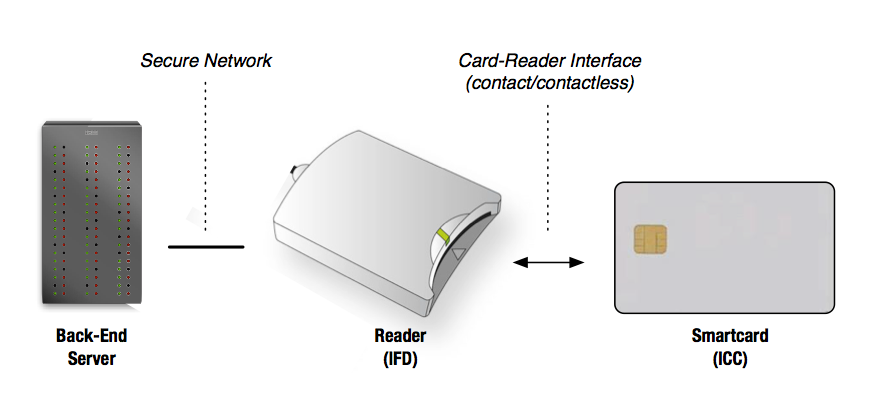
It seems that not only do Australians have healthcare, but they also have access to a ‘smart’ ID card that allows them to authenticate themselves. These contactless smartcards run the proprietary PLAID protocol, which handles all of the ugly steps in authenticating the bearer, while also providing some very complicated protections to prevent user tracking.

This protocol has been standardized as Australian standard AS-5185-2010 and is currently “in the fast track standardization process for ISO/IEC 25185-1.2”. You can obtain your own copy of the standard for a mere 118 Swiss Francs, which my currency converter tells me is entirely too much money. So I’ll do my best to provide the essential details in this post — and many others are in the research paper.

How does PLAID work?
Accompanying tinfoil hat
not pictured.

PLAID is primarily an identification and authentication protocol, but it also attempts to offer its users a strong form of privacy. Specifically, it attempts to ensure that only authorized readers can scan your card and determine who you are.

This is a laudable goal, since contactless smartcards are ‘promiscuous’, meaning that they can be scanned by anyone with the right equipment. Countless research papers have been written on tracking RFID devices, so the PLAID designers had to think hard about how they were going to prevent this sort of issue.

Before we get to what steps the PLAID designers took, let’s talk about what one shouldn’t do in building such systems.

Let’s imagine you have a smartcard talking to a reader where anyone can query the card. The primary goal of an authentication protocol is to perform some sort of mutual authentication handshake and derive a session key that the card can use to exchange sensitive data. The naive protocol might look like this:
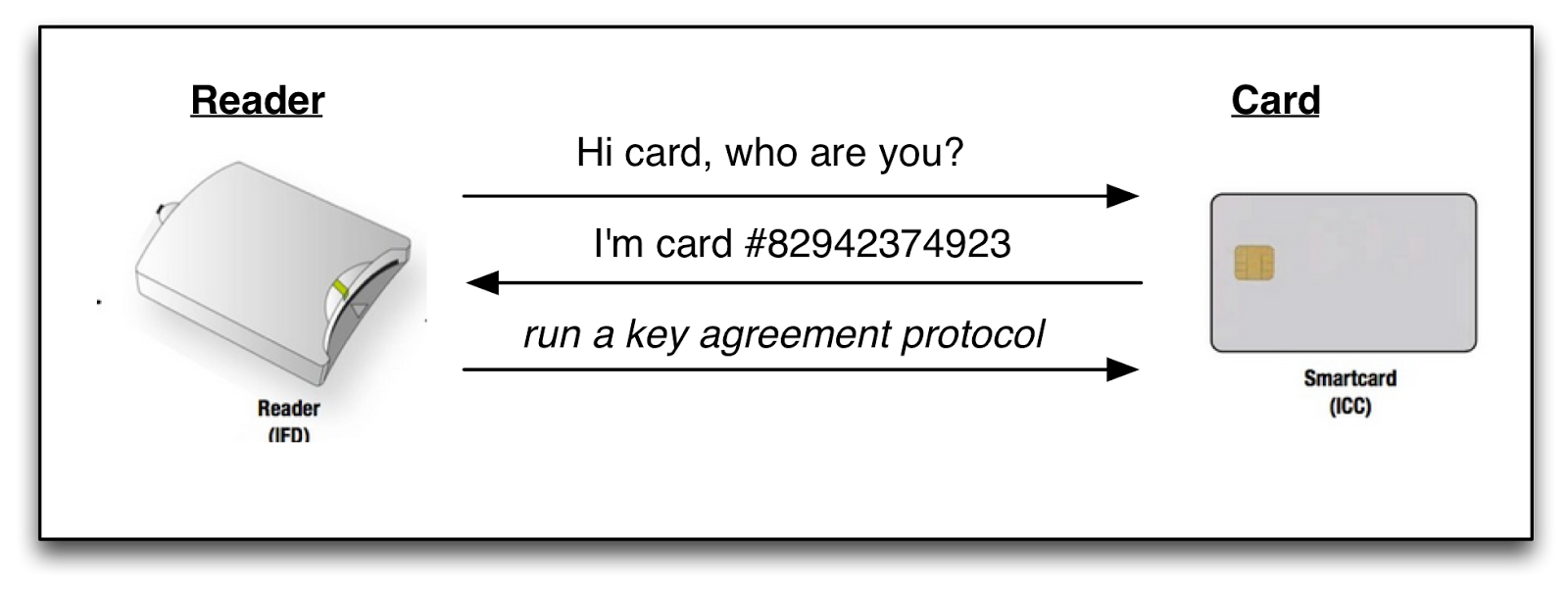
Naive approach to an authentication protocol. The card identifies itself
before the key agreement protocol is run, so the reader can look up a card-specific key.

The obvious problem with this protocol is that it reveals the card ID number to anyone who asks. Yet such identification appears necessary, since each card will have its own secret key material — and the reader must know the card’s key in order to run an authenticated key agreement protocol.

PLAID solves this problem by storing a set of RSA public keys corresponding to various authorized applications. When the reader says “Hi, I’m a hospital“, a PLAID card determines which public key it use to talk to hospitals, then encrypts data under the key and sends it over. Only a legitimate hospital should know the corresponding RSA secret key to decrypt this value.

So what’s the problem here?

PLAID’s approach would be peachy if there were only one public key to deal with. However PLAID cards can be provisioned to support many applications (called ‘capabilities’). For example, a citizen who routinely finds himself wrestling crocodiles might possess a capability unique to the Reptile Wound Treatment unit of a local hospital.* If the card responds to this capability, it potentially leaks information about the bearer.

To solve this problem, PLAID cards do some truly funny stuff.

Specifically, when a reader queries the card, the reader initially transmits a set of capabilities that it will support (e.g., ‘hospital’, ‘bank’, ‘social security center’). If the PLAID card has been provisioned with a matching public key, it goes ahead and uses it. If no matching key is found, however, the card does not send an error — since this would reveal user-specific information. Instead, it fakes a response by encrypting junk under a special ‘dummy’ RSA public key (called a ‘shill key’) that’s stored within the card. And herein lies the problem.

You see, the ‘shill key’ is unique to each card, which presents a completely new avenue for tracking individual cards. If an attacker can induce an error and subsequently fingerprint the resulting RSA ciphertext — that is, figure out which shill key was used to encipher it — they can potentially identify your card the next time they encounter you.
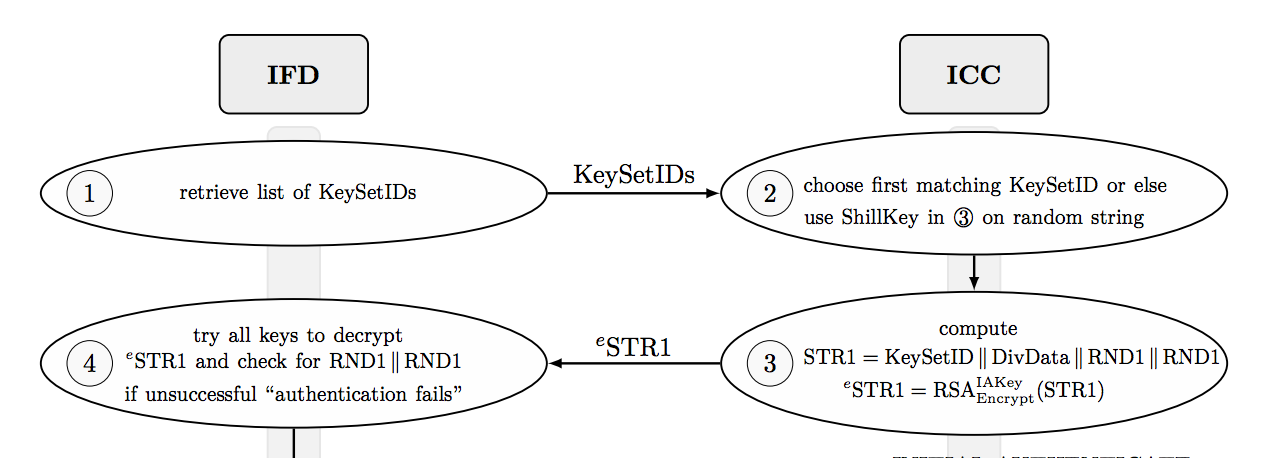
A portion of the PLAID protocol (source). The reader (IFD) is on the left, the card (ICC) is on the right.

Thus the problem of tracking PLAID cards devolves to one of matching RSA ciphertexts to unknown public keys. The PLAID designers assumed this would not be possible. What Degabriele et al. show is that they were wrong.

What do German Tanks have to do with RSA encryption?


To distinguish the RSA moduli of two different cards, the researchers employed of an old solution to a problem called the German Tank Problem. As the name implies, this is a real statistical problem that the allies ran up against during WWII.

The problem can be described as follows:

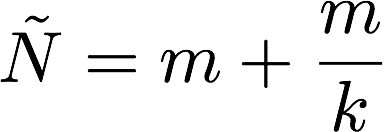
Imagine that a factory is producing tanks, where each tank is printed with a sequential serial number in the ordered sequence 1, 2, …, N. Through battlefield captures you then obtain a small and (presumably) random subset of k tanks. From the recovered serial numbers, your job is to estimate N, the total number of tanks produced by the factory.

Happily, this is the rare statistical problem with a beautifully simple solution.** Let m be the maximum serial number in the set of k tanks you’ve observed. To obtain a rough guess Ñ for the total number of tanks produced, you can simply compute the following formula:
So what’s this got to do with guessing an unknown RSA key?

Well, this turns out to be another instance of exactly the same problem. Imagine that I can repeatedly query your card with bogus ‘capabilities’ and thus cause it to enter its error state. To foil tracking, the card will send me a random RSA ciphertext encrypted with its (card-specific) “shill key”. I don’t know the public modulus corresponding to your key, but I do know that the ciphertext was computed using the standard RSA encryption formula m^e mod N.

My goal, as it was with the tanks, is to make a guess for N.

It’s worth pointing out that RSA is a permutation, which means that, provided the plaintext messages are randomly distributed, the ciphertexts will be randomly distributed as well. So all I need to do is collect a number of ciphertexts and apply the equation above. The resulting guess Ñ should then serve as a (fuzzy) identifier for any given card.
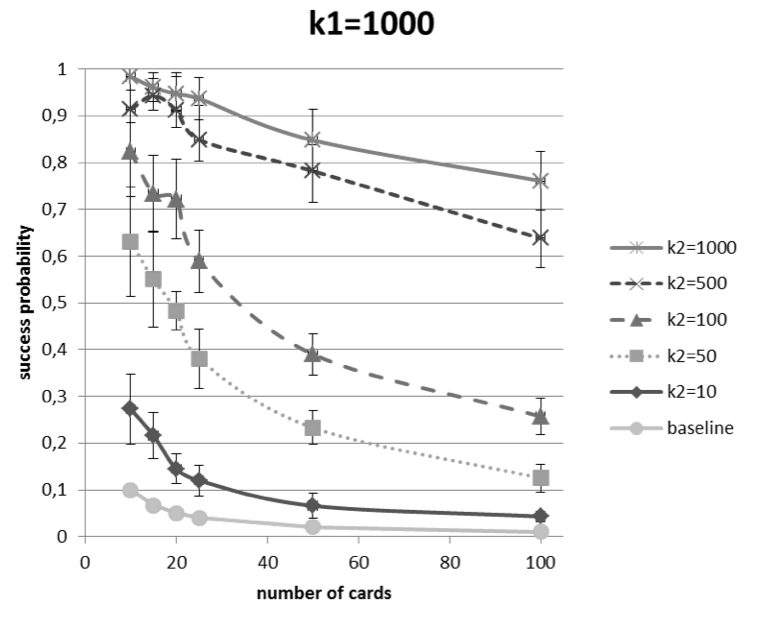
Results for identifying a given card in a batch of (up to) 100 cards. Each card was initially ‘fingerprinted’ by collecting k1=1000 RSA ciphertexts. Arbitrary cards were later identified by collecting varying number of ciphertexts (k2).

Now obviously this isn’t the whole story — the value Ñ isn’t exact, and you’ll get different levels of error depending on how many ciphertexts you get, and how many cards you have to distinguish amongst. But as the chart above shows, it’s possible to identify a specific card within in a real system (containing 100 cards) with reasonable probability.

But that’s not realistic at all. What if there are other cards in play?

It’s important to note that real life is nothing like a laboratory experiment. The experiment above considered a ‘universe’ consisting of only 100 cards, required an initial ‘training period’ of 1000 scans for a given card, and subsequent recognition demanded anywhere from 50 to 1000 scans of the card.

Since the authentication time for the cards is about 300 milliseconds per scan, this means that even the minimal number (50) of scans still requires about 15 seconds, and only produces the correct result with about 12% probability. This probability goes up dramatically the more scans you get to make.

Nonetheless, even the 50-scan result is significantly better than guessing, and with more concerted scans can be greatly improved. What this attack primarily serves to prove is that homebrew solutions are your enemy. Cooking up a clever approach to foiling tracking might seem like the right way to tackle a problem, but sometimes it can make you even more vulnerable than you were before.

How should one do this right?

The basic property that the PLAID designers were trying to achieve with this protocol is something called key privacy. Roughly speaking, a key private cryptosystem ensures that an attacker cannot link a given ciphertext (or collection of ciphertexts) to the public key that created them — even if the attacker knows the public key itself.

There are many excellent cryptosystems that provide strong key privacy. Ironically, most are more efficient than RSA; one solution to the PLAID problem is simply to switch to one of these. For example, many elliptic-curve (Diffie-Hellman or Elgamal) solutions will generally provide strong key privacy, provided that all public keys in the system are set in the same group.

A smartcard encryption scheme based on, say, Curve25519 would likely avoid most of the problems presented above, and might also be significantly faster to boot.

What else should I know about PLAID?

There are a few other flaws in the PLAID protocol that make the paper worthy of a careful read — if only to scare you away from designing your own protocols.

In addition to the shill key fingerprinting attacks, the authors also show how to identify the set of capabilities that a card supports, using a relatively efficient binary search approach. Beyond this, there are also many significantly more mundane flaws due to improper use of cryptography.

By far the ugliest of these are the protocol’s lack of proper RSA-OAEP padding, which may present potential (but implementation specific) vulnerabilities to Bleichenbacher’s attack. There’s also some almost de rigueur misuse of CBC mode encryption, and a handful of other flaws that should serve as audit flags if you ever run into them in the wild.

At the end of the day, bugs in protocols like PLAID mainly help to illustrate the difficulty of designing secure protocols from scratch. They also keep cryptographers busy with publications, so perhaps I shouldn’t complain too much.

You should probably read up a bit on Australia before you post again.

I would note that this really isn’t a question. But it’s absolutely true. And to this end: I would sincerely like to apologize to any Australian citizens who may have been offended by this post.

Notes:

* This capability is not explicitly described in the PLAID specification.

** The solution presented here — and used in the paper — is the frequentist approach to the problem. There is also a Bayesian approach, but it isn’t required for this application.

Attack of the week: POODLE

Believe it or not, there’s a new attack on SSL. 4241034941_3188086980_mYes, I know you’re thunderstruck. Let’s get a few things out of the way quickly.

First, this is not another Heartbleed. It’s bad, but it’s not going to destroy the Internet. Also, it applies only to SSLv3, which is (in theory) an obsolete protocol that we all should have ditched a long time ago. Unfortunately, we didn’t.

Anyway, enough with the good news. Let’s get to the bad.

The attack is called POODLE, and it was developed by Bodo Möller, Thai Duong and Krzysztof Kotowicz of Google. To paraphrase Bruce Schneier, attacks only get better — they never get worse. The fact that this attack is called POODLE also tells us that attack names do get worse. But I digress.

The rough summary of POODLE is this: it allows a clever attacker who can (a) control the Internet connection between your browser and the server, and (b) run some code (e.g., script) in your browser to potentially decrypt authentication cookies for sites such as Google, Yahoo and your bank. This is obviously not a good thing, and unfortunately the attack is more practical than you might think. You should probably disable SSLv3 everywhere you can. Sadly, that’s not so easy for the average end user.

To explain the details, I’m going to use the usual ‘fun’ question and answer format I employ for attacks like these.

What is SSL?

SSL is probably the most important security protocol on the Internet. It’s used to encrypt connections between two different endpoints, most commonly your web browser and a web server. We mostly refer to SSL by the dual moniker SSL/TLS, since the protocol suite known as Secure Sockets Layer was upgraded and renamed to Transport Layer Security back in 1999.

This bug has nothing to do with TLS, however. It’s purely a bug in the old pre-1999 SSL, and specifically version 3 — something we should have ditched a long time ago. Unfortunately, for legacy reasons many browsers and servers still support SSLv3 in their configurations. It turns out that when you try to turn this option off, a good portion of the Internet stops working correctly, thanks to older browsers and crappy load balancers, etc.

As a result, many modern browsers and servers continue to support SSLv3 as an option. The worst part of this is that in many cases an active attacker can actually trigger a fallback. That is, even if both the server and client support more modern protocols, as long as they’re willing to support SSLv3, an active attacker can force them to use this old, terrible protocol. In many cases this fallback is transparent to the user.

What’s the matter with SSL v3?

So many things it hurts to talk about. For our purposes we need focus on just one. This has to do with the structure of encryption padding used when encrypting with the CBC mode ciphersuites of SSLv3.

SSL data is sent in ‘record’ structures, where each record is first authenticated using a MAC. It’s subsequently enciphered using a block cipher (like 3DES or AES) in CBC mode. This MAC-then-encrypt design has been the cause of much heartache in the past. It’s also responsible for the problems now.

Here’s the thing: CBC mode encryption requires that the input plaintext length be equal to a multiple of the cipher’s block size (8 bytes in the case of 3DES, 16 bytes for AES). To make sure this is the case, SSL implementations add ‘padding’ to the plaintext before encrypting it. The padding can be up to one cipher block in length, is not covered by the MAC, and always ends with a single byte denoting the length of the padding that was added.

In SSLv3, the contents of the rest of the padding is unspecified. This is the problem that will vex us here.

How does the attack work?

Let’s imagine that I’m an active attacker who is able to obtain a CBC-encrypted record containing an interesting message like a cookie. I want to learn a single byte of this cookie — and I’m willing to make the assumption that this byte happens to live at the end of a cipher block boundary.

(Don’t worry about how I know that the byte I want to learn is in this position. Just accept this as a given for now.)

Imagine further that the final block of the record in question contains a full block of padding. If we’re using AES as our cipher, this means that the last byte of the plaintext of the final block contains a ’15’ value, since there are 15 bytes of padding. The preceding 15 bytes of said block contain arbitrary values that the server will basically strip off and ignore upon decryption, since SSLv3 doesn’t specify what they should contain. (NB: TLS does, which prevents this issue.)

The attack works like this. Since I control the Internet connection, I can identify the enciphered block that I want to learn within an encrypted record. I can then substitute (i.e., move) this block in place of the final block that should contain only padding.

When the server receives this new enciphered record, it will go ahead and attempt to decrypt the final block (which I’ll call C_n) using the CBC decryption equation, which looks like this:

Decrypted final block := Decipher(C_n) XOR C_{n-1}

Note that C_{n-1} is the second-to-last block of the encrypted record.

If the decrypted final block does not contain a ’15’ in the final position, the server will assume either that the block is bogus (too much padding) or that there’s less padding in the message than we intended. In the former case it will simply barf. In the latter case it will assume that the meaningful message is longer than it actually is, which should trigger an error in decryption since MAC verification will fail. This should also terminate the SSL connection.

Indeed, this is by far the most likely outcome of our experiment, since the deciphered last byte is essentially random — thus failure will typically occur 255 out of every 256 times we try this experiment. In this case we have to renegotiate the handshake and try again.

Every once in a while we’ll get lucky. In 1/256 of the cases, the deciphered final block will contain a 15 byte at the final position, and the server will accept this as as a valid padding length. The preceding fifteen bytes have also probably been changed, but the server will then strip off and ignore those values — since SSLv3 doesn’t care about the contents of the padding. No other parts of the ciphertext have been altered, so decryption will work perfectly and the server should report no errors.

This case is deeply meaningful to us. If this happens, we know that the decipherment of the final byte of C_n, XORed with the final byte of the preceding ciphertext block, is equal to ’15’. From this knowledge we can easily determine the actual plaintext value of the original byte we wanted to learn. We can recover this value by XORing it with the final byte of the preceding ciphertext block, then XOR that with the last byte of the ciphertext block that precedes the original block we targeted.

Voila, in this case — which occurs with probability 1/256 — we’ve decrypted a single byte of the cookie.

The important thing to know is that if at first we don’t succeed, we can try, try again. That’s because each time we fail, we can re-run the SSL handshake (which changes the encryption key) and try the attack again. As long as the cookie byte we’re attacking stays in the same position, we can continue our attempts until we get lucky. The expected number of attempts needed for success is 256.

We’ve got one byte, how do we get the rest?

The ability to recover a single byte doesn’t seem so useful, but in fact it’s all we need to decipher the entire cookie — if we’re able to control the cookie’s alignment and location within the enciphered record. In this case, we can simply move one byte after another into that critical final-byte-of-the-cipher-block location and run the attack described above.

One way to do this is to trick the victim’s browser into running some Javascript we control. This script will make SSL POST requests to a secure site like Google. Each time it does so, it will transmit a request path first, followed by an HTTP cookie and other headers, followed by a payload it controls.

Source: Möller et al.

Since the script controls the path and payload, by varying these values and knowing the size of the intermediate headers, the script can systematically align each specific byte of the cookie to any location it wants. It can also adjust the padding length to ensure that the final block of the record contains 16 bytes of padding.

This means that our attack can now be used to decrypt an entire cookie, with an average of 256 requests per cookie byte. That’s not bad at all.

So should we move to West Virginia and stock up on canned goods?

Portions of the original SSL v3 specification being
reviewed at IETF 90.

Maybe. But I’m not so sure. For a few answers on what to do next, see Adam Langley and Rob Graham’s blog posts on this question.

Note that this entire vulnerability stems from the fact that SSLv3 is older than Methuselah. In fact, there are voting-age children who are younger than SSLv3. And that’s worrying.

The obvious and correct solution to this problem is find and kill SSLv3 anywhere it lurks. In fact, this is something we should have done in the early 2000s, if not sooner. We can do it now, and this whole problem goes away.

The problem with the obvious solution is that our aging Internet infrastructure is still loaded with crappy browsers and servers that can’t function without SSLv3 support. Browser vendors don’t want their customers to hit a blank wall anytime they access a server or load balancer that only supports SSLv3, so they enable fallback. Servers administrators don’t want to lock out the critical IE6 market, so they also support SSLv3. And we all suffer.

Hopefully this will be the straw that breaks the camel’s back and gets us to abandon obsolete protocols like SSLv3. But nobody every went bankrupt betting on insecurity. It’s possible that ten years from now we’ll still be talking about ways to work around POODLE and its virulent flesh-eating offspring. All we can do is hope that reason will prevail.

Why can’t Apple decrypt your iPhone?

Last week I wrote about Apple’s new default encryption policy for iOS 8. Apple_Computer_Logo_rainbow.svgSince that piece was intended for general audiences I mostly avoided technical detail. But since some folks (and apparently the Washington Post!) are still wondering about the nitty-gritty details of Apple’s design, I thought it might be helpful to sum up what we know and noodle about what we don’t.

To get started, it’s worth pointing out that disk encryption is hardly new with iOS 8. In fact, Apple’s operating system has enabled some form of encryption since before iOS 7. What’s happened in the latest update is that Apple has decided to protect much more of the interesting data on the device under the user’s passcode. This includes photos and text messages — things that were not previously passcode-protected, and which police very much want access to.*

Excerpt fro Apple iOS Security Guide, 9/2014.

So to a large extent the ‘new’ feature Apple is touting in iOS 8 is simply that they’re encrypting more data. But it’s also worth pointing out that newer iOS devices — those with an “A7 or later A-series processor” — also add substantial hardware protections to thwart device cracking.

In the rest of this post I’m going to talk about how these protections may work and how Apple can realistically claim not to possess a back door.

One caveat: I should probably point out that Apple isn’t known for showing up at parties and bragging about their technology — so while a fair amount of this is based on published information provided by Apple, some of it is speculation. I’ll try to be clear where one ends and the other begins.

Password-based encryption 101

Normal password-based file encryption systems take in a password from a user, then apply a key derivation function (KDF) that converts a password (and some salt) into an encryption key. This approach doesn’t require any specialized hardware, so it can be securely implemented purely in software provided that (1) the software is honest and well-written, and (2) the chosen password is strong, i.e., hard to guess.

The problem here is that nobody ever chooses strong passwords. In fact, since most passwords are terrible, it’s usually possible for an attacker to break the encryption by working through a ‘dictionary‘ of likely passwords and testing to see if any decrypt the data. To make this really efficient, password crackers often use special-purpose hardware that takes advantage of parallelization (using FPGAs or GPUs) to massively speed up the process.

Thus a common defense against cracking is to use a ‘slow’ key derivation function like PBKDF2 or scrypt. Each of these algorithms is designed to be deliberately resource-intensive, which does slow down normal login attempts — but hits crackers much harder. Unfortunately, modern cracking rigs can defeat these KDFs by simply throwing more hardware at the problem. There are some approaches to dealing with this — this is the approach of memory-hard KDFs like scrypt — but this is not the direction that Apple has gone.

How Apple’s encryption works

Apple doesn’t use scrypt. Their approach is to add a 256-bit device-unique secret key called a UID to the mix, and to store that key in hardware where it’s hard to extract from the phone. Apple claims that it does not record these keys nor can it access them. On recent devices (with A7 chips), this key and the mixing process are protected within a cryptographic co-processor called the Secure Enclave.

The Apple Key Derivation function ‘tangles’ the password with the UID key by running both through PBKDF2-AES — with an iteration count tuned to require about 80ms on the device itself.** The result is the ‘passcode key’. That key is then used as an anchor to secure much of the data on the phone.

Overview of Apple key derivation and encryption (iOS Security Guide, p.10)

Since only the device itself knows UID — and the UID can’t be removed from the Secure Enclave — this means all password cracking attempts have to run on the device itself. That rules out the use of FPGA or ASICs to crack passwords. Of course Apple could write a custom firmware that attempts to crack the keys on the device but even in the best case such cracking could be pretty time consuming, thanks to the 80ms PBKDF2 timing.

(Apple pegs such cracking attempts at 5 1/2 years for a random 6-character password consisting of lowercase letters and numbers. PINs will obviously take much less time, sometimes as little as half an hour. Choose a good passphrase!)

So one view of Apple’s process is that it depends on the user picking a strong password. A different view is that it also depends on the attacker’s inability to obtain the UID. Let’s explore this a bit more.

Securing the Secure Enclave

The Secure Enclave is designed to prevent exfiltration of the UID key. On earlier Apple devices this key lived in the application processor itself. Secure Enclave provides an extra level of protection that holds even if the software on the application processor is compromised — e.g., jailbroken.

One worrying thing about this approach is that, according to Apple’s documentation, Apple controls the signing keys that sign the Secure Enclave firmware. So using these keys, they might be able to write a special “UID extracting” firmware update that would undo the protections described above, and potentially allow crackers to run their attacks on specialized hardware.

Which leads to the following question? How does Apple avoid holding a backdoor signing key that allows them to extract the UID from the Secure Enclave?

It seems to me that there are a few possible ways forward here.

  1. No software can extract the UID. Apple’s documentation even claims that this is the case; that software can only see the output of encrypting something with UID, not the UID itself. The problem with this explanation is that it isn’t really clear that this guarantee covers malicious Secure Enclave firmware written and signed by Apple.

Update 10/4: Comex and others (who have forgotten more about iPhone internals than I’ve ever known) confirm that #1 is the right answer. The UID appears to be connected to the AES circuitry by a dedicated path, so software can set it as a key, but never extract it. Moreover this appears to be the same for both the Secure Enclave and older pre-A7 chips. So ignore options 2-4 below.

  • Apple does have the ability to extract UIDs. But they don’t consider this a backdoor, even though access to the UID should dramatically decrease the time required to crack the password. In that case, your only defense is a strong password.
  • Apple doesn’t allow firmware updates to the Secure Enclave firmware period. This would be awkward and limiting, but it would let them keep their customer promise re: being unable to assist law enforcement in unlocking phones.
  • Apple has built a nuclear option. In other words, the Secure Enclave allows firmware updates — but before doing so, the Secure Enclave will first destroy intermediate keys. Firmware updates are still possible, but if/when a firmware update is requested, you lose access to all data currently on the device.


All of these are valid answers. In general, it seems reasonable to hope that the answer is #1. But unfortunately this level of detail isn’t present in the Apple documentation, so for the moment we just have to cross our fingers.

Addendum: how did Apple’s “old” backdoor work?

One wrinkle in this story is that allegedly Apple has been helping law enforcement agencies unlock iPhones for a while. This is probably why so many folks are baffled by the new policy. If Apple could crack a phone last year, why can’t they do it today?

But the most likely explanation for this policy is probably the simplest one: Apple was never really ‘cracking’ anything. Rather, they simply had a custom boot image that allowed them to bypass the ‘passcode lock’ screen on a phone. This would be purely a UI hack and it wouldn’t grant Apple access to any of the passcode-encrypted data on the device. However, since earlier versions of iOS didn’t encrypt all of the phone’s interesting data using the passcode, the unencrypted data would be accessible upon boot.

No way to be sure this is the case, but it seems like the most likely explanation.

Notes:

* Previous versions of iOS also encrypted these records, but the encryption key was not derived from the user’s passcode. This meant that (provided one could bypass the actual passcode entry phase, something Apple probably does have the ability to do via a custom boot image), the device could decrypt this data without any need to crack a password.

** As David Schuetz notes in this excellent and detailed piece, on phones with Secure Enclave there is also a 5 second delay enforced by the co-processor. I didn’t (and still don’t) want to emphasize this, since I do think this delay is primarily enforced by Apple-controlled software and hence Apple can disable it if they want to. The PBKDF2 iteration count is much harder to override.