How do you know if an RNG is working?

No matter how much cryptographers accomplish, we’re always
building on a questionable foundation. (illustration: Marc S. Rousseau)

Last week, Edward Snowden spoke to a packed crowd at SXSW about the many problems (and limited solutions) facing those of us who want to keep our communications private. Snowden said a number of things — including a shout out to Moxie’s company Whisper Systems, who certainly deserve it. But instead of talking about that, I wanted to focus on (in my opinion) one of Snowden’s most important quotes:

We need all those brilliant Belgian cryptographers to go “alright we know that these encryption algorithms we are using today work, typically it is the random number generators that are attacked as opposed to the encryption algorithms themselves. How can we make them [secure], how can we test them?”

Now it’s possible I’m a little biased, but it seems to me this cuts to the core of our problems with building secure systems in an increasingly hostile world. Namely: most encryption relies on some source of “random” numbers, either to generate keys or (particularly in the case of public key encryption) to provide semantic security for our ciphertexts.

What this means is that an attacker who can predict the output of your RNG — perhaps by taking advantage of a bug, or even compromising it at a design level — can often completely decrypt your communications. The Debian project learned this firsthand, as have many others. This certainly hasn’t escaped NSA’s notice, if the allegations regarding its Dual EC random number generator are true.

All of this bring us back to Snowden’s quote above, and the question he throws open for us. How do you know that an RNG is working? What kind of tests can we run on our code to avoid flaws ranging from the idiotic to the highly malicious? Unfortunately this question does not have an easy answer. In the rest of this post I’m going to try to explain why.

Background: Random and Pseudorandom Number Generation

I’ve written quite a bit about random number generation on this blog, but before we go forward it’s worth summarizing a few basic facts about random number generation.

First off, the ‘random’ numbers we use in most deployed cryptographic systems actually come from two different systems:

  1. A ‘true’ random number generator (or entropy generator) that collects entropy from the physical world. This can include entropy collected from low-level physical effects like thermal noise and shot noise, or it can include goofy stuff like mouse movements and hard disk seek times.
  2. An algorithmic ‘pseudorandom number generator’ (PRNG) that typically processes the output of (1) to both stretch the output to provide more bits and, in some cases, provide additional security protections in case the output of (1) proves to be biased.
It’s important to note that pseudorandom number generators aren’t “random number generators” at all. These generators typically use cryptographic algorithms (e.g., block ciphers or hash functions) to process a seed value from the RNG into many apparently random looking and unpredictable bytes.

In most cases, it’s quite rare for your application to ever see the raw output of a true random number generator.* Even the low-level entropy collector within Linux’s RNG uses cryptographic constructs like hash functions in order to ‘mix’ the output of various entropy sources. To produce the bits produced in /dev/random or /dev/urandom Linux then seeds a PRNG like Yarrow or Fortuna.**

Another similar pattern occurs inside of the Intel “secure key” random number generator included in Intel Ivy Bridge processors. When you buy one of these processors, you’re getting (free!) a hardware ‘1-shot‘ circuit that collects high-entropy electronic noise, which is then measured and processed into useful RNG output. The design looks like this:

Hardware random number generator used on Intel Ivy Bridge processors. Left: the ‘1-shot’ circuit used to collect physical entropy. Right: the data flow from generator to output, including health checks and
PRNG computation. (source).

Once again, with Intel’s design you (i.e., the application developer) don’t get access to this raw randomness. It’s first used to seed a PRNG based on AES (CTR-DRBG from NIST SP800-90A). What you actually get as an application developer is the processed output of that algorithm.

In practice this typical design some implications. On the positive side, the presence of a PRNG means that the underlying RNG circuit can get pretty borked (e.g., biased) without the results being detectable by your application. On the negative side, the underlying RNG circuit can get pretty borked without the results being detectable in your application.

In other words, with only a few ugly glitches — things that can happen in real life — you can easily get a broken random number generator that nobody notices until it’s way too late. And that’s without deliberate tampering, which makes things way, way worse.

Which brings us back to our fundamental question: how do systems know that their RNG is working. This turns out to be a question without a perfect answer.

Statistical Tests

If you look at the literature on random number generators, you’ll find a lot of references to statistical randomness testing suites like Diehard or NIST’s SP 800-22. The gist of these systems is that they look a the output of an RNG and run tests to determine whether the output is, from a statistical perspective, “good enough” for government work (very literally, in the case of the NIST suite.)

The nature of these tests varies. Some look at simple factors like bias (the number of 1s and 0s) while others look for more sophisticated features such as the distribution of numbers when mapped into 3-D space.

Now I don’t want to knock these tests. They’re a perfectly valid way to detect serious flaws in a (true) RNG — I can attest to this, since I’ve built one that failed the tests miserably — but they probably won’t detect flaws in your system. That’s because like I said above, most deployed systems include a combination of RNG and PRNG, or even RNG plus “conditioning” via cryptographic hash functions or ciphers. The nature of these cryptographic, algorithmic processes is such that virtually every processed output will pass statistical tests with flying colors — even if the PRNG is initialized with ‘garbage’ input.

This means, unfortunately, that it can be very hard to use statistical tests to detect a broken RNG unless you properly test it only at the low level. And even there you won’t rule out intentional backdoors — as I’ll discuss in a moment.

Known Answer Tests (KATs)

Assuming that you’ve tested your true RNG properly and it’s passing all tests, it’s still important to test your PRNG. One approach to doing this is to use Known Answer Tests (KATs) that are essentially test vectors. These contain some input seed material as well as a set of output bytes that should be the algorithmic result of running the PRNG on that seed.

Since PRNGs are purely algorithmic, the theory here is that you can test them like algorithms. While this approach is valid, it raises two potential issues (both of which I’ve seen in practice).

First, you can only test your PRNG on so many points. Thus it’s quite possible that your PRNG will succeed on one particular test vector (i.e., it’ll output just so many valid bytes) but go completely off the reservation on some other input. This is unlikely, but not impossible in normal conditions. It’s very possible if someone is trying to build a malicious backdoor into your PRNG implementation.

Second, the process of instrumenting your PRNG implementation for testing can actually introduce vulnerabilities in your deployed system! Think about this for a second. Normal PRNGs take in real random seeds from your RNG. The last thing you’d ever want to do is run your PRNG on some predictable seed — if you did, everyone would be able to predict the PRNGs outputs. Yet adding a test harness your system means building in logic to re-seed your RNG to something predictable!

This is like adding an ejection seat to your car. Might make you safer — unless it goes off while you’re driving to work.

A quick glance through e.g., the OpenSSL code shows that indeed, exactly this sort of code exists and ships in some versions of the library. Of course, the experienced developers will note that surely such features could be surrounded by pre-processor directives (or the equivalent in your language of choice) ensuring that they’ll never be activated in production code. Sadly, at least in the case of FIPS, this is not possible — for reasons I’ll explain next.

Runtime Health Checks

Another approach to testing RNGs is to test them while the system is running. This isn’t intended to rule out design-level flaws (as the above statistical and KAT tests are) but it is intended to catch situations where the RNG becomes broken during normal operation. This can occur for a variety of reasons, e.g., manufacturing defects, system damage, and even exposure to outside radiation.

Health checks can take different forms. FIPS 140, for example, mandates that all approved RNGs be tested at startup time using KATs. (This is why you can’t make your test harness conditional on compilation flags — it must ship in your production code!) They subsequently mandate a runtime health check that verifies the generator has not become ‘stuck’, i.e., is spitting out the same bytes over and over again.

While I’m sure this last test may have saved someone, somewhere, it seems totally inappropriate and useless when applied to the output of an RNG/PRNG pair, which is how NIST recommends it be used. This is because even the most broken algorithmic PRNGs will almost never spit out duplicate values — even if the underlying RNG fails completely.

The upshot of this decision is that NIST (FIPS) recommend a check that will almost never succeed in catching anything useful from a PRNG, but does introduce a whole bunch of extra logic that can suffer from flaws and/or malicious circumvention. I’m sure the good folks at NIST realize this, but they recommend it anyway — after all, what else are they going to do?

Tampering

Which brings us to the $10 million question. What happens if an attacker is deliberately tampering with our RNG/PRNG in order to make it fail? Note that this is not an academic question. We have excellent reason to believe it’s happened in some real systems.

Just for fun, let’s go back to the Intel Ivy Bridge RNG described above. We’ll take a look specifically at the PRNG portion of the design, which uses the NIST CTR-DRBG random number generator with AES:

Portion of the Intel Ivy Bridge design, with a few annotations added by yours truly. (original source)

The CTR-DRBG design relies on two features. First, an AES key is selected at random along with some input seed. This pair goes into the AES cipher, where it is processed to derive a new key and data. The result should be unpredictable to most attackers.

But if you were able to change the way keys were updated (in the key_in_mux hilighted) so that instead of updating the key and/or using an unpredictable one, it chose a fixed key known to the attacker, you would now have a very powerful backdoor. Specifically, the output would still look statistically perfectly random. But an attacker who knows this key could simply decrypt one block of RNG output to obtain all future and past outputs of the generator until the next time it was reseeded.

Note that I am not saying the Intel system has a backdoor in it — far from it. I’m only considering how easily it might be made to have one if you were an attacker with control of Intel’s fabrication plants (or their microcode updates). And this is hardly Intel’s fault. It’s just the nature of this particular RNG design. Others could be just as vulnerable.

Actually using this knowledge to attack applications would be more complex, since many system-level RNGs (including the Linux Kernel RNG) combine the output of the RNG with other system entropy (through XOR, unfortunately, not hashing). But Intel has pushed hard to see their RNG output used directly, and there exist plugins for OpenSSL that allow you to use it similarly. If you used such a method, these hypothetical flaws could easily make their way all the way into your cryptography.

Designing against these issues

Unfortunately, so far all I’ve done is call out the challenges with building trustworthy RNGs. And there’s a reason for this: the challenges are easy to identify, while the solutions themselves are hard. And unfortunately at this time, they’re quite manual.

Building secure RNG/PRNGs still requires a combination of design expertise, careful low-level (true) RNG testing — using expert design and statistical tests — and the use of certified algorithms with proper tests. All of the techniques above contribute to building a secure RNG, but none of them are quite sufficient.

Solving this problem, at least in software, so we can ensure that code is correct and does not contain hidden ‘easter eggs’, represents one of the more significant research challenges facing those of us who depend on secure cryptographic primitives. I do hope some enterprising graduate students will give these issues the attention they deserve.

Notes:

* Though there are some exceptions. See, for example, this FIPS certified smart card that included a bad RNG which was used to generate cryptographic secrets. In general FIPS disallows this except for a very small number of approved RNGs. Perhaps this was one.

** The original version of this post claimed that /dev/random seeds /dev/urandom. This is actually a mistake — both /dev/random and /dev/urandom use the same PRNG, but /dev/random simply keeps track of how much ‘entropy’ is in the pool and blocks when you have drawn too many bits. Thanks to Brendan Long and Thomas Ptacek for setting me straight.
Cryptographic obfuscation and ‘unhackable’ software

I have a thing for over-the-top cryptography headlines — mostly because I enjoy watching steam come out of researchers’ ears when their work gets totally misrepresented. And although I’ve seen quite a few good ones, last week WIRED managed a doozy.

The headline in question, Cryptography Breakthrough Could Make Software Unhackable, managed to accomplish something that few cryptography headlines do. It sent its own protagonist, Amit Sahai, into the comments section to perform intellectual garbage pickup.

In contrast to the headline, which is quite bad, the article is actually pretty decent. Still, the discussion around it has definitely led to some confusion. As a result, many now think an amazing breakthrough has taken place — one that will finally make software secure. They’re probably right about the first part. They may be disappointed about the rest.

The truth, as usual, is complicated. There is, indeed, something very neat going on with the new obfuscation results. They’re just not likely to make software ‘unhackable’ anytime soon. They might, however, radically expand what we can do with cryptography. Someday. When they’re ready. And in ways we don’t fully understand yet.

But before I go into all that, it’s probably helpful to give some background.

Program obfuscation

The Wired article deals with the subject of ‘program obfuscation‘, which is a term that software developers and cryptographers have long been interested in. The motivation here is pretty simple: find a way that we can give people programs they can run — without letting them figure out how the programs work.

Note that the last part necessarily covers a lot of ground. In principle it includes aspects ranging from the nature of specific secret algorithms used — which may be proprietary and thus worth money — to secret information like passwords and cryptographic keys that might be hardcoded into the program.

For a simple example, consider the following routine:

// Check a password and print out top secret information if it’s correct
//
SuperSecretPasswordProtectedStuff(string passwd) {
  if (password == “0xt438fh27266629zn28366492923aai3jnqobbyc4t!”) {
    print(“Congratulations. Here’s some super secret private information: ….\n”);
  } else {
    print(“Wrong password, fool.\n”);
  }
}

If you’re like me, you probably wrote a program like this at some point in your life. You may have eventually realized how ineffective it would be — against a smart attacker who could dump the program code. This is because most programs (and even compiled binaries) are pretty easy to read. An attacker could just look at this program to recover the secret password.

Program obfuscation is motivated by the idea that many useful programs would benefit if we could somehow ‘stop’ people from doing this, while still letting them possess and run the code on their own computers.

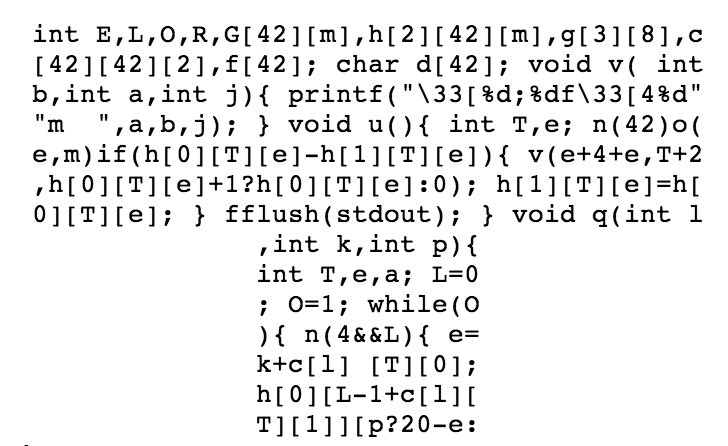
In real world software systems, ‘obfuscation’ usually refers to a collection of ad-hoc techniques that turn nice, sensible programs into a morass of GOTOs and spaghetti code. Sometimes important constants are chopped up and distributed around the code. Some portions of the code may even be encrypted — though only temporarily, since decryption keys must ship with the program so it can actually be run. Malware authors and DRM folks love this kind of obfuscation.

A chunk of ‘birken’, one of the winning entries in the 2013 obfuscated C contest.

While these techniques are nice, they’re not really ‘unhackable’ or even secure against reverse-engineering in the strong sense we’d like. Given enough time, brains and tools, you can get past most common software obfuscation techniques. If you have, say, Charlie Miller or Dion Blazakis on your side, you probably do it quickly. This isn’t just because those guys are smart (though they are), it’s because the techniques are not mathematically rigorous. Most practical obfuscation amounts to roadblocks — designed to slow reverse-engineers down and make them give up.

So what does it mean to securely ‘obfuscate’ a program?

The poor quality of existing software obfuscation set cryptographers up with a neat problem. Specifically, they asked, could we define a strong definition of program obfuscation that would improve on, to put it politely, the crap people were actually using? Given such an obfuscator I could hand you my obfuscated program to run while provably protecting all partial information — except for the legitimate inputs and outputs.

If this could be done, it would have an incredible number of applications. Stock traders could obfuscate their proprietary trading algorithms and send them to the cloud or to end-customers. The resulting programs would still work — in the sense that they produced the right results — but customers would never learn anything about ‘how they worked’. The internals of the program would be secret sauce.

Unfortunately, when the first researchers started looking at this problem, they ran into a very serious problem: nobody had any idea what it meant to securely ‘obfuscate a program in the first place.

Do think about it for a second before you roll your eyes. What do you think it means to obfuscate a program? You’re probably thinking something like ‘people shouldn’t learn stuff‘ about the program. But can you explain what stuff? And does ‘stuff‘ depend on the program? What about programs where you can efficiently learn the whole program from sending it inputs and seeing the results? What does it mean to obfuscate those?

Clearly before progress could begin on solving the problem, cryptographers needed to sit down and figure out what they were trying to do. And indeed, several cryptographers immediately began to do exactly this.

Black-box cryptographic obfuscation

The first definitions cryptographers came up addressed a very powerful type of obfuscation called ‘virtual black box obfuscation‘. Roughly speaking, it starts from the following intuitive thought experiment.

Imagine you have a program P, as well as some code obfuscation technique you’ve developed. It’s important that the obfuscation be efficient, meaning it doesn’t slow the program down too much. To determine whether the obfuscation is successful, you can conduct the following experiment.

  1. Give Alice a copy of the obfuscated program code Obf(P), in a form that she can look at and run on her own computer.
  2. Take the original (unobfuscated) program P, and seal it in a special computer located inside an armored ‘black box’. Let a user Sam interact with the program by sending it inputs and receiving outputs. But don’t let him access the code.

Roughly speaking, what we want from secure obfuscation is that Alice should learn ‘no more‘ information after seeing the obfuscated program code, than could some corresponding user Sam who interacts with the same program locked up in the black box.

What’s nice here is that this is we have the beginnings of an intuitive definition. In some sense the obfuscation should render the program itself basically unintelligible — Alice should not get any more information from seeing the obfuscated program than Sam could get simply by interacting with its input/output interface. If Sam can ‘learn’ how the program works just by talking to it, even that’s ok. What’s not ok is for Alice to learn more than Sam.

The problem with this intuition is, that of course, it’s hard to formulate. One thing you may have noticed is that the user Alice who views the obfuscated program truly does learn something more than the user Sam, who only interacts with it via the black box. When the experiment is over, the user who got the obfuscated program still has a copy of the obfuscated program. The user who interacted with the black box does not.

To give a practical example, let’s say this program P is a certificate signing program that has a digital signing key hard-coded inside of it — say, Trustwave’s — that will happily attach valid digital signatures on certificates (CSRs) of the user’s devising. Both Alice and Sam can formulate certificate signing requests and send them into the program (either the obfuscated copy or the version in the ‘black box’) and get valid, signed certificates out the other end.

But here’s the thing: when the experiment is over and we shut down Sam’s access to the black box, he won’t be able to sign any more certificates. On the other hand, Alice, who actually who learned the obfuscated program Obf(P), will still have the program! This means she can keep signing certificates on and forevermore. Knowing a program that can sign arbitrary certificates is a pretty darn significant ‘piece’ of information for Alice to have!

Worse, there’s no way the ‘black box’ user Sam can ever learn a similar piece of information — at least not if the signature scheme is any good. If Sam could ask the black box for a bunch of signatures, then somehow learn a program that could make more signatures, this would imply a fundamental weakness in the digital signature scheme. This cuts against a basic property we expect of secure signatures.

Barak et al. proposed a clever way to get around this problem — rather than outputting an arbitrary piece of information, Alice and Sam would be restricted to outputting a single bit at the end of their experiment (i.e., computing a predicate function). This helps to avoid the problems above and seems generally like the “right” definition.

An impossibility result

Having proposed this nice definition, Barak et al. went on to do an irritating thing that cryptographers sometimes do: they proved that even their definition doesn’t work. Specifically, they showed that there exist programs that simply can’t be obfuscated under this definition.

The reason is a little wonky, but I’m going to try to give the flavor for it below.

Imagine that you have two programs A and B, where A is similar to our password program above. That is, it contains a hard-coded, cryptographic secret which we’ll denote by password. When you run A(x), the program checks whether (x == password) and if so, it outputs a second cryptographically strong password, which we’ll cleverly denote by password_two. If you run A on any other input, it doesn’t output anything.

Now imagine the second program B works similarly to the first one. It contains both password and password_two hardcoded within it. A major difference is that B doesn’t take a string as input. It takes another computer program. You feed a program in as input to B, which then:

  1. Executes the given program on input password to get a result r.
  2. If (r == password_two)it outputs a secret bit.

It should be apparent to you that if you run the program B on input the program A — that is, you compute B(A) — it will always output the secret bit.* It doesn’t even matter if either B or A has been obfuscated, since obfuscation doesn’t change the behavior of the programs.

At the same time, Barak et al. pointed out that this trick only works if you actually have code for the program A. If I give you access to a black box that contains the programs A, B and will simply let you query them on chosen inputs, you’re screwed. As long as password and password_two are cryptographically strong, you won’t be able to get A to output anything in any reasonable amount of time, and hence won’t be able to get B to output the secret bit.

What this means is that Alice, who gets the obfuscated copies of both programs, will always learn the secret bit. But if Sam is a reasonable user (that is, he can’t run long enough to brute-force the passwords) he won’t be able to learn the secret bit. Fundamentally, the obfuscated pair of programs always gives more information than black-box access to them.

It remains only to show that the two programs can be combined into one program that still can’t be obfuscated. And this is what Barak et al. did, completing their work and showing the general programs can’t be obfuscated using their definition.

Now you can be forgiven for looking askance at this. You might, for example, point out that the example above only shows that it’s hard to obfuscate a specific and mildly ridiculous program. Or that this program is some kind of weird exception. But in general it’s not. There are many other useful programs that also can’t obfuscate, particularly when you try to use them in real systems. These points were quickly pointed out by Barak et al., and later in other practical settings by Goldwasser and Kalai, among others.

You might also think that obfuscation is plain impossible. But here cryptography strikes again — it’s never quite that simple.

We can obfuscate some things!

Before we completely write off black box obfuscation, let’s take a moment to go back to the password checking program I showed at the beginning of this post.

Here’s a slightly simpler version:

// Check a password and return true if it’s correct, false otherwise
//
bool SuperSecretPasswordProtectedStuff(string passwd) {
  if (password == “0xt438fh27266629zn28366492923aai3jnqobbyc4t!”) {
    return true;
  } else {
    return false;
  }
}

This function is an example of a ‘point function‘: that is, a functions that returns false on most inputs, but returns true at exactly one point. As you can see, there is exactly one point (the correct password) that makes this routine happy.

Point functions are interesting for a two simple reasons: the first is that we use them all the time in real systems — password checking programs being the obvious example. The second is that it turns out we can obfuscate them, at least under some strong assumptions. Even better, we can do it in a way that should be pretty familiar to real system designers.

Let be a secure hash function — we’ll get back to what that means in a second — and consider the following obfuscated password checking routine:

// Check a password and return ‘true’ if it’s correct, ‘false’ otherwise
// But do it all *obfuscated* and stuff
//
bool ObfuscatedSuperSecretPasswordProtectedStuff(string passwd) {

  static string HARDCODED_SALT          = 0x……; // this is a salt value

  static string HARDCODED_PASSWORD_HASH = 0x……; // this value is H(salt + target password)

  // First, hash the input password with the salt
  hashedPass = H(HARDCODED_SALT + passwd);

  if (hashedPass == HARDCODED_PASSWORD_HASH) {
    return true;
  } else {
    return false;
  }
}

Note that our ‘obfuscated’ program no longer stores the plaintext of the password. Instead we store its hash only (and salt), and wrap it inside a program that simply compares this hash to a hash of the user’s input. This should be familiar, since it’s the way you should be storing password files today.**

A number of cryptographers looked at formulations like this and showed the following: if the password is very hard to guess (for example, it’s secret and drawn at random from an exponentially-sized space of passwords) and the hash function is ‘strong’ enough, then the hash-checking program counts as a secure ‘obfuscation’ of the basic password comparison program above it.

The intuition for this is fairly simple: imagine Alice and Sam don’t know the password. If the password is strong, i.e., it’s drawn from a large enough space, then their probability of ever getting the program to output ‘true’ is negligible. If we assume an ideal hash function — in the simplest case, a random oracle — then the hard-coded hash value that Alice learns is basically just a useless random string, and hides all partial input about the real password. This means, in practice, that any general question Alice can answer at the end of the experiment, Sam can answer with about the same probability.***

Finding better definitions

More than a decade after the definition was formulated, there are basically two kinds of results about ‘strong’ virtual-black-box obfuscation. The first set shows that it’s impossible to do it for general programs, and moreover, that many of the interesting functions we want to obfuscate (like some signatures and pseudorandom functions) can’t be obfuscated in this powerful sense.

The second class of results shows that we can black-box obfuscate certain functions, but only very limited ones like, say, point functions and re-encryption. These results are neat, but they’re hardly going to set the world on fire.

What cryptographers have been trying to achieve since then is a different — and necessarily weaker — definition that could capture interesting things we wanted from obfuscating general programs, but without all the nasty impossibility results.

And that, finally, brings us to the advances described in the WIRED article.

Indistinguishability Obfuscation

In shooting down their own proposed definitions, Barak et al. also left some breadcrumbs towards a type of obfuscation that might actually work for general programs. They called their definition “indistinguishability obfuscation” (IO) and roughly speaking it says the following:

Imagine we have two programs C1, C2 — which we’ll describe as similarly-sized circuits — that compute the same function. More concretely, let’s say they have exactly the same input/output behavior, although they may be implemented very differently inside. The definition of indistinguishability obfuscation states that it should be possible to obfuscate the two circuits C1, C2 such that no efficient algorithm will be able to tell the difference between Obf(C1) from Obf(C2). 

While this idea was proposed years ago, nobody actually knew how to build any such thing, and it was left as one of those ‘open problems’ that cryptographers love to tear their hair out over. This remained the case until just last year, when a group of authors from UCLA, UT Austin and IBM Research proposed a ‘candidate construction’ for building such obfuscators, based on the new area of multilinear map-based cryptography.

Another interesting variant of this notion is called extractability obfuscation (EO), which implies not only that you can’t distinguish between Obf(C1) and Obf(C2), but moreover, that if you could distinguish the two, then you could necessarily find an input value on which both C1 and C2 would produce different outputs. Moreover, other work indicates IO and EO give essentially the ‘best possible’ obfuscation you can provide for general programs.

The question you’re probably asking is: so what? What can we do with indistinguishability obfuscation?

And this is where the WIRED article differs substantially from the reality. The truth is that IO will probably bring us major cryptographic and software advances — it’s already been shown to bring about succinct functional encryption for all circuits, as well as advances in deniable encryption. Moreover it can be used to build known forms of encryption such as public-key encryption based on new techniques that differ from what we use today — for example, by obfuscating ‘symmetric’ primitives like pseudorandom functions.****

And if this doesn’t seem quite as exciting as the WIRED article would imply, that’s because we’re still learning what the possibilities are. The new techniques could, for example, allow us to build exciting new types of security systems — or else show us radical new ways to build systems that we already have. Even the latter is very important, in case advances in our field result in ‘breaks’ to our existing constructions.

What IO and EO will probably not do is make programs unhackable, since that implies something a whole lot stronger than either of these techniques currently provide. In fact, it’s not clear what the heck you’d need to make programs unhackable.

And the reason for that is quite simple: even obfuscated software can still suck.

Notes:

Thanks to Susan Hohenberger and Zooko for comments on this post. 

The bit in the Barak et al. proof doesn’t have to be secret.

** With a pretty damn big caveat, which is that in real life (as opposed to cryptographic examples) users pick terrible passwords, which makes your password hashes vulnerable to dictionary attacks. We have a variety of countermeasures to slow down these attacks, including salt and computationally intensive password hashing functions.

*** God I hate footnotes. But it’s worth unpacking this. Imagine that Alice learns ‘some information’ from seeing an average program containing the hash of a strong password. If the password is strong, then Alice can only guess the right input password with negligible probability. Then Sam can ‘use’ Alice to get the same information as follows. He formulates a ‘fake’ program that contains a completely bogus password hash and mails it to Alice. Whatever information she learns from his program, he takes and outputs as the information he ‘learned’. It remains to show that if the password hash is strong (a random oracle), Alice isn’t going to be able to learn more from a random hash than she would from the hash of a strong password.

**** The basic idea here is that symmetric encryption (like AES, say) can’t be used for public key encryption, since anyone who learns your encryption key also learns your decryption key. But if you can obfuscate an encryption program that contains your symmetric encryption key, then the new program becomes like a public key. You can hand it out to people to encrypt with.

A letter from US security researchers

This week a group of more than fifty prominent security and cryptography researchers signed a letter protesting the mass surveillance efforts of the NSA, and attempts by NSA to weaken cryptography and privacy protections on the Internet. The full letter can be found here.

Most of you have already formed your own opinions on the issue over the past several months, and it’s unlikely that one letter is going to change that. Nonetheless, I’d like a chance to explain why this statement matters.

For academic professionals in the information security field, the relationship with NSA has always been a bit complicated. However, for the most part the public side of that relationship has been generally positive. Up until 2013 if you’d asked most US security researchers for their opinions on NSA, you would, of course, have heard a range of views. But you also might have heard notes of (perhaps grudging) respect. This is because many of the NSA’s public activities have been obviously in everyone’s interest — helping to fund research and secure our information systems.

Even where evidence indicated the possibility of unfair dealing, most researchers were content to dismiss these allegations as conspiracy theories. We believed the NSA would stay between the lines. Putting backdoors into US information standards was possible, of course. But would they do it? We thought nobody would be that foolish. We were wrong.

In my opinion this letter represents more than just an appeal to conscience. It measures the priceless trust and goodwill the NSA has lost — and continues to lose while our country fails to make serious reforms to this agency.

While I’m certain the NSA itself will survive this loss of faith in the short term, in the long term our economic and electronic security depend very much on the cooperation of academia, industry and private citizens. The NSA’s actions have destroyed this trust. And ironically, that makes us all less safe.

A few more notes on NSA random number generators

Last Friday, Joseph Menn from Reuters published an article claiming that RSA, the pioneering security firm and division of EMC, accepted $10 million dollars to include the 3a7ac-thomas_adversaryDual EC random number generator as the default in their flagship BSAFE library. I’ve written a bit about Dual EC on this blog, so readers will know that I don’t think highly of it. For one thing, it’s a rotten choice for a commercial product, due to its lousy software performance. Much worse: it may introduce a practical backdoor into any system that uses it.

Given the numerous problems with Dual EC it’s baffling that RSA would select this particular generator as the default for their software. It’s particularly strange given that BSAFE is designed for use in Java-based and embedded systems where performance truly is at a premium. And none of this can be explained by the needs of a single RSA customer, since those needs could be satisfied merely by making BSAFE an option, rather than the default.

Of course there have been many people who had viewed RSA’s decision as potentially malicious. Unsupported rumors have been floating around since long before Reuters got involved. What’s new this time is that RSA insiders appear to be going on the record.

I suppose time will tell how the industry reacts to this news. In the interim I have a few small facts to add to the discussion, so I thought I’d sketch them out in this post.

#1: Dual_EC_DRBG’s ‘backdoor’ was known as of January 2005

It’s widely believed that the ‘vulnerability’ in Dual_EC was first identified by Microsoft employees Dan Shumow and Niels Ferguson in the summer of 2007. Tanja Lange (and nymble) recently tipped me off to the fact that this isn’t precisely true.

In point of fact, the possibility of a backdoor was known to at least some members of the ANSI X9.82 standardization committee as far back in January 2005. This surprising news comes via a patent application filed by Certicom employees Dan Brown and Scott Vanstone. The application claims a priority date of January 2005. Here’s the scary bit:

If P and Q are established in a security domain controlled by an administrator, and the entity who generates Q for the domain does so with knowledge of e (or indirectly via knowledge of d). The administrator will have an escrow key for every ECRNG that follows that standard. 

Escrow keys are known to have advantages in some contexts. They can provide a backup functionality. If a cryptographic key is lost, then data encrypted under that key is also lost. However, encryption keys are generally the output of random number generators. Therefore, if the ECRNG is used to generate the encryption key K, then it may be possible that the escrow key e can be used to recover the encryption key K. Escrow keys can provide other functionality, such as for use in a wiretap. In this case, trusted law enforcement agents may need to decrypt encrypted traffic of criminals, and to do this they may want to be able to use an escrow key to recover an encryption key.

For example, in the SSL and TLS protocols, which are used for securing web (HTTP) traffic, a client and server perform a handshake in which their first actions are to exchange random values sent in the clear.

The patent also describes a number of ways to close the backdoor in Dual_EC_DRBG. Indeed, it may be due to Brown and Vanstone that the NIST standard includes an alternative method to close the backdoor (by generating a random Q point).

The existence of this patent does not mean that Brown and Vanstone were responsible for Dual EC. In fact, the generator appears to be an NSA invention, and may date back to the early 2000s. What this patent demonstrates is that some members of the ANSI committee, of which RSA was also a member, had reason to at least suspect that Dual EC could be used to create a wiretapping backdoor. (Update: John Kelsey confirms this.) It would be curious to know how widely this information was shared, and whether anyone on the committee ever inquired as to the provenance of the default parameters.

#2. Dual_EC_DRBG is not really a NIST standard

This is hardly a secret, but it’s something that hasn’t been widely acknowledged in the press. Dual_EC_DRBG is generally viewed as a NIST standard, since it was published in NIST Special Publication 800-90. But that’s not the only place it appears, nor was it developed at NIST.

A complete history of Dual_EC_DRBG would begin with NSA’s drive to include it in the ANSI X9.82 DRBG standard, with a standardization process kicked off in the early 2000s. The draft ANSI standard includes Dual_EC_DRBG with all of the known parameters, along with several additional elliptic curve parameters that were not included in the NIST standards.

Members of the ANSI X9F1 Tool Standards and Guidelines Group which wrote ANSI X9.82.

However you’ll also find Dual_EC_DRBG in the international standard ISO 18031. In other words, Dual EC was widely propagated in numerous standards long before NIST finalized it, and it’s hardly limited to US borders. The ANSI and ISO drafts are in some sense worse, since they don’t include a technique for generating your own Q parameter.

#3. Dual_EC_DRBG is not the only asymmetric random number generator in the ANSI and ISO standards

Cryptographers generally think of Dual EC as the only ‘public key’ random number generator to be widely standardized. We also point to NSA’s generation of the public parameters as evidence that Dual_EC may be compromised.

But in fact, the ANSI X9.82 and ISO standards each include a second generator based on public key cryptographic techniques. And like Dual EC, this one ships with a complete set of default parameters! The additional generator is based on an algorithm due to Micali and Schnorr, and relies for its security on assumptions related to the hardness of factoring large composite numbers. It requires an RSA-type modulus, several of which are conveniently provided in the specification.

Two default MS-DRBG moduli from the ISO 18031 specification.

There’s no reason to suspect that MS-DRBG is used by any real products, let alone that there’s a backdoor in the standard. In fact, there’s a curious fact about it: it’s not obvious from the public literature how one would attack the generator even if one knew the factorization of the n values above — though it seems intuitively likely that an attack does exist. Solving the problem, and finding a practical attack for known factorization, would be a fun project for an enthusiastic mathematician.

Since MS-DRBG comes from the same people who brought you Dual EC, if you are using it you might want to think twice.

Can hackers decrypt Target’s PIN data?

Short answer: probably not.

Slightly longer answer: it depends on whether they have access to the encryption key, or to a machine that contains the encryption key.

In case you have no idea what I’m talking about: there was recently a massive credit card breach at Target. If you’re like many people you probably heard about this three times. First in the news, then again in your email when Target notified you that you were a victim, and finally a third time when you checked your credit card bill. Not a proud day for our nation’s retailers.

The news got a bit messier today when Target announced the thieves had also managed to get their hands on the PIN numbers of unfortunate debit card customers. But this time there’s a silver lining: according to Target, the PIN data was encrypted under a key the hackers don’t have.

Snyder said PIN data is encrypted at a retail location’s keypad with Triple-DES [3DES] encryption and that data remains encrypted over the wire until it reaches its payment processor. Attackers would have to have compromised the point-of-sale system and intercepted the PIN data before it is encrypted in order to have accessed it.

Several folks on Twitter have noted that 3DES is no spring chicken, but that’s not very important. Aside from a few highly impractical attacks, there isn’t much to worry about with 3DES. Moreover, PCI standards appear to mandate unique keys for every payment terminal, which means that the attackers would need to compromise the terminals themselves, or else break into the back-end payment processor. If Target is to be believed, this has not happened.

Others have pointed out that PINs are pretty short. For example, there are only 10,000 4-digit PINs — so surely the attackers can “brute-force” through this space to figure out your PIN. The good news is that encryption is decidedly not the same thing as password hashing, which means this is unlikely to be a serious concern. Provided that Target is being proactive and makes sure to change the keys now.

Of course you shouldn’t take my word for this. It helps to take a quick look at the PCI PIN encryption standards themselves. Before you encrypt a 4-digit PIN, the PIN is first processed and in some cases padded to increase the complexity of the data being encrypted. There are four possible encryption formats:

  • Format 0. XOR the PIN number together with the Primary Account Number (PAN), usually the rightmost twelve digits of the card number, not including the last digit. Then encrypt the result using 3DES in ECB mode.
  • Format 1. Concatenate the PIN number with a unique transaction number and encrypt using 3DES in ECB mode.
  • Format 2. Pad with some fixed (non-random) padding, then encrypt in 3DES/ECB with a unique, derived per-transaction key (called a DUKPT). Update: only used for EMV cards.
  • Format 3. Pad with a bunch of random bytes, then 3DES/ECB encrypt.
Notice that in each case the encryption is ECB mode, but in Formats 0, 1 and 3 the plaintext has been formatted in such a way that two users with PIN “1234” are unlikely to encrypt exactly the same value under the same key. For example, consider the Format 0 encryptions for two users with the same PIN (1234) but different PANs:

(PIN) 0x1234FFFFFFFF ⊕ (PAN) 0x937492492032 = 0x81406DB6DFCD
(PIN) 0x1234FFFFFFFF ⊕ (PAN) 0x274965382343 = 0x357D9AC7DCBC

Notice that the values being encrypted (at right) will be quite different. ECB mode has many flaws, but one nice feature is that the encryption of two different values (even under the same key) should lead to effectively unrelated ciphertexts. This means that even an attacker who learns the user’s PAN shouldn’t be able to decompose the encrypted PIN without knowledge of the key. Their best hope would be to gain access to the terminal, hope that it was still configured to use the same key, and build a dictionary — encrypting every possible PIN under a specific user’s PAN — before they could learn anything useful about one user’s key.

This does not seem practical.

The one exception to the above rule is Format 2, which does not add any unpredictable padding to the plaintext at all. While the PIN is padded out, but there are still exactly 10,000 possible plaintexts going into the encryption. PCI deals with this by mandating that the payment terminal derive a unique key per transaction, hopefully using a secure key derivation function. Update: this one probably isn’t used by Target.

All of this is a long, dull way of saying that encryption is not like password hashing. Provided that you can keep the keys secret, it’s perfectly fine to encrypt messages drawn from even small message spaces — like PINs — provided you’re not an idiot about it. The PCI standards clearly skirt the borders of idiocy, but they mostly steer clear of disaster.

So in summary, Target debit card users are probably just fine. Until tomorrow, when we learn that the thieves also have the decryption keys. Then we can panic.

An update on Truecrypt

Several people have been asking for an update on our public audit of the Truecrypt disk encryption software. I’m happy to say that the project is on track and proceeding apace. Here I wanted to give a few quick updates:

  1. Thanks to the amazingly generous donations of 1,434 individual donors from over 90 countries, as of today, we’ve collected $62,104 USD and 32.6 BTC* towards this effort. This is an unbelievable response and I can’t thank our donors enough. I’m blown away that this is happening.
  2. We’ve assembled a stellar technical advisory board to make sure we spend this money properly and generally to keep us honest. More details shortly.
  3. In order to make best use of the donated funds and manage on-going governance of the project, we’ve incorporated as a non-profit corporation in North Carolina—the Open Crypto Audit Project (OCAP)—and are currently seeking 501c(3) tax-exempt designation. Board members include myself, Kenn White (who has been doing most of the heavy organizational lifting) and the amazing Marcia Hoffman. We have high hopes that OCAP will find a purpose beyond this Truecrypt audit.
  4. The Open Technology Fund has generously agreed to donate a substantial amount of contracted evaluation time to our effort
  5. And finally, the most exciting news: we’ve signed a first contract with iSEC partners to evaluate large portions of the Windows software and bootloader code. This review will begin in January.
Despite the progress above, there’s still a lot of work to do. The iSEC review will cover a lot of the thorniest bits of the code, but we are still working to audit the core cryptographic routines of Truecrypt and move the project onto a secure (deterministic) build footing. We hope to have further announcements in the next few weeks.

Let me add one more personal note.

I usually take a pretty skeptical attitude on this blog when it comes to Internet security. For the most part we do things wrong, and I used to think most people didn’t care. The fact is that I was wrong. If the response to our audit call is any evidence, you do care. You care a lot.

Donations (click to enlarge)

I can’t tell you how amazed I am that any of this is happening. As far as I know, this is the first time that the Internet has come together in this way for the purposes of making us all a bit safer. I hope it’s the beginning of a trend.

More updates to come.

* Incidentally, determining the dollar value of BTC is fun, fun fun. We’ve been trying to responsibly sell these at the ‘best’ price. But, ugh.

How does the NSA break SSL?

A few weeks ago I wrote a long post about the NSA’s ‘BULLRUN’ project to subvert modern encryption standards. I had intended to come back to this at some point, since I didn’t have time to discuss the issues in detail. But then things got in the way. A lot of things, actually. Some of which I hope to write about in the near future.

But before I get there, and at the risk of boring you all to tears, I wanted to come back to this subject at least one more time, if only to pontificate a bit about a question that’s been bugging me.

You see, the NSA BULLRUN briefing sheet mentions that NSA has been breaking quite a few encryption technologies, some of which are more interesting than others. One of those technologies is particularly surprising to me, since I just can’t figure how NSA might be doing it. In this extremely long post I’m going to try to dig a bit deeper into the most important question facing the Internet today.

Specifically: how the hell is NSA breaking SSL?

Section of the BULLRUN briefing sheet. Source: New York Times.

To keep things on target I’m going to make a few basic ground rules.

First, I’m well aware that NSA can install malware on your computer and pwn any cryptography you choose. That doesn’t interest me at all, for the simple reason that it doesn’t scale well. NSA can do this to you, but they can’t do it for an entire population. And that’s really what concerns me about the recent leaks: the possibility that NSA is breaking encryption for the purposes of mass surveillance.

For the same reason, we’re not going to worry about man-in-the-middle (MITM) attacks. While we know that NSA does run these, they’re also a very targeted attack. Not only are MITMs detectable if you do them at large scale, they don’t comport with what we know about how NSA does large-scale interception — mostly via beam splitters and taps. In other words: we’re really concerned about passive surveillance.

The rules above aren’t absolute, of course. We will consider limited targeted attacks on servers, provided they later permit passive decryption of large amounts of traffic; e.g., decryption of traffic to major websites. We will also consider arbitrary modifications to software and hardware — something we know NSA is already doing.

One last point: to keep things from going off the rails, I’ve helpfully divided this post into two sections. The first will cover attacks that use only known techniques. Everything in this section can be implemented by a TAO employee with enough gumption and access to software. The second section, which I’ve titled the ‘Tinfoil Hat Spectrum‘ covers the fun and speculative stuff — ranging from new side channel attacks all the way to that huge quantum computer the NSA keeps next to BWI.

We’ll start with the ‘practical’.

Attacks that use Known Techniques

Theft of RSA keys. The most obvious way to ‘crack’ SSL doesn’t really involve cracking anything. Why waste time and money on cryptanalysis when you can just steal the keys? This issue is of particular concern in servers configured for the TLS RSA handshake, where a single 128-byte server key is all you need to decrypt every past and future connection made from the device.

In fact, this technique is so obvious that it’s hard to imagine NSA spending a lot of resources on sophisticated cryptanalytic attacks. We know that GCHQ and NSA are perfectly comfortable suborning even US providers overseas. And inside our borders, they’ve demonstrated a willingness to obtain TLS/SSL keys using subpoena powers and gag orders. If you’re using an RSA connection to a major website, it may be sensible to assume the key is already known.

Of course, even where NSA doesn’t resort to direct measures, there’s always the possibility of obtaining keys via a remote software exploit. The beauty is that these attacks don’t even require remote code execution. Given the right vulnerability, it may simply require a handful of malformed SSL requests to map the full contents of the OpenSSL/SChannel heap.

Source: New York Times

Suborning hardware encryption chips. A significant fraction of SSL traffic on the Internet is produced by hardware devices such as SSL terminators and VPN-enabled routers. Fortunately we don’t have to speculate about the security of these devices — we already know NSA/GCHQ have been collaborating with hardware manufacturers to ‘enable’ decryption on several major VPN encryption chips.

The NSA documents aren’t clear on how this capability works, or if it even involves SSL. If it does, the obvious guess is that each chip encrypts and exflitrates bits of the session key via ‘random’ fields such as IVs and handshake nonces. Indeed, this is relatively easy to implement on an opaque hardware device. The interesting question is how one ensures these backdoors can only be exploited by NSA — and not by rival intelligence agencies. (Some thoughts on that here.)

Side channel attacks. Traditionally when we analyze cryptographic algorithms we concern ourselves with the expected inputs and outputs of the system. But real systems leak all kinds of extra information. These ‘side channels’ — which include operation time, resource consumption, cache timing, and RF emissions — can often be used to extract secret key material.

The good news is that most of these channels are only exploitable when the attacker is in physical proximity to a TLS server. The bad news is that there are conditions in which the attacker can get close. The most obvious example involves virtualized TLS servers in the cloud setting, where a clever attacker may share physical resources with the target device.

A second class of attack uses remote timing information to slowly recover an RSA key. These attacks can be disabled via countermeasures such as RSA blinding, though amusingly, some ‘secure’ hardware co-processors may actually turn these countermeasures off by default! At very least, this makes the hardware vulnerable to attacks by a local user, and could even facilitate remote recovery of RSA keys.

Weak random number generators. Even if you’re using strong Perfect Forward Secrecy ciphersuites, the security of TLS depends fundamentally on the availability of unpredictable random numbers. Not coincidentally, tampering with random number generator standards appears to have been a particular focus of NSA’s efforts.

Random numbers are critical to a number of elements in TLS, but they’re particularly important in three places:

  1. On the client side, during the RSA handshake. The RNG is used to generate the RSA pre-master secret and encryption padding. If the attacker can predict the output of this generator, she can subsequently decrypt the entire session. Ironically, a failure of the server RNG is much less devastating to the RSA handshake.*
  2. On the client or server side, during the Diffie-Hellman handshake(s). Since Diffie-Hellman requires a contribution from each side of the connection, a predictable RNG on either side renders the session completely transparent.
  3. During long-term key generation, particularly of RSA keys. If this happens, you’re screwed.
And you just don’t need to be that sophisticated to weaken a random number generator. These generators are already surprisingly fragile, and it’s awfully difficult to detect when one is broken. Debian’s maintainers made this point beautifully back in 2008 when an errant code cleanup reduced the effective entropy of OpenSSL to just 16 bits. In fact, RNGs are so vulnerable that the challenge here is not weakening the RNG — any idiot with a keyboard can do that — it’s doing so without making the implementation trivially vulnerable to everyone else.

The good news is that it’s relatively easy to tamper with an SSL implementation to make it encrypt and exfiltrate the current RNG seed. This still requires someone to physically alter the library, or install a persistent exploit, but it can be done cleverly without even adding much new code to the existing OpenSSL code. (OpenSSL’s love of function pointers makes it particularly easy to tamper with this stuff.)

If tampering isn’t your style, why not put the backdoor in plain sight? That’s the approach NSA took with the Dual_EC RNG, standardized by NIST in Special Publication 800-90. There’s compelling evidence that NSA deliberately engineered this generator with a backdoor — one that allows them to break any TLS/SSL connection made using it. Since the generator is (was) the default in RSA’s BSAFE library, you should expect every TLS connection made using that software to be potentially compromised.

And I haven’t even mentioned Intel’s plans to replace the Linux kernel RNG with its own hardware RNG.

Esoteric Weaknesses in PFS systems. Many web servers, including Google and Facebook, now use Perfect Forward Secrecy ciphersuites like ephemeral Diffie-Hellman (DHE and ECDHE). In theory these ciphersuites provide the best of all possible worlds: keys persist for one session and then disappear once the connection is over. While this doesn’t save you from RNG issues, it does make key theft a whole lot more difficult.

PFS ciphersuites are a good thing, but a variety of subtle issues can cramp their style. For one thing, the session resumption mechanism can be finicky: session keys must either be stored locally, or encrypted and given out to users in the form of session tickets. Unfortunately, the use of session tickets somewhat diminishes the ‘perfectness’ of PFS systems, since the keys used for encrypting the tickets now represent a major weakness in the system. Moreover, you can’t even keep them internal to one server, since they have to be shared among all of a site’s front-end servers! In short, they seem like kind of a nightmare.

A final area of concern is the validation of Diffie-Hellman parameters. The current SSL design assumes that DH groups are always honestly generated by the server. But a malicious implementation can violate this assumption and use bad parameters, which enable third party eavesdropping. This seems like a pretty unlikely avenue for enabling surveillance, but it goes to show how delicate these systems are.

The Tinfoil Hat Spectrum

I’m going to refer to the next batch of attacks as ‘tinfoil hat‘ vulnerabilities. Where the previous issues all leverage well known techniques, each of the following proposals require totally new cryptanalytic techniques. All of which is a way of saying that the following section is pure speculation. It’s fun to speculate, of course. But it requires us to assume facts not in evidence. Moreover, we have to be a bit careful about where we stop.

So from here on out we are essentially conducting a thought-experiment. Let’s imagine the NSA has a passive SSL-breaking capability; and furthermore, that it doesn’t rely on the tricks of the previous section. What’s left?

The following list begins with the most ‘likely’ theories and works towards the truly insane.

Breaking RSA keys. There’s a persistent rumor in our field that NSA is cracking 1024-bit RSA keys. It’s doubtful this rumor stems from any real knowledge of NSA operations. More likely it’s driven by the fact that cracking 1024-bit keys is highly feasible for an organization with NSA’s resources.

How feasible? Several credible researchers have attempted to answer this question, and it turns out that the cost is lower than you think. Way back in 2003, Shamir and Tromer estimated $10 million for a purpose-built machine that could factor one 1024-bit key per year. In 2013, Tromer reduced those numbers to about $1 million, factoring in hardware advances. And it could be significantly lower. This is pocket change for NSA.

Along similar lines, Bernstein, Heninger and Lange examined at the feasibility of cracking RSA using distributed networks of standard PCs. Their results are pretty disturbing: in principal, a cluster about the size of the real-life Conficker botnet could do serious violence to 1024-bit keys.

Given all this, you might ask why this possibility is even in the ‘tinfoil hat’ category. The simple answer is: because nobody’s actually done it. That means it’s at least conceivable that the estimates above are dramatically too high — or even too low. Moreover, RSA-1024 keys are being rapidly being phased out. Cracking 2048 bit keys would require significant mathematical advances, taking us much deeper into the tinfoil hat.**

Cracking RC4. On paper, TLS supports a variety of strong encryption algorithms. In practice, about half of all TLS traffic is secured with the creaky old RC4 cipher. And this should worry you — because RC4 is starting to show its age. In fact, as used in TLS it’s already vulnerable to (borderline) practical attacks. Thus it seems like a nice candidate for a true cryptanalytic advance on NSA’s part.

Unfortunately the problem with this theory is that we simply don’t know of any attack that would allow the NSA to usefully crack RC4! The known techniques require an attacker to collect thousands or millions of ciphertexts that are either (a) encrypted with related keys (as in WEP) or (b) contain the same plaintext. The best known attack against TLS takes the latter form — it requires the victim to establish billions of sessions, and even then it only recovers fixed plaintext elements like cookies or passwords.

The counterargument is that the public research community hasn’t been thinking very hard about RC4 for the past decade — in part because we thought it was so broken people had stopped using it (oops!) If we’d been focusing all our attention on it (or better, the NSA’s attention), who knows what we’d have today.

If you told me the NSA had one truly new cryptanalytic capability, I’d agree with Jake and point the finger at RC4. Mostly because the alternatives are far scarier.

New side-channel attacks. For the most part, remote timing attacks appear to have been killed off by the implementation of countermeasures such as RSA blinding, which confound timing by multiplying a random blinding factor into each ciphertext prior to decryption. In theory this should make timing information essentially worthless. In practice, many TLS implementations implement compromises in the blinding code that might resurrect these attacks, things like squaring a blinding factor between decryption operations, rather than generating a new one each time. It’s quite unlikely there are attacks here, but who knows.

Goofy stuff. Maybe NSA does have something truly amazing up its sleeve. The problem with opening this Pandora’s box is that it’s really hard to get it closed again. Did Jerry Solinas really cook the NIST P-curves to support some amazing new attack (which NSA knew about way back in the late 1990s, but we have not yet discovered)? Does the NSA have a giant supercomputer named TRANSLTR that can brute-force any cryptosystem? Is there a giant quantum computer at the BWI Friendship annex? For answers to these questions you may as well just shake the Magic 8-Ball, cause I don’t have a clue.

Conclusion

We don’t know and can’t know the answer to these things, and honestly it’ll make you crazy if you start thinking about it. All we can really do is take NSA/GCHQ at their word when they tell us that these capabilities are ‘extremely fragile’. That should at least give us hope.

The question now is if we can guess well enough to turn that fragility from a warning into a promise.

Notes:

* A failure of the server RNG could result in some predictable values like the ServerRandom and session IDs. An attacker who can predict these values may be able to run active attacks against the protocol, but — in the RSA ciphersuite, at least — they don’t admit passive compromise.

** Even though 1024-bit RSA keys are being eliminated, many servers still use 1024-bit for Diffie-Hellman (mostly for efficiency reasons). The attacks on these keys are similar to the ones used against RSA — however, the major difference is that fresh Diffie-Hellman ‘ephemeral’ keys are generated for each new connection. Breaking large amounts of traffic seems quite costly.

Let’s audit Truecrypt!

A few weeks ago, after learning about the NSA’s efforts to undermine encryptionsoftware, I wrote a long post urging developers to re-examine our open source encryption software. Then I went off and got distracted by other things.

Well, I’m still distracted by other things, but people like Kenn White have been getting organized. Today I’m proud to announce the result. It is my great pleasure to publicize (and belatedly kick off) an open project to audit the Truecrypt disk encryption tool.

If you already know why this is important, by all means stop reading this post now. Go to the site and donate! It doesn’t have to be money, although that would be best. If you’re an information security professional/expert/hobbyist please consider giving us some of your time to help identify bugs in the software.

In case you don’t see the reason for a Truecrypt audit, I’m going to devote the remainder of this post to convincing you how important it is. And who knows, maybe I’ll even convince you we can do more.

Why audit Truecrypt?

In case you haven’t noticed, there’s a shortage of high-quality and usable encryption software out there. Truecrypt is an enormous deviation from this trend. It’s nice, it’s pretty, it’s remarkably usable. My non-technical lawyer friends have been known to use it from time to time, and that’s the best ‘usable security’ complement you can give a piece of software.

But the better answer is: because Truecrypt is important! Lots of people use it to store very sensitive information. That includes corporate secrets and private personal information. Bruce Schneier is even using it to store information on his personal air-gapped super-laptop, after he reviews leaked NSA documents. We should be sweating bullets about the security of a piece of software like this.

So what’s wrong with Truecrypt?

Maybe nothing at all. Rest assured if I knew of a specific problem with Truecrypt, this post would have a very different title — something with exclamation points and curse words and much wry humor. Let me be clear: I am not implying anything like this. Not even a little.

The ‘problem’ with Truecrypt is the same problem we have with any popular security software in the post-September-5 era: we don’t know what to trust anymore. We have hard evidence that the NSA is tampering with encryption software and hardware, and common sense tells us that NSA is probably not alone. Truecrypt, as popular and widely trusted as it is, makes a fantastic target for subversion.

But quite frankly there are other things that worry me about Truecrypt. The biggest one is that nobody knows who wrote it. This skeeves me out. As Dan Kaminsky puts it, ‘authorship is a better predictor of quality than openness‘. I would feel better if I knew who the TrueCrypt authors were.

Now please don’t take this the wrong way: anonymity is not a crime. It’s possible the Truecrypt developers are magical security elves who are simply trying to protect their vital essence. More prosaically, perhaps they live in a country where privacy advocates aren’t as revered as they are in the US. (I kid.)

But anonymity isn’t the only thing that concerns me about Truecrypt. For one thing, the software does some damned funny things that should make any (correctly) paranoid person think twice. Here I will quote from the Ubuntu Privacy Group’s review of Truecrypt 7.0:

[T]he Windows version of TrueCrypt 7.0a deviates from the Linux version in that it fills the last 65,024 bytes of the header with random values whereas the Linux version fills this with encrypted zero bytes. From the point of view of a security analysis the behavior of the Windows version is problematic. By an analysis of the decrypted header data it can’t be distinguished whether these are indeed random values or a second encryption of the master and XTR key with a back door password. From the analysis of the source we could preclude that this is a back door… As it can’t be ruled out that the published Windows executable of Truecrypt 7.0a is compiled from a different source code than the code published in “TrueCrypt_7.0a_Source.zip” we however can’t preclude that the binary Windows package uses the header bytes after the key for a back door.

Which of course tees up the most important concern: even if the Truecrypt source code is trustworthy, there’s no reason to believe that the binaries are. And many, many people only encounter Truecrypt as a Windows binary. In my very humble opinion that should worry you.

In short: there are numerous reasons we need to audit this software — and move its build process onto safe, deterministic footing.

What’s your plan?

The exact terms are still a work in progress, but our proposal breaks down into roughly four components:

  1. License review. Truecrypt uses an odd, potentially non-FOSS license. We’d like to have it reviewed by a competent attorney to see how compatible it is with GPL and other OSS software.
  2. Implement deterministic/reproducible builds. Many of our concerns with Truecrypt could go away if we knew the binaries were compiled from source. Unfortunately it’s not realistic to ask every Windows user to compile Truecrypt themselves. Our proposal is to adapt the deterministic build process that Tor is now using, so we can know the binaries are safe and untampered. This is really a precondition to everything else. And it’s not an easy process.
  3. Pay out bug bounties. Not every developer has time or money to audit the entire source. But some have a little time. If we collect enough, we’d like to compensate bug hunters a little bit for anything security critical they find in the code.
  4. Conduct a professional audit. The real dream of this project is to see the entire codebase receive a professional audit from one of the few security evaluation companies who are qualified to review crypto software. We’re hoping to convince one of the stronger companies to donate some time and/or reduced rates. But good work doesn’t come free, and that’s why we’re asking for help.

We don’t expect any single person to do all of this. The exact balance of payouts from our collected fund is still TBD, but we will be formalizing it soon. We also want specialists and experts, and we also want people to donate their time wherever possible.

We deserve better tools than what we have now. Done correctly, this project makes us all stronger.

Aren’t you worried you’ll insult the Truecrypt developers?

I sure hope not, since we’re all after the same thing. Remember, our goal isn’t to find some mythical back door in Truecrypt, but rather, to wipe away any doubt people have about the security of this tool.

But perhaps this will tick people off. And if you’re one of the developers and you find that you’re ticked, I’ll tell you exactly how to get back at us. Up your game. Beat us to the punch and make us all look like fools. We’ll thank you for it.

Wait, if we can do this for Truecrypt, couldn’t we do it for other software?

And now you’ve seen the true promise of this plan. Help us make it work for Truecrypt. Then let’s talk.

RSA warns developers not to use RSA products

In today’s news of the weird, RSA (a division of EMC) has recommended that developers desist from using the (allegedly) ‘backdoored’ Dual_EC_DRBG random number generator — which happens to be the default in RSA’s BSafe cryptographic toolkit. Youch.

In case you’re missing the story here, Dual_EC_DRBG (which I wrote about yesterday) is the random number generator voted most likely to be backdoored by the NSA. The story here is that — despite many valid concerns about this generator — RSA went ahead and made it the default generator used for all cryptography in its flagship cryptography library. The implications for RSA and RSA-based products are staggering. In the worst case a modestly bad but by no means worst case, the NSA may be able to intercept SSL/TLS connections made by products implemented with BSafe.

So why would RSA pick Dual_EC as the default? You got me. Not only is Dual_EC hilariously slow — which has real performance implications — it was shown to be a just plain bad random number generator all the way back in 2006. By 2007, when Shumow and Ferguson raised the possibility of a backdoor in the specification, no sensible cryptographer would go near the thing.

And the killer is that RSA employs a number of highly distinguished cryptographers! It’s unlikely that they’d all miss the news about Dual_EC.

We can only speculate about the past. But here in the present we get to watch RSA’s CTO Sam Curry publicly defend RSA’s choices. I sort of feel bad for the guy. But let’s make fun of it anyway.

I’ll take his statement line by line (Sam is the boldface):

“Plenty of other crypto functions (PBKDF2, bcrypt, scrypt) will iterate a hash 1000 times specifically to make it slower.”

Password hash functions are built deliberately slow to frustrate dictionary attacks. Making a random number generator slow is just dumb.

At the time, elliptic curves were in vogue

Say what?

and hash-based RNG was under scrutiny.

Nonsense. A single obsolete hash based generator (FIPS 186) was under scrutiny — and fixed. The NIST SP800-90 draft in which Dual_EC appeared ALSO provided three perfectly nice non-backdoored generators: two based on hash functions and one based on AES. BSafe even implements some of them. Sam, this statement is just plain misleading.

The hope was that elliptic curve techniques—based as they are on number theory—would not suffer many of the same weaknesses as other techniques (like the FIPS 186 SHA-1 generator) that were seen as negative

Dual-EC suffers exactly the same sort of weaknesses as FIPS 186. Unlike the alternative generators in NIST SP800-90 it has a significant bias and really should not be used in production systems. RSA certainly had access to this information after the analyses were published in 2006.

and Dual_EC_DRBG was an accepted and publicly scrutinized standard.

And every bit of public scrutiny said the same thing: this thing is broken! Grab your children and run away!

SP800-90 (which defines Dual EC DRBG) requires new features like continuous testing of the output, mandatory re-seeding,

The exact same can be said for the hash-based and AES-based alternative generators you DIDN’T choose from SP800-90.

optional prediction resistance and the ability to configure for different strengths.

So did you take advantage of any of these options as part of the BSafe defaults? Why not? How about the very simple mitigations that NIST added to SP800-90A as a means to remove concerns that the generator might have a backdoor? Anyone?

There’s not too much else to say here. I guess the best way to put it is: this is all part of the process. First you find the disease. Then you see if you can cure it.

The Many Flaws of Dual_EC_DRBG

The Dual_EC_DRBG generator from NIST SP800-90A.

Update 9/19: RSA warns developers not to use the default Dual_EC_DRBG generator in BSAFE. Oh lord.

As a technical follow up to my previous post about the NSA’s war on crypto, I wanted to make a few specific points about standards. In particular I wanted to address the allegation that NSA inserted a backdoor into the Dual-EC pseudorandom number generator.

For those not following the story, Dual-EC is a pseudorandom number generator proposed by NIST for international use back in 2006. Just a few months later, Shumow and Ferguson made cryptographic history by pointing out that there might be an NSA backdoor in the algorithm. This possibility — fairly remarkable for an algorithm of this type — looked bad and smelled worse. If true, it spelled almost certain doom for anyone relying on Dual-EC to keep their system safe from spying eyes.

Now I should point out that much of this is ancient history. What is news today is the recent leak of classified documents that points a very emphatic finger towards Dual_EC, or rather, to an unnamed ‘2006 NIST standard’. The evidence that Dual-EC is this standard has now become so hard to ignore that NIST recently took the unprecedented step of warning implementers to avoid it altogether.

Better late than never.

In this post I’m going to try to explain the curious story of Dual-EC. While I’ll do my best to keep this discussion at a high and non-mathematical level, be forewarned that I’m probably going to fail at least at a couple of points. I you’re not the mood for all that, here’s a short summary:

  • In 2005-2006 NIST and NSA released a pseudorandom number generator based on elliptic curve cryptography. They released this standard — with very little explanation — both in the US and abroad.
  • This RNG has some serious issues with just being a good RNG. The presence of such obvious bugs was mysterious to cryptographers.
  • In 2007 a pair of Microsoft researchers pointed out that these vulnerabilities combined to produce a perfect storm, which — together with some knowledge that only NIST/NSA might have — opened a perfect backdoor into the random number generator itself.
  • This backdoor may allow the NSA to break nearly any cryptographic system that uses it.

If you’re still with me, strap in. Here goes the long version.

Dual-EC

For a good summary on the history of Dual-EC-DRBG, see this 2007 post by Bruce Schneier. Here I’ll just give the highlights.

Back in 2004-5, NIST decided to address a longstanding weakness of the FIPS standards, namely, the limited number of approved pseudorandom bit generator algorithms (PRGs, or ‘DRBGs’ in NIST parlance) available to implementers. This was actually a bit of an issue for FIPS developers, since the existing random number generators had some known design weaknesses.*

NIST’s answer to this problem was Special Publication 800-90, parts of which were later wrapped up into the international standard ISO 18031. The NIST pub added four new generators to the FIPS canon. None these algorithms is a true random number generator in the sense that they collect physical entropy. Instead, what they do is process the (short) output of a true random number generator — like the one in Linux — conditioning and stretching this ‘seed’ into a large number of random-looking bits you can use to get things done.** This is particularly important for FIPS-certified cryptographic modules, since the FIPS 140-2 standards typically require you to use a DRBG as a kind of ‘post-processing’ — even when you have a decent hardware generator.

The first three SP800-90 proposals used standard symmetric components like hash functions and block ciphers. Dual_EC_DRBG was the odd one out, since it employed mathematics more that are typically used to construct public-key cryptosystems. This had some immediate consequences for the generator: Dual-EC is slow in a way that its cousins aren’t. Up to a thousand times slower.

Now before you panic about this, the inefficiency of Dual_EC is not necessarily one of its flaws! Indeed, the inclusion of an algebraic generator actually makes a certain amount of sense. The academic literature includes a distinguished history of provably secure PRGs based on on number theoretic assumptions, and it certainly didn’t hurt to consider one such construction for standardization. Most developers would probably use the faster symmetric alternatives, but perhaps a small number would prefer the added confidence of a provably-secure construction.

Unfortunately, here is where NIST ran into their first problem with Dual_EC.

Flaw #1: Dual-EC has no security proof

Let me spell this out as clearly as I can. In the course of proposing this complex and slow new PRG where the only damn reason you’d ever use the thing is for its security reduction, NIST forgot to provide one. This is like selling someone a Mercedes and forgetting to attach the hood ornament.

I’d like to say this fact alone should have damned Dual_EC, but sadly this is par for the course for NIST — which treats security proofs like those cool Japanese cookies you can never find. In other words, a fancy, exotic luxury. Indeed, NIST has a nasty habit of dumping proof-writing work onto outside academics, often after the standard has been finalized and implemented in products everywhere.

So when NIST put forward its first draft of SP800-90 in 2005, academic cryptographers were left to analyze it from scratch. Which, to their great credit, they were quite successful at.

The first thing reviewers noticed is that Dual-EC follows a known design paradigm — it’s a weird variant of an elliptic curve linear congruential generator. However they also noticed that NIST had made some odd rookie mistakes.

Now here we will have to get slightly wonky — though I will keep mathematics to a minimum. (I promise it will all come together in the end!) Constructions like Dual-EC have basically two stages:

1. A stage that generates a series of pseudorandom elliptic curve points. Just like on the graph at right, an elliptic curve point is a pair (x, y) that satisfies an elliptic curve equation. In general, both x and y are elements of a finite field, which for our purposes means they’re just large integers.***

The main operation of the PRNG is to apply mathematical operations to points on the elliptic curve, in order to generate new points that are pseudorandom — i.e., are indistinguishable from random points in some subgroup.

And the good news is that Dual-EC seems to do this first part beautifully! In fact Brown and Gjøsteen even proved that this part of the generator is sound provided that the Decisional Diffie-Hellman problem is hard in the specific elliptic curve subgroup. This is a well studied hardness assumption so we can probably feel pretty confident in this proof.

2. Extract pseudorandom bits from the generated EC points. While the points generated by Dual-EC may be pseudorandom, that doesn’t mean the specific (x, y) integer pairs are random bitstrings. For one thing, ‘x‘ and ‘y‘ are not really bitstrings at all, they’re integers less than some prime number. Most pairs don’t satisfy the curve equation or are not in the right subgroup. Hence you can’t just output the raw x or y values and expect them to make good pseudorandom bits.

Thus the second phase of the generator is to ‘extract’ some (but not all) of the bits from the EC points. Traditional literature designs do all sorts of things here — including hashing the point or dropping up to half of the bits of the x-coordinate. Dual-EC does something much simpler: it grabs the x coordinate, throws away the most significant 16-18 bits, and outputs the rest.

In 2006, first Gjøsteen and later Schoenmakers and Sidorenko took a close look at Dual-EC and independently came up with a surprising result:

Flaw #2: Dual-EC outputs too many bits

Unlike those previous EC PRGs which output anywhere from 2/3 to half of the bits from the x-coordinate, Dual-EC outputs nearly the entire thing.

This is good for efficiency, but unfortunately it also gives Dual-EC a bias. Due to some quirks in the mathematics of the field operations, an attacker can now predict the next bits of Dual-EC output with a fairly small — but non-trivial — success probability, in the range of 0.1%. While this number may seem small to non-cryptographers, it’s basically a hanging offense for a cryptographic random number generator where probability of predicting a future bit should be many orders of magnitude lower.

What’s just plain baffling is that this flaw ever saw the light of day. After all, the specification was developed by bright people at NIST — in collaboration with NSA. Either of those groups should easily have discovered a bug like this, especially since this issue had been previously studied. Indeed, within a few months of public release, two separate groups of academic cryptographers found it, and were able to implement an attack using standard PC equipment.

So in summary, the bias is mysterious and it seems to be very much an ‘own-goal’ on the NSA’s part. Why in the world would they release so much information from each EC point? It’s hard to say, but a bit more investigation reveals some interesting consequences:

Flaw #3: You can guess the original EC point from looking at the output bits

By itself this isn’t really a flaw, but will turn out to be interesting in just a minute.

Since Dual-EC outputs so many bits from the x-coordinate of each point — all but the most significant 16 bits — it’s relatively easy to guess the original source point by simply brute-forcing the missing 16 bits and solving the elliptic curve equation for y. (This is all high-school algebra, I swear!)

While this process probably won’t uniquely identify the original (x, y), it’ll give you a modestly sized list of candidates. Moreover with only 16 missing bits the search can be done quickly even on a desktop computer. Had Dual_EC thrown away more bits of the x-coordinate, this search would not have been feasible at all.

So what does this mean? In general, recovering the EC point shouldn’t actually be a huge problem. In theory it could lead to a weakness — say predicting future outputs — but in a proper design you would still have to solve a discrete logarithm instance for each and every point in order to predict the next bytes output by the generator.

And here is where things get interesting.

Flaw #4: If you know a certain property about the Dual_EC parameters, and can recover an output point, you can predict all subsequent outputs of the generator

Did I tell you this would get interesting in a minute? I totally did.

The next piece of our puzzle was discovered by Microsoft researchers Dan Shumow and Niels Ferguson, and announced at the CRYPTO 2007 rump session. I think this result can best be described via the totally intuitive diagram below. (Don’t worry, I’ll explain it!)

Annotated diagram from Shumow-Ferguson presentation (CRYPTO 2007).
Colorful elements were added by yours truly. Thick green arrows mean ‘this part is
easy to reverse’. Thick red arrows should mean the opposite. Unless you’re the NSA.

The Dual-EC generator consists of two stages: a portion that generates the output bits (right) and a part that updates the internal state (left).

Starting from the “r_i” value (circled, center) and heading right, the bit generation part first computes the output point using the function “r_i * Q” — where Q is an elliptic curve point defined in the parameters — then truncates 16 bits its off its x-coordinate to get the raw generator output. The “*” operator here describes elliptic point multiplication, which is a complex operation that should be relatively hard to invert.

Note that everything after the point multiplication should be easy to invert and recover from the output, as we discussed in the previous section.

Every time the generator produces one block of output bits, it also updates its internal state. This is designed to prevent attacks where someone compromises the internal values of a working generator, then uses this value to wind the generator backwards and guess past outputs. Starting again from the circled “r_i” value, the generator now heads upwards and computes the point “r_i * P” where P is a different elliptic curve point also described in the parameters. It then does some other stuff.

The theory here is that P and Q should be random points, and thus it should be difficult to find “r_i * P” used for state update even if you know the output point “r_i * Q” — which I stress you do know, because it’s easy to find. Going from one point to the other requires you to know a relationship between P and Q, which you shouldn’t actually know since they’re supposed to be random values. The difficulty of this is indicated by the thick red arrow.

Looks totally kosher to me. (Source: NIST SP800-90A)

There is, however, one tiny little exception to this rule. What if P and Q aren’t entirely random values? What if you chose them yourself specifically so you’d know the mathematical relationship between the two points?

In this case it turns out you can easily compute the next PRG state after recovering a single output point (from 32 bytes of RNG output). This means you can follow the equations through and predict the next output. And the next output after that. And on forever and forever.****

This is a huge deal in the case of SSL/TLS, for example. If I use the Dual-EC PRG to generate the “Client Random” nonce transmitted in the beginning of an SSL connection, then the NSA will be able to predict the “Pre-Master” secret that I’m going to generate during the RSA handshake. Given this information the connection is now a cleartext read. This is not good.

So now you should all be asking the most important question of all: how the hell did the NSA generate the specific P and Q values recommended in Appendix A of Dual-EC-DRBG? And do they know the relationship that allows them to run this attack? All of which brings us to:

Flaw #5Nobody knows where the recommended parameters came from

And if you think that’s problematic, welcome to the club.

But why? And where is Dual-EC used?

The ten million dollar question of Dual-EC is why the NSA would stick such an obviously backdoored algorithm into an important standard. Keep in mind that cryptographers found the major (bias) vulnerabilities almost immediately after Dual-EC shipped. The possibility of a ‘backdoor’ was announced in summer 2007. Who would still use it?

A few people have gone through the list of CMVP-evaluated products and found that the answer is: quite a few people would. Most certify Dual-EC simply because it’s implemented in OpenSSL-FIPS, and they happen to use that library. But at least one provider certifies it exclusively. Yuck.

Hardcoded constants from the OpenSSL-FIPS
implementation of Dual_EC_DRBG. Recognize ’em?

It’s worth keeping in mind that NIST standards carry a lot of weight — even those that might have a backdoor. Folks who aren’t keeping up on the latest crypto results could still innocently use the thing, either by accident or (less innocently) because the government asked them to. Even if they don’t use it, they might include the code in their product — say through the inclusion of OpenSSL-FIPS or MS Crypto API — which means it’s just a function call away from being surreptitiously activated.

Which is why people need to stop including Dual-EC immediately. We have no idea what it’s for, but it needs to go away. Now.

So what about the curves?

The last point I want to make is that the vulnerabilities in Dual-EC have precisely nothing to do with the specifics of the NIST standard elliptic curves themselves. The ‘back door’ in Dual-EC comes exclusively from the relationship between P and Q — the latter of which is published only in the Dual-EC specification. The attack can work even if you don’t use the NIST pseudorandom curves.

However, the revelations about NIST and the NSA certainly make it worth our time to ask whether these curves themselves are somehow weak. The best answer to that question is: we don’t know. Others have observed that NIST’s process for generating the curves leaves a lot to be desired. But including some kind of hypothetical backdoor would be a horrible, horrific idea — one that would almost certainly blow back at us.

You’d think people with common sense would realize this. Unfortunately we can’t count on that anymore.

Thanks to Tanja Lange for her assistance proofing this post. Any errors in the text are entirely mine.

Notes:

* My recollection of this period is hazy, but prior to SP800-90 the two most common FIPS DRBGs in production were (1) the SHA1-based DSA generator of FIPS 186-2 and (2) ANSI X9.31. The DSA generator was a special-purpose generator based on SHA1, and was really designed just for that purpose. ANSI X9.31 used block ciphers, but suffered from some more subtle weaknesses it retained from the earlier X9.17 generator. These were pointed out by Kelsey, Schneier, Wagner and Hall.

** This is actually a requirement of the FIPS 140-2 specification. Since FIPS does not approve any true random number generators, it instead mandates that you run your true RNG output through a DRBG (PRNG) first. The only exception is if your true RNG has been approved ‘for classified use’.

*** Specifically, x and y are integers in the range 0 to p-1 where p is a large prime number. A point is a pair (x, y) such that y^2 = x^3 + ax + b mod p. The values a and b are defined as part of the curve parameters.

**** The process of predicting future outputs involves a few guesses, since you don’t know the exact output point (and had to guess at the missing 16 bits), but you can easily reduce this to a small set of candidates — then it’s just a question of looking at a few more bits of RNG output until you guess the right one.