Is the cryptopocalypse nigh?

I’ve been traveling a bit over the past couple of weeks, so I haven’t had much of a chance to keep up on blogging. One consequence is that I completely missed my chance to say something about, well, anything that happened at BlackHat or Def Con.

Which is too bad, since a surprising amount of crypto stuff did go down! One thing that I wish I’d had a chance to talk about was a presentation at BlackHat called ‘The Factoring Dead‘ by Tom Ritter, Javed Samuel and Alex Stamos. (Thomas Ptacek was also involved, but he insists that he did nothing and they only included him out of pity.)

Although I don’t quite agree with the premise of this presentation, talks like it are fun — in the way that zombie movies are fun — because you get to abandon reality and think about some non-serious things for a while.

Factually, the presentation addresses some new results on the discrete logarithm problem published by Antoine Joux and his co-authors Razvan Barbulescu, Pierrick Gaudry and Emmanuel Thomé — developments the presenters cite as a very serious reason for people to get worried. And we’re not talking about the usual ‘you’re going to use crypto wrong’ kind of worry, but a more earthshaking kind: namely that RSA and Diffie-Hellman and DSA are soon going to be broken altogether.

Now let me be clear that Ritter, Samuel and Stamos and even lame, non-contributing Ptacek (henceforth RSSp) are all smart guys. In fact, I would venture to say they’re probably much more familiar with the Joux et al. work than I am since they seem interested in the details. Me, I like my hardness assumptions the way I like my hamburgers: neatly ground up and without the mooing. I could live my whole life without voluntarily digging into the efficiency of discrete logarithm solvers in fields of small characteristic.

Moreover, it’s hard to really argue with the content of RSSp’s presentation, since the bulk of what they do is to simply present facts. There really have been some major recent advances in solving discrete logarithms over certain special fields. There have been major attacks in the more distant past that took us by surprise. And yes, it would really awesome if people stopped fiddling with 1024-bit RSA keys and moved to elliptic curve crypto.

What’s concerning is the conclusions they (and other sources) have reached: namely, that factoring-based cryptosystems could be dead in just a few years. This kind of thing could incite panic! (I mean, it could if people actually cared about cryptography. Which unfortunately they mostly don’t.)

So let’s spend some time examining this.

Razvan Barbulescu, Emmanuel Thomé
and Antoine Joux hungrily eye a defenseless
discrete logarithm instance.
(Source: Steven Galbraith)

The background

The jumping off point for RSSp’s slides is a set of recent advances made by Joux and subsequently by Barbulescu, Gaudry, Joux and Thomé. The discrete logarithm problem (which you can learn about in this highly informative video) is noteworthy for two reasons. First, it’s believed that in many settings, the discrete logarithm problem is difficult to solve. Second: that assumption is critical to the security of many of the cryptosystems we know and love — for example, Diffie-Hellman and DSA.

Now the Joux and Barbulescu et al. results are important work, and really do deserve attention from cryptographers and non-cryptographers alike. What they show is that there exist relatively efficient algorithms for solving discrete logarithms in certain very specific types of field. Even more amazingly, the new algorithms are efficient enough to actually implement and run — against parameters that were previously thought to have cryptographic security!

Indeed this has already had some (limited) impact on practitioners in the research community. For example, many of the pairing-based cryptography libraries I work with ship with parameters that are now deemed to be too risky thanks to these new attacks. However — and this is key — these are research libraries. To my knowledge, none of these fields is actually being used in deployment, let alone standardized cryptography.

In other words, this is the kind of result that should receive (and has received!) lots of attention from cryptographers. But not necessarily from people who use cryptography. And here’s why.

You see, while the Joux and Barbulescu et al. algorithms really are efficient, they only work in fields with very specific properties. Namely, the fields must have small characteristic. Indeed, this feature of the field is critical to certain key steps of the algorithm. Take this property away and you still get some advances over the previous state of the art, but the advances are decidedly more theoretical.

Which brings us to the payoff: all of the fields we use to implement most cryptography — things like (non-elliptic-curve) DSA, Diffie-Hellman, and even the fields we use to implement NIST standard elliptic curves — are prime fields and hence don’t have the necessary properties to make the Joux results meaningful. Hence these attacks don’t seem to apply. Moreover there’s really no good reason to believe that they will anytime soon.

The BlackHat presentation

Which brings us to the RSSp BlackHat presentation. The overall premise of RSSp’s presentation is that advances happen rapidly. It’s not unprecedented for theoretical attacks in the literature to rapidly morph into real things that keep security engineers up at night. They also point out that attacks on the DLP have closely tracked attacks on factoring, both in the classical and the quantum world. (Ok, they don’t say the last part but it’s also true.)

RSSp also correctly imply that we should be switching away from cryptosystems that rely on the hardness of the (field-based) discrete logarithm problem, and should instead be moving to cryptosystems based on the elliptic curve discrete logarithm problem (ECDLP).* This is because none of the efficient attacks on DLP — including Joux’s algorithms — seem to apply in the (standardized) EC setting.

Lastly, they correctly point out that cryptosystems based on factoring and (field-based) Discrete Logarithms are already being deprecated by organizations like NIST for a variety of good — though not panic-related — reasons. Mostly this is because our current pre-Joux algorithms against those settings have made it too costly to get long-term (256-bit) security; you just need enormous keys. This was the case before Joux came along, and it’s still the case now.

The last point RSSp make is also absolutely correct: we should be switching to elliptic curve cryptography (ECC) as soon as possible, in part just so people can start using high-security cryptosystems without paying performance and bandwidth through the nose for the privilege. This isn’t totally academic, since — as Thomas Ptacek reminds me — we’re getting close to the death of 1024-bit keys. If your adversary is the NSA, anyway.

(It also doesn’t hurt that getting more people on this bandwagon will reduce the number of people rolling their own RSA implementation.)

So should we stock up on canned goods and move to Vermont?

Vermont is lovely. But you shouldn’t move there because of this presentation.

In fact this is hardly the first time we’ve seen a major breakthrough against an important cryptographic problem. In the 90s it was fast number field sieving against factoring-based systems and slightly later, things like the MOV attack on the ECDLP. In both cases, there was a small degree of panic, but ultimately a pretty mild result: cryptographers carefully examined the attack and chose new parameters that made it impractical. Then everyone went back to business.

In this case it looks like we’ve already got a set of parameters that keep us safe, so it’s even more unlikely — that except for a few researchers doing what researchers do — any of us will have to think about this in three years or five or even ten.

And by the way, you should not believe this because I say so — that would be foolish. You should believe it because the people who work in this area also don’t seem to think it’s an issue. If you doubt this, go to CRYPTO this week look for people running around with their hair on fire. The number should be barely higher than usual.

What would we do if there was a real cryptpocalypse?

Right! If we’re going to gin up a cryptpocalypse let’s have a real one. What if in 2015, Joux and his co-authors publish a new algorithm that efficiently solves the DLP in prime fields and at realistic key sizes, and moreover has a factoring analog that breaks RSA? Well, this would certainly be very bad for everything we’ve encrypted in the past, but at least we’d have an immediate solution: a rapid transition to elliptic curve crypto. Whew!

But this is not much fun: like watching an alien invasion movie where the aliens are allergic to water.

So let’s go way out on a limb and imagine that in 2017, after everyone has piled into ECC, Joux et al. and a team from the University of Waterloo team up to publish a revolutionary new attack that reduces ECDLP to roughly the hardness of field-based DLP. What would happen then?

Well, this would be really bad.

Let me reiterate that there’s a reason we like our current batch of public-key cryptosystems — EC, field-based and factoring-based systems. They’re relatively easy to understand, they’ve all been studied quite a bit. But most importantly: they’re really efficient.

Once you leave this domain you enter a region that the maps label with ‘here be dragons‘. Not because this space is empty. It’s just that there are relatively few efficient schemes that have received anywhere near the level of study that our beloved ones have.

Probably the oldest and most familiar of the alternative encryption schemes is the McEliece cryptosystem, which was developed way back in 1978 (that’s one year after RSA, in case you’re keeping score at home). McEliece and its modern variants are based on problems in algebraic coding theory: they depend for security on the hardness of decoding general codes, as well as some assumptions about the specific code used.

McEliece is surprisingly fast and (so far as we know) quite secure. There’s only one major problem: the public keys are big. According to a 2008 analysis by Bernstein, Lange and Peters, achieving security equivalent to a 3072-bit RSA key (aka the ‘128 bit’ symmetric-equivalent security level) requires a stunning 187 kilobyte McEliece public key. Moving up to 256-bit security — notably hard even for RSA — takes this to nearly 1MB. Recent improvements may cut that down a bit, but they’re still relatively unstudied.

Another possibility is to use Lattice-based cryptosystems. While there are several in the research literature, one of the most studied is the NTRU cryptosystem. I won’t confess to caring much about NTRU, except to note that it’s relatively well-studied by the standards of such alternative schemes and even shows up in some standards. Unfortunately that doesn’t mean everyone loves it. The inventors also hold a patent on it.

Lastly, for signatures at least we can always fall back on old standbys such as hash based signatures, which should hold us as long as Joan Daemen’s team can think up new hash functions.

Conclusion

We live in frightening times and yes, it’s always tempting to peek under the bed and imagine scary monsters. In practice, the reality is probably a bit more mundane.

As much as we love to read stories of solitary mathematicians making revolutionary leaps in their unlit apartment, this is rarely how things go. Even the most significant advances are usually telegraphed via a series of public, widely-read research papers.

In other words: when RSA and DSA really are in danger you’ll know about it. Just look for a bunch of cryptographers running around with their hair on fire.

Notes:

* By ‘based on’ I don’t mean that these cryptosystems necessarily reduce to the ECDLP, but rather that their security depends upon the hardness of the ECDLP.

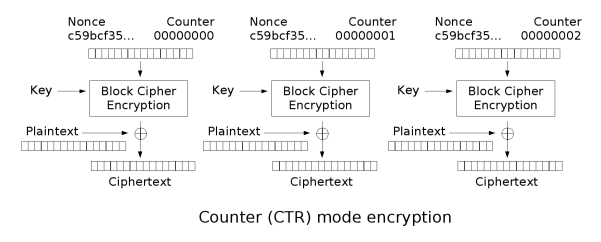
The Ideal Cipher Model (wonky)

A friend who’s learning cryptography writes with a few questions about block ciphers:

(1) Let’s say we’re using AES-128 — 128 bit keys, 128 bit blocks.

  • For a given 128 bit block of plaintext “P” – if I was to iterate through all 2**128 key permutations and encrypt the same plaintext P with each key, would the outputs all be unique, or would there be collisions?
  • For a given 128 bit key “K”, if I was to use K to encrypt every possible (2**128) plaintext, would the outputs all be unique, or would there be collisions?
These are all reasonable questions with simple answers. But I’m not going to give them. Why bother with two simple answers when we can give one really complicated intuition?

What’s Claude Shannon got to do with it?

Back in the late 1940s when people were still thinking on this whole information theory business, a gentleman named Claude Shannon came up with a model for what a block cipher should do. His idea was — and yes, I’m embellishing a lot here — that an ‘ideal’ block cipher would work kind of like a magical elf.*

You could ask the elf to encipher and decipher things for you. But instead of using a mathematical algorithm, it would just keep a blackboard with a big table. The table would have three columns (Key, Plaintext, Ciphertext), and it would start off empty.

When you asked the elf to encipher a plaintext P under a key K, it would do the following:
  1. Check to see if (K, P) were already recorded in some row of the table. If they were, it would read off the corresponding ciphertext value C from the same row, and return C.
  2. If no matching row was found, it would generate a perfectly random ciphertext C.
  3. It would then check for an existing table entry containing the same key and ciphertext (K, C). If this entry was found in the table, it would throw C away and repeat step (2).
  4. Otherwise it would add (K, P, C) to the table and return C to the caller.

Now I realize this looks complicated, but if you think about this for a little while you’ll realize that this little thought experiment does ‘work’ a lot like a real block cipher.

Just like a block cipher, it will always give the same output when you pass it a given key and plaintext. Furthermore — for a given key K, no two plaintexts will ever encipher to the same ciphertext. This models the fact that a block cipher is a permutation.

Lastly, the output of the encipherment is very ‘random’ — in the sense that it’s intuitively not linked to the input. Calling the cipher on different inputs should produce values that are very much unrelated.

Of course, you also need the elf to decipher stuff as well. Decipherment works mostly like the process above. When you ask to decipher (K, C), it checks to see whether the given key and ciphertext are already in the table (i.e., they were previously enciphered). If so it looks up and returns the corresponding plaintext. Otherwise it generates a new random plaintext, makes sure it hasn’t previously appeared in the table with that key, and returns the result.

Under the assumption that AES works like our elf, we can now answer my friend’s questions. Clearly if I encrypt the same plaintext with many different keys, I will get many different ciphertexts. They’ll each be random and 128 bits long, which means the probability of any two ciphertexts being the same (colliding) is quite small. But there’s no rule preventing it, and over a large enough set it’s actually quite likely.

Similarly, the second question is answered by the fact that the cipher is a permutation, something that’s captured in our elf’s rule (3).

This is an awful lot of work to answer a few simple questions…

Yes, it certainly is. But the ‘Elf’ model is useful for answering much more interesting questions — like: is a given encryption scheme secure?

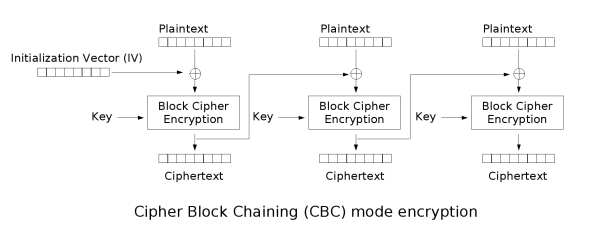
For example, take the CBC mode of operation, which is a way to turn a block cipher into an encryption scheme:

CBC encryption takes in a random key (K) and a random ‘Initialization Vector’ (IV), both of which are chosen by the encryptor. Now let’s see what happens if we CBC-encrypt an N-block message using our elf.

  1. The encryptor XORs the first plaintext block with the (random) Initialization Vector (IV), which should give a randomly-distributed value. We’ll call this P’.
  2. He then sends (K, P’) to be enciphered by the elf. Since the elf has never seen (K, P’) — meaning it’s not in the table — it will generate a random value (C1), which will become the first ciphertext block.
  3. The encryptor now XORs the next plaintext block with C1, which again should yield a randomly-distributed value which we’ll call P”.
  4. He sends (K, P”) to be enciphered by the elf. Since P” is also random (and, say, 128 bits long), the probability that it’s already in the table is astronomically low. Thus with high probability the elf will again generate a random value (C2), which becomes the second ciphertext block.
  5. He then repeats steps (3) and (4) for all the remaining blocks.
Note that with overwhelming probability — and unless you encrypt really long ciphertexts** — the elf will generate a random value for each ciphertext block. Hence the entire ciphertext will consist of a random string, which means it really shouldn’t leak anything about the message (except for the length).

Of course, an attacker might also talk to the elf to try to learn something about the message. But note that even this attack isn’t useful unless he can guess the (random) key K, since the elf will give him random results unless he asks for a value that includes K. Since K is a randomly-chosen secret key, the attacker should not be able to guess it.

Do ideal ciphers exist?

Now all of this is well and good, but it leaves us with an important question: is AES actually as good as an ideal cipher? Unfortunately, the resounding answer to this question is no.

The problem here is that ideal ciphers are totally unworkable. Obviously we can’t have an actual elf randomly filling in a bulletin board as we encrypt things. I want to carry a copy of the block cipher around with me (in software or hardware). I also want my copy of the cipher to be consistent with your copy, so that I can send you messages and you can decrypt them.

To make the elf idea work, we would each need to carry around a copy of the elf’s table that’s completely filled in from the start — meaning it would already contain entries for every possible plaintext (resp. ciphertext) and key I might ever need to encipher/decipher. When you consider that there would be 2^128 rows just for a single key, you realize that, no, this is not a question of running out to Best Buy and picking up some more SD cards. It’s fundamentally hard.

So carrying ideal ciphers around is not possible. The question then is: is there something that’s as good as an ideal cipher, without requiring us to carry around an exponentially-sized table.

The answer to that question is a mixed bag. The bad news is that nothing really works as well as an ideal cipher. Worse yet, there exists schemes that would be provably secure with an ideal cipher, but would fail catastrophically if you implemented them with any real block cipher. So that sucks.

On the other hand, those are theoretical results. Unless you’re doing some very specific things, the ideal cipher model is a moderately helpful tool for understanding what block ciphers are capable of. It’s also a good jumping off point for understanding the real proofs we actually use for modes like CBC. These proofs use more ‘realistic’ assumptions, e.g., that the block cipher is a pseudorandom permutation.

But those proofs will have to wait for another time. I’ve reached my wonkery limit for today.

Notes:

* For the record, at no point did Claude Shannon ever refer to an ‘elf’. At least not in writing.

** The probability of a ‘collision’ (i.e., asking the elf to encipher a value that’s already been enciphered) goes up as you put encipher more blocks. At a certain point (for AES, close to 2^64 blocks) it becomes quite high. Not coincidentally, this roughly coincides with the number of blocks NIST says you should encrypt with CBC mode.

Why I hate CBC-MAC

If you’re like most people, you don’t have a strong opinion about CBC-MAC. In fact, if you’re like most people, you don’t have a strong opinion about any crypto primitive.

This is healthy. Keep up the good work.

I’m not most people. I’ve spent the last week thinking about and dealing with CBC-MAC — or more specifically, code that uses it in various contexts — and I need to share with you how much I despise this little algorithm. And beg you never to use it.

Oh yes, I know the temptation. You have this nice block cipher just sitting around — maybe you’re encrypting something — and you’ve heard how serious this whole message authentication thing is. Maybe you’ve even thought about using one of those fancy authenticated encryption modes, but found them to be too exotic and complicated.

Then it comes to you that all your problems would be solved if you just used CBC-MAC. This is too bad, because now your troubles are just beginning.

Now a quick note: there’s nothing really wrong with CBC-MAC, when implemented correctly. And it’s not even that hard to implement properly. The problem is that many people who use CBC-MAC (rather than HMAC or a proper AEAD mode) seem incapable of actually doing this. They get it wrong in hilariously, embarassingly, stupid, complicated ways.

But of course you wanted examples. Ok, let’s give some.

1. Your implementation doesn’t handle variable-length messages.

A quick reminder. CBC-MAC is very similar to the classic CBC mode for encryption, with a few major differences. First, the Initialization Vector (IV) is a fixed value, usually zero. Second, CBC-MAC only outputs the last block of the ciphertext — this single value forms the MAC.

Many dumb implementations stop here. And that leads to big problems.

Most notably, if your system allows for variable-length messages — as it should — there is a simple attack that allows you to forge new messages. First, get a MAC T on a message M1. Now XOR the tag T into the first block of some arbitrary second message M2, and get a MAC on the modified version of M2.

The resulting tag T’ turns out to be a valid MAC for the combined message (M1 || M2). This is a valid forgery, and in some cases can actually be useful.

The standard fix to prepend the message length to the first block of the message before MACing it. But a surprisingly large number of (dumb) implementations skip this extra step. And many CBC-MAC implementations are dumb implementations.

2. Your implementation uses a random Initialization Vector.

If CBC-MAC with a fixed IV is great, surely CBC-MAC with a random IV must be super-great. But no, it isn’t.

Using a random (or variable IV) is bad for the simple reason that verifying a CBC-MAC requires you to know the IV, and to know the IV you probably need to read it from somewhere. Typically this means the same untrusted place where you were storing your message.

If the attacker can change the CBC-MAC IV, they can also change the first block of the MACed message in an equivalent manner. This works because the first step of CBC-MAC is to XOR the IV with the message. There are all kinds of silly variants of this problem, and all of them hurt.

3. You’ve used the same key for MAC and encryption.

A general rule in cryptography is that you shouldn’t use the same key for two different cryptographic primitives — encryption and signature, for example. Or encryption and MAC.

Some people figure that rules were made to be broken.

Note that shared keys can actually be ok, in some cases. Combined modes like CCM (short for CTR + CBC-MAC) actually do use the same key for both operations. However, these modes do it in a very careful, thoughtful manner. Your garden-variety implementation doesn’t.

One particularly ugly pattern I’ve seen is to use (dumb) CBC-MAC on a plaintext, then to encrypt said plaintext in CTR mode using some initial counter (C). This is insecure for a bunch of reasons, but specifically because I might be able to completely decrypt your ciphertext.

To do this, I simply ask you to encrypt a series of small files corresponding to the counter values C, C+1, etc. of the ciphertext I want to attack. The CBC-MAC of each of these files lets me recreate the CTR-mode keystream I need to decrypt the original ciphertext. Now I have your message.

4. You’ve used CBC-MAC as a hash function.

This one isn’t really a problem with CBC-MAC, but it does crop up. In fact, it happened recently to the file sharing site Mega.

To make a long story short: cryptographic hash functions are public functions (i.e., no secret key) that have the property of collision-resistance (it’s hard to find two messages with the same hash). MACs are keyed functions that (typically) provide message unforgeability — a very different property. Moreover, they guarantee this only when the key is secret.

If you attempt to use CBC-MAC with a non-secret key, it becomes a very bad candidate for anything. In fact, you can trivially find useful collisions in the output, something that’s very bad if you’re using it to authenticate code. Which is what Mega was doing with it.

This isn’t true of all MACs — HMAC, for example, should retain the collision resistance of the underlying hash function even if the MAC key is compromised. This is yet another reason to prefer it for cases where cryptographic expertise is not a sure bet.

In summary

I’ll repeat that none of these are really problems with CBC-MAC, which is a perfectly lovely algorithm if implemented and used correctly. The problems above only crop up when people try to whip it up themselves, without using a standard construction.

If you must write your own code, my recommendation is to use HMAC — which is extremely hard to screw up. If you’re doing combined encryption/MAC and you only have a block cipher, then look into the CCM spec, which is a patent free AEAD mode. This should address all of these problems and give you some nice test vectors too.

What you shouldn’t do is code up some half-assed CBC-MAC thing and expect you’ll be ok. The fact is, you probably won’t.

Indifferentiability

After umpteen weeks writing about broken stuff, I’m thrilled to tell you that for once, nothing awful is happening in the crypto world. It won’t last. But while it does, let’s grab the opportunity to talk about something constructive. 

Now a word of warning: what I’m going to talk about today is fairly wonky and (worse), involves hash functions. If you’re not feeling up for this, this is your cue to bail and go read something nice about buffer overflows.

For those still with me, the subject of this post is the design of hash functions, and more specifically: the indifferentiability proofs that designers write to argue for their security. I was surprised to find that most people have never heard of these proofs, and thus have no idea why they’re useful. That’s too bad, since they’re extremely important to the way we analyze hash functions today.

Merkle-Damgård

This is not Ivan Damgård. (Seriously Google?)

The best way to begin any discussion of hash function design is to take a quick peek inside of the hash functions we actually use. Since the most popular hashes today are MD5 (ugh) and SHA, the right place to start is with the ‘Merkle-Damgård’ paradigm.

To understand Merkle-Damgård, you need to understand that cryptographers love to build complicated things out of simpler components. Under the hood of most block ciphers you’ll find S-boxes. Similarly, if you take the lid off a Merkle-Damgård hash function — surprise! — you find block ciphers. Or at least, something very much like them.

This approach dates to a 1979 proposal by a young cryptographer named Ralph Merkle. What Merkle showed is a way to build hash functions with a variable-length input, using any fixed one-way compression function (a one-way function that spits out fewer bits than it takes in). While Merkle wasn’t specific about the function, he suggested that DES might be a good candidate.

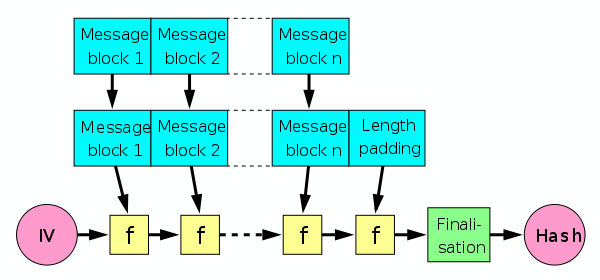
Expressed as a colorful diagram, the Merkle construction looks something like this:

Merkle-Damgård Construction (source: Wikipedia because I’m too lazy to
draw my own diagrams). IV is a fixed value. f is a one-way compression function.

The beauty of Merkle’s proposal is that it’s relatively simple to understand. You simply chop your message into blocks, then feed each block into the function f along with the output of the previous function evaluation. Throw in a finalization stage and you’re done.

Of course there’s a difference between proposing a technique and showing that it actually works. It would take ten more years, but at CRYPTO 1989, Merkle and another cryptographer named Ivan Damgård independently submitted formal analyses of Merkle’s proposal. What they showed is that as long as the function f has certain ideal properties, the resulting hash function is guaranteed to be collision-resistant.  The rest, as they say, is history.

The popularity of Merkle-Damgård can be attributed in part to its security proof. But it also owes something to some major practical advantages:

  1. You can use any secure block cipher as the function f, with just a few tweaks.
  2. M-D hash functions can be pretty darn fast, again depending on f and how you use it.
  3. M-D hashes allow you to digest ‘live’ data streams, where you don’t know in advance how much data you’re going to be hashing. 
Of course, Merkle-Damgård hashes also have serious weaknesses. The most famous is the ‘length extension attack‘ in which an attacker, given only H(M) for some unknown message M, can ‘tack on’ additional blocks of her own choosing. This issue spells big trouble for people who think that H(key || message) is a good Message Authentication CodeWhat’s interesting about the length-extension issue is not that it leads to broken MACs. I mean, that is interesting, and it’s why you should use HMAC. But what’s really interesting is that this flaw doesn’t represent a violation of the collision-resistance guarantee. The two issues are in fact completely orthogonal. And this tells us something fundamental. Namely: collision-resistance is not enough.Today’s implementers do all kinds of crazy things with hash functions, and many of those applications require much more than collision-resistance. To achieve the necessary properties, we first need to figure out what they are. And that requires us to think hard about the following question:

What the heck is a secure hash function?

If you crack a typical security textbook (or visit the Wikipedia page on hash functions), you’ll see a long list of things of things a hash function ‘must’ accomplish. The list usually starts with these:
  1. Collision resistance. It should be hard to find any pair of messages M1, M2 such that H(M1) == H(M2).
  2. Pre-image resistance. Given only h it should be hard to find a ‘pre-image’ M2 such that H(M2) == h.

Now leave aside the technical fact that none of the unkeyed hash functions we use today are ‘truly’ collision-resistant. Or that the above definition of pre-image resistance implies that I can hash my cat’s name (‘fluffy’) and nobody can invert the hash (note: not true. Go ask LinkedIn if you don’t believe me.) The real problem is that these definitions don’t cover the things that people actually do with hash functions.

For example, take the construction of PRNGs. A common PRNG design hashes together large pools of gathered entropy in the hope that the result will be sufficiently uniform for cryptographic work. This is so common that it’s probably happening somewhere on your computer right now. And yet, absolutely nothing in the definitions above implies that this technique is safe!* Similar problems exist for key derivation functions, and even for signature schemes like ECDSA which clearly require hash functions that are more than just collision-resistant.
The more you look into the way that people use hash functions, the more you realize that they really need something that produces ‘random-looking’ output. Unfortunately, this notion is surprisingly hard to formalize. Hash functions are unkeyed, so they’re not pseudo-random functions. What in the world are people asking for?

Random oracles and indifferentiability

The answer, if you dig hard enough, is that people want hash functions to be random oracles.

Random oracles are cryptographers’ conception of what an ‘ideal’ hash function should be. Put succinctly, a random oracle is a perfectly random function that you can evaluate quickly. Random functions are beautiful not just because the output is random-looking (of course), but also because they’re automatically collision-resistant and pre-image resistant. It’s the only requirement you ever need.

The problem with random functions is that you just can’t evaluate them quickly: you need exponential storage space to keep them, and exponential time to evaluate one. Moreover, we know of nothing in the ‘real’ world that can approximate them. When cryptographers try to analyze their schemes with random functions, they have to go off into an imaginary fantasy world that we call the ‘random oracle model.

But ok, this post is not to judge. For the moment, let’s imagine that we are willing to visit this fantasy world. An obvious question is: what would it take to build a random oracle? If we had a compression function that was good enough — itself a random function — could we use a technique like Merkle-Damgård to get the rest of the way?

In 2004, Maurer, Renner and Holenstein gave us a powerful tool for answering this question. What they showed is that it’s always possible to replace functionality A (e.g., a random oracle) with another functionality B (e.g., an ideal compression function) provided that the following rules are satisfied:

  1. There exists a way to ‘construct’ something ‘like’ A out of B.
  2. There exists a way to ‘simulate’ something ‘like’ B using A.
  3. An attacker who interacts with {constructed A-like thing, B} cannot tell the difference (i.e., can’t differentiate it) from {A, simulated B-like thing}

The definition of simulation gets a bit wonky. but expressed in simpler language all this means is: if you can show that your hash function, instantiated with an ‘ideal’ compression function, looks indistinguishable from a random oracle. And you can show that a manufactured compression function, built using a random oracle as an ingredient, looks indistinguishable from an ideal compression function, then you can always replace one with the other. That is, your hash function is ‘good enough’ to be a random oracle.

The following year, Coron, Dodis, Malinaud and Puniya applied this framework to Merkle-Damgård-hash functions. Their first result was immediate: such a proof does not work for Merkle-Damgård. Of course this shouldn’t actually surprise us. We already know that Merkle-Damgård doesn’t behave like a random oracle, since random oracles don’t exhibit length-extension attacks. Still it’s one thing to know this, and another to see a known problem actually turn up and screw up a proof. So far, no problem.

What Coron et al. showed next is much more interesting:
  • They proved formally that Merkle-Damgård can be made indifferentiable from a random oracle, as long as you apply a prefix-free encoding to the input before hashing it. Prefix-free encodings prevent length-extensions by ensuring that no message can ever be a prefix of another.
  • Next, they proved the security of HMAC applied to a Merkle-Damgård hash.
  • Finally, and best of all, they showed that if you simply drop some bits from the last output block — something called a ‘chop’ construction — you can make Merkle-Damgård hashes secure with much less work.

The best part of Coron et al.‘s findings is that the chop construction is already (inadvertently) in place on SHA384, which is constructed by dropping some output bits from its big-brother hash SHA512. The modern hash variants SHA512/224 and SHA512/256 also have this property.** So this theoretical work already has one big payoff: we know that (under certain assumptions) these hashes may be better than some of the others.

And these results have bigger implications. Now that we know how to do this, we can repeat the process for just about every candidate hash function anyone proposes. This lets us immediately weed out obvious bugs, and avoid standardizing another hash with problems like the length extension attack. This process has become so common that all of the SHA3 candidates now sport exactly such an indifferentiability proof.

Of course, in the real world, indifferentiability only takes you so far. It does tell us something, but it doesn’t tell us everything. Sure, if the compression function is perfect, you obtain a strong result about the hash function. But compression functions are never perfect. Real compression functions have glitches and oddities that can make these theoretical results irrelevant. This is why we’ll always need smart people to arm wrestle over which hash we get to use next.

In conclusion

If I had it in me, I’d go on to talk about the SHA3 candidates, and the techniques that each uses to achieve security in this model. But this has already been a long post, so that will have to wait for another time.

I want to say only one final thing.

This is a practical blog, and I admit that I try to avoid theory. What fascinates me about this area is that it’s a great example of a place where theory has directly come to the aid of practice. You may think of hash functions as whizzing little black boxes of ad-hoc machinery, and to some extent they are. But without theoretical analysis like this, they’d be a whole lot more ad-hoc. They might not even work.

Remember this when NIST finally gets around to picking Keccak BLAKE.

Notes:

* For a ridiculous example, imagine that you have a secure (collision-resistant, pre-image resistant) hash function H. Now construct a new hash function H’ such that H'(M) = {“long string of 0s” || H(M)}. This function is as collision-resistant as the original, but won’t be very useful if you’re generating keys with it.

** Thanks to Paulo Barreto for fixing numerous typos and pointing out that SHA512/256 and /224 make excellent candidates for chop hashes!

How to choose an Authenticated Encryption mode

If you’ve hung around this blog for a while, you probably know how much I like to complain. (Really, quite a lot.) You might even be familiar with one of my favorite complaints: dumb crypto standards. More specifically: dumb standards promulgated by smart people.

The people in question almost always have justifications for whatever earth-shakingly stupid decision they’re about to take. Usually it’s something like ‘doing it right would be hard‘, or ‘implementers wouldn’t be happy if we did it right‘. Sometimes it’s ‘well, we give the option to do it right‘. In the worst case they’ll tell you: ‘if it bothers you so much, why don’t you join the committee and suggest that idea yourself, Mr. Smartypants‘.

Well, first of all, it’s Dr. Smartypants. And moreover, I’ve tried. It doesn’t work.

Case in point: I happen to be lurking on the mailing list of a standards committee that recently decided to allow unauthenticated CBC mode encryption as an option in their new web encryption standard. When I pointed out that the exact same decision led to the failure of a previous standard — ironically, one that this new standard will probably replace — I was told, politely, that:

  1. Mandating authenticated encryption would be hard.
  2. Real implementers don’t know how to implement it.
  3. We already offer the option to use authenticated encryption.
  4. Stop telling us things we already know.

The worst part: they really did know. The committee included some smart, smart people. People who know that this is a bad idea, and who have decided either to just go with it, or else have convinced themselves that implementers won’t (a) pick the easy, insecure option, and then (b) screw it up completely. I have news for these people: Yes, they will. This is why we write standards.

After all this build-up, it may surprise you that this is not a post about standards committees. It’s not even a post about smart people screwing things up. What I’m here to talk about today is Authenticated Encryption, what the hell it is, why you need it. And finally, (assuming you’re good with all that) which of the many, many AE schemes should you consider for your application.
First, some background.

What’s Authenticated Encryption and why should I care?

For those of you who don’t know what AE is, I first need to explain one basic fact that isn’t well explained elsewhere:

Nearly all of the symmetric encryption modes you learned about in school, textbooks, and Wikipedia are (potentially) insecure.

This covers things like AES when used in standard modes of operation like CBC and CTR. It also applies to stream ciphers like RC4. Unfortunately, the list of potentially insecure primitives includes many of the common symmetric encryption schemes that we use in practice.

Now, I want to be clear. These schemes are not insecure because they leak plaintext information to someone who just intercepts a ciphertext. In fact, most modern schemes hold up amazingly well under that scenario, assuming you choose your keys properly and aren’t an idiot.

The problem occurs when you use encryption in online applications, where an an adversary can intercept, tamper with, and submit ciphertexts to the receiver. If the attacker can launch such attacks, many implementations can fail catastrophically, allowing the attacker to completely decrypt messages.

Sometimes these attacks requires the attacker to see only an error message from the receiver. In other cases all he needs to do is measure time it takes for the receiver to acknowledge the submission. This type of attack is known as a chosen ciphertext attack, and by far the most common embodiment is the ‘padding oracle attack‘ discovered in 2002 by Serge Vaudenay. But there are others.

The simplest way to protect yourself against these attacks is to simply MAC your ciphertexts with a secure Message Authentication Code such as HMAC-SHA. If you prefer this route, there are two essential rules:

  1.  Always compute the MACs on the ciphertext, never on the plaintext.
  2.  Use two different keys, one for encryption and one for the MAC.

Rule (1) prevents chosen-ciphertext attacks on block cipher modes such as CBC, since your decryption process can reject those attacker-tampered ciphertexts before they’re even decrypted. Rule (2) deals with the possibility that your MAC and cipher will interact in some unpleasant way. It can also help protect you against side-channel attacks.

This approach — encrypting something, then MACing it — is not only secure, it’s provably secure as long as your encryption scheme and MAC have certain properties. Properties that most common schemes do seem to possess.*

Dedicated AE(AD) modes

Unfortunately, the ‘generic composition’ approach above is not the right answer for everyone. For one thing, it can be a little bit complicated. Moreover, it requires you to implement two different primitives (say, a block cipher and a hash function for HMAC), which can be a hassle. Last, but not least, it isn’t necessarily the fastest way to get your messages encrypted.

The efficiency issue is particularly important if you’re either (a) working on a constrained device like an embedded system, or (b) you’re working on a fast device, but you just need to encrypt lots of data. This is the case for network encryptors, which have to process data at line speeds — typically many gigabytes per second!

For all of these reasons, we have specialized block cipher modes of operation called Authenticated Encryption (AE) modes, or sometimes Authenticated Encryption with Associated Data (AEAD). These modes handle both the encryption and the authentication in one go, usually with a single key.

AE(AD) modes were developed as a way to make the problem of authentication ‘easy’ for implementers. Moreover, some of these modes are lightning fast, or at least allow you to take advantage of parallelization to speed things up.

Unfortunately, adoption of AE modes has been a lot slower than one would have hoped for, for a variety of reasons. One of which is: it’s hard to find good implementations, and another is that there are tons and tons of AE(AD) schemes.

So, which AE mode should I choose?

And now we get down to brass tacks. There are a plethora of wonderful AE(AD) modes out there, but which one should you use? There are many things to consider. For example:

  • How fast is encryption and decryption?
  • How complicated is the implementation?
  • Are there free implementations out there?
  • Is it widely used?
  • Can I parallelize it?
  • Is it ‘on-line’, i.e., do I need to know the message length before I start encrypting?
  • Is it patented?
  • Does it allow me to include Associated Data (like a cleartext header)?
  • What does Matt Green think about it?

To answer these questions (and particularly the most important final one), let’s take a look at a few of the common AE modes that are out there. All of these modes support Associated Data, which means that you can pre-pend an unencrypted header to your encrypted message if you want. They all take a single key and some form of Initialization Vector (nonce). Beyond that, they’re quite different inside.

GCM. Galois Counter Mode has quietly become the most popular AE(AD) mode in the field today, despite the fact that everyone hates it. The popularity is due in part to the fact that GCM is extremely fast, but mostly it’s because the mode is patent-free. GCM is ‘on-line’ and can be parallelized, and (best): recent versions of OpenSSL and Crypto++ provide good implementations, mostly because it’s now supported as a TLS ciphersuite. As a side benefit, GCM will occasionally visit your house and fix broken appliances.

Given all these great features, you might ask: why does everyone hate GCM? In truth, the only people who hate GCM are those who’ve had to implement it. You see, GCM is CTR mode encryption with the addition of a Carter-Wegman MAC set in a Galois field. If you just went ‘sfjshhuh?’, you now understand what I’m talking about. Implementing GCM is a hassle in a way that most other AEADs are not. But if you have someone else’s implementation — say OpenSSL’s — it’s a perfectly lovely mode.

OCB. In performance terms Offset Codebook Mode blows the pants off of all the other modes I mention in this post. It’s ‘on-line’ and doesn’t require any real understanding of Galois fields to implement** — you can implement the whole thing with a block cipher, some bit manipulation and XOR. If OCB was your kid, he’d play three sports and be on his way to Harvard. You’d brag about him to all your friends.

Unfortunately OCB is not your kid. It belongs to Philip Rogaway, who also happens to hold a patent on it. This is no problem if you’re developing GPL software (it’s free for you), but if you want to use it in a commercial product — or even license under Apache — you’ll probably have to pay up. As a consequence OCB is used in approximately no industry standards, though you might find it in some commercial products.

EAX. Unlike the other modes in this section, EAX mode doesn’t even bother to stand for anything. We can guess that E is Encryption and A is Authentication, but X? I’m absolutely convinced that EAX is secure, but I cannot possibly get behind a mode of operation that doesn’t have a meaningful acronym.

EAX is a two-pass scheme, which means that encryption and authentication are done in separate operations. This makes it much slower than GCM or OCB, though (unlike CCM) it is ‘on-line’. Still, EAX has three things going for it: first, it’s patent-free. Second, it’s pretty easy to implement. Third, it uses only the Encipher direction of the block cipher, meaning that you could technically fit it into an implementation with a very constrained code size, if that sort of thing floats your boat. I’m sure there are EAX implementations out there; I just don’t know of any to recommend.

Whatever you do, be sure not to confuse EAX mode with its dull cousin EAX(prime), which ANSI developed only so it could later be embarrassingly broken.

CCM. Counter Mode with CBC MAC is the 1989 Volvo station wagon of AEAD modes. It’ll get you to your destination reliably, just not in a hurry. Like EAX, CCM is also a two-pass scheme. Unfortunately, CCM is not ‘on-line’, which means you have to know the size of your message before you start encrypting it. The redeeming feature of CCM is that it’s patent-free. In fact, it was developed and implemented in the 802.11i standard (instead of OCB) solely because of IP concerns. You can find an implementation in Crypto++.

The rest. There are a few more modes that almost nobody uses. These include XCBC, IAPM and CWC. I have no idea why the first two haven’t taken off, or if they’re even secure. CWC is basically a much slower version of GCM mode, so there’s no real reason to use it. And of course, there are probably plenty more that I haven’t listed. In general: you should use those at your own risk.

Summing up

So where are we?

In general, the decision of which cipher mode to use is not something most people make every day, but when you do make that decision, you need to make the right one. Having read back through the post, I’m pretty sure that the ‘right’ answer for most people is to use GCM mode and rely on a trusted free implementation, like the one you can get from OpenSSL.

But there are subcases. If you’re developing a commercial product, don’t care about cross-compatibility, and don’t mind paying ‘a small one-time fee‘, OCB is also a pretty good option. Remember: even cryptographers need to eat.

Finally, if you’re in the position of developing your own implementation from scratch (not recommended!) and you really don’t feel confident with the more complicated schemes, you should serious consider EAX or CCM. Alternatively, just use HMAC on your ciphertexts. All of these things are relatively simple to deal with, though they certainly don’t set the world on fire in terms of performance.

The one thing you should not do is say ‘gosh this is complicated, I’ll just use CBC mode and hope nobody attacks it’, at least not if you’re building something that will potentially (someday) be online and subject to active attacks like the ones I described above. There’s already enough stupid on the Internet, please don’t add more.

Notes:

* Specifically, your encryption scheme must be IND-CPA secure, which would apply to CBC, CTR, CFB and OFB modes implemented with a secure block cipher. Your MAC must be existentially unforgeable under chosen message attack (EU-CMA), a property that’s (believed) to be satisfied by most reasonable instantiations of HMAC.

** An earlier version of this post claimed that OCB didn’t use Galois field arithmetic. This commenter on Reddit correctly points out that I’m an idiot. It does indeed do so. I stand by my point that the implementation is dramatically simpler than GCM.

Wonk post: Circular security

Apologies in advance for a super-wonky post, but I’m in kind of a wonky mood this week. It happens that I’m putting together a talk on the subject of circular security, and I figured this blog might be a good place to get my thoughts together.

If you’ve never heard of circular security, don’t feel bad — you’re in good company. In a nutshell, circular security describes the way that an encryption scheme behaves when you ask it to encrypt its own key. In theory, that behavior can be pretty unpredictable.

The key word in the previous sentence is ‘theory’. Circular security is a very interesting research area, but if your primary reason for reading this blog is to learn about practical things, this post may not be for you. (Though please come back next week, when I hope to be writing about electronic cash!)

Assuming you’re still reading, the first order of business is to talk about what circular security (or insecurity) is in the first place. To do that, we need to define what it means for an encryption scheme to be ‘secure’. And that means a discussion of semantic security.

Semantic Security

Semantic security is one of the earliest and most important security definitions in our field. It’s generally considered to be the minimum bar for any modern ‘secure’ encryption scheme. In English, the informal definition of semantic security is something like this:

An attacker who sees the encryption of a message — drawn from a known, or even chosen message space — gains approximately the same amount of information as they would have obtained if they didn’t see the encryption in the first place. (The one exception being the length of the message.)

This is a nice, intuitive definition since it captures what we really want from encryption.

You see, in an ideal world, we wouldn’t need encryption at all. We would send all of our data via some sort of magical, buried cable that our adversary couldn’t tap. Unfortunately, in the real world we don’t have magical cables: we send our data via the public WiFi at our neighborhood Starbucks.

Semantic security tells us not to worry. As long as we encrypt with a semantically-secure scheme, the adversary who intercepts our encrypted data won’t learn much more than the guy who didn’t intercept it at all — at worst, he’ll learn only the amount of data we sent. Voila, security achieved.

(Now, just for completeness: semantic security is not the strongest definition we use for security, since it does not envision active attacks, where the adversary can obtain the decryption of chosen ciphertexts. But that’s a point for another time.)

Unfortunately, before we can do anything with semantic security, we need to turn the English-language intuition above into something formal and mathematical. This is surprisingly complicated, since it requires us to formalize the notion of ‘an attacker gains approximately the same amount of information‘. In the early definitions this was done by making grand statements about predicate functions. This approach is faithful and accurate. It’s also kind of hard to do anything with.

Fortunately there’s a much simpler, yet equivalent way to define semantic security. This definition is called ‘indistinguishability under chosen plaintext attack‘, or IND-CPA for short. IND-CPA is described by the following game which is ‘played’ between an adversary and some honest party that we’ll call the challenger:

  1. The challenger generates a public/private keypair, and gives the public key to the adversary.
  2. The adversary eventually picks two equal-length messages (M0, M1) from the set of allowed plaintexts, and sends them to the challenger.
  3. The challenger flips a coin, then returns the encryption of one of the messages under the public key.
  4. The attacker tries to guess which message was encrypted. He ‘wins’ if he guesses correctly.

(This game can also be applied to symmetric encryption. Since there’s no public key in a symmetric scheme, the challenger makes up the lost functionality by providing an encryption oracle: i.e., it encrypts messages for the adversary as she asks for them.)

A quick glance at the game should convince you that even a moron adversary can win this game. In fact, if the adversary simply guesses randomly he’ll be right exactly half the time. Hence the real question is: how much better can he do?

And that leads us to our (basically) formal definition:

A scheme is IND-CPA secure if no adversary can win the above game with probability (significantly) greater than 1/2.

The term ‘significantly’ in this case hides a lot of detail — typically it means that ‘non-negligibly‘. In many schemes we also require the adversary to run in limited time (i.e., be a probabilistic polynomial-time Turing machine). But details, details…

Encrypting your own key

One of the weirder aspects of the IND-CPA definition above is that it doesn’t handle a very basic (and surprisingly common!) use case: namely, cases where you encrypt your own secret key.

Believe it or not, this actually happens. If you use a disk encryption system like Bitlocker, you maybe already be encrypting your own keys, without even noticing it. Moreover, newer schemes like Gentry’s Fully Homomorphic Encryption depend fundamentally on this kind of “circular” encryption.

It seems surprising that IND-CPA can give us such a strong notion of security — where the attacker learns nothing about a plaintext — and yet can’t handle this very simple case. After all, isn’t your secret key just another message? What makes it special?

The technical answer to this question hangs on the fact that the IND-CPA game above only works  with messages chosen by the adversary. Specifically, the adversary is asked to attack the encryption of either M0 or M1, which he chooses in step (2). Since presumably — if the scheme is secure — the adversary doesn’t know the scheme’s secret key, he won’t be able to submit (M0,M1) such that either message contains the scheme’s secret key. (Unless he makes a lucky guess, but this should happen with at most negligible probability.)

What this means is that an encryption scheme could do something terribly insecure when asked to encrypt its own secret key. For example, it could burp out the secret key without encrypting it at all! And yet it would still satisfy the IND-CPA definition. Yikes! And once you raise the possibility that such a scheme could exist, cryptographers will immediately wants to actually build it.

(This may seem a little perverse: after all, aren’t there enough broken schemes in the world without deliberately building more? But when you think about it, this kind of ‘counterexample’ is extremely valuable to us. If we know that such oddball, insecure schemes can exist, that motivates to watch out for them in the real constructions that we use. And it tells us a little about the strength of our definitions.)

It turns out that there’s a ‘folklore’ approach that turns any IND-CPA secure public-key encryption scheme into one that’s still IND-CPA secure, but is also totally insecure if it ever should encrypt its own secret key.

The basic approach is to modify the original scheme by changing the encryption algorithm as follows:

  1. On input a public key and a message to be encrypted, it tests to see if the message is equal to the scheme’s secret key.*
  2. If not, it encrypts the message using the original scheme’s encryption algorithm (which, as we noted previously, is IND-CPA secure).
  3. If the message is equal to the secret key, it just outputs the secret key in cleartext.
It’s pretty easy to see that this scheme is as secure as the original scheme for messages that aren’t the secret key. It’s also easy to see that it’s totally insecure when you do encrypt the actual secret key. (Though I’ve glossed over a small technical challenge in step 2, see footnote*).

Circles and cycles

Just as cryptographers were congratulating each other for answering the previous question — showing that there are schemes that fail catastrophically when they encrypt their own secret key — some smartass decided to up the stakes.

The question (s)he asked was: what if two people encrypt each other’s secret keys?

Let’s be clear what I’m saying here. Imagine that Alice decides to entrust Bob with her secret key, so she wraps it up under his public key (say, sending him a PGP encrypted email). And imagine that Bob decides to do exactly the same with his key, encrypting it under Alice’s public key. We now have the following ‘key cycle’:

CA = Encrypt(pkA, skB),               CB = Encrypt(pkB, skA)

To be clear, IND-CPA by itself tells us that it’s perfectly secure for Alice to encrypt her own key under Bob’s key (or vice versa). There’s no problem there. However, the minute Bob also encrypts Alice’s secret key, a cycle is formed — and semantic security doesn’t tell us anything about whether this is secure.

So this is worrisome in theory, but are there actual schemes where such cycles can cause problem?

Up until 2010, the answer was: no. It turns out to be much harder to find a counterexample for this case, since the approach described in the previous section doesn’t work. You can’t just hack a little bit of code into the encryption algorithm; the ciphertexts are encrypted independently. At the time they’re encrypted, the ciphertexts are perfectly secure. They only become insecure when they come into close proximity with one another.

(If a weird analogy helps, think of those encrypted keys like two hunks of Plutonium, each inside of its own briefcase. As long as they’re apart, everything’s fine. But get them close enough to one another, they interact with one another and basically ruin your whole day.)

It gets worse

A breakthrough occurred at Eurocrypt 2010, where Acar, Belenkiy, Bellare and Cash showed that indeed, there is a scheme that’s perfectly IND-CPA secure in normal usage, but fails when Alice and Bob encrypt their keys in a cycle like the one described above.

The Acar et al. scheme is based on certain type of elliptic-curve setting known as bilinear SXDH, and what they show is that when Alice and Bob create a key cycle like the one above, an adversary can recognize it as such.

To be clear, what this means is that the ciphertexts (Encrypt(pkA, skB), Encrypt(pkB, skA)) jointly leak a little bit of information — simply the fact that they encrypt each other’s secret keys! This may not seem like much, but it’s far more than they should ever reveal.

The Acar et al. result is interesting to me, because along with my colleague Susan Hohenberger, I was thinking about the same problem around the same time. We independently came up with a similar finding just a few months after Acar et al. submitted theirs — crappy luck, but it happens. On the bright side, we discovered something slightly worse.

Specifically, we were able to construct a scheme that’s totally secure in normal usage, but becomes catastrophically insecure the minute Alice and Bob encrypt each others’ secret keys. This means in practice that if two parties innocently encrypt a key cycle, then both of their secret keys become public. This means every message that either party has ever encrypted (or will encrypt) becomes readable. Not good!**

The worst part is that both the Acar et al. scheme and our scheme are (almost) normal-looking constructions. They could be real schemes that someone came up with and deployed in the real world! And if they did, and if someone encrypted their secret keys in a cycle, things would be very bad for everyone.

So what do we do about this?

The solution to this problem is to develop schemes that can handle (by design) the case where someone encrypts a secret key, or a function of a secret key. This concept is known as Key-Dependent Message (KDM) security, and it’s been the subject of some research.

Unfortunately, building provably KDM-secure schemes is not an easy task, at least, not without resorting to artificial constructs like random oracles. While this may change in the future, for the moment we have a ways to go before we can build truly efficient schemes that don’t (potentially) have problems like the above.

And this is what makes cryptography so interesting. No matter what we say about our schemes being  ‘provably secure’, the truth is: there’s always something we haven’t thought of. Just when you thought you’d finally solved all the major security problems (ha!), another one will always pop up to surprise you.

Notes:

* The obvious objection is that a public key encryption algorithm takes in only a public key and a message. It doesn’t take in the scheme’s secret key. So: how can it check whether the given message is the encryption of the secret key? There’s a general solution to this, but I’ll leave it as an exercise for the reader.

** David Cash, Susan Hohenberger and I have summarized these results, along with several related to symmetric encryption, and will be presenting them at PKC 2012. If you’re interested, a full version of our paper should appear here shortly.

Poker is hard, especially for cryptographers

I have this friend who’s an obsessive poker fan, to the point where it’s actually a little scary. The worst part is that as a computer scientist, he approaches the game with a numeracy that would make an Apollo 11 technician blush. He refuses to touch a hand until he’s computed the precise odds, which wouldn’t be so bad if he didn’t tell me about it — all while gibbering mysterious 19th-century words like ‘flop’ and ‘river’ and ‘hole card’.

When this happens I try to smile and nod like I have some idea what he’s talking about. But trust me, I don’t. My card-playing experience runs to a few tense games of ‘Go Fish!’ and a drunken weekend in Vegas playing Blackjack.

Still, there’s one aspect of card playing that I am fascinated by: mental poker. This is a blanket term for a protocol that allows mutually-distrustful people to deal and play cards without a dealer, or, indeed, any trusted party at all.

Like all crypto/privacy protocols, mental poker interests me because it’s so counterintuitive. You get a bunch of people together, none of whom trust each other — some of whom may be actively trying to cheat the others — and at the end of the day everyone gets a fair deal, or at worst, enough warning to get out clean.

I also love the concept because it’s so obviously disruptive. In case you hadn’t heard, US law enforcement doesn’t have warm, cuddly feelings towards online poker. This past spring, the FBI took down three of the biggest sites, and there’s no reason to think they’re done. I may not be a poker player myself, but decentralized mental poker appeals to me, mostly because it would be a lot harder to shut down — especially if it was tied to a peer-to-peer currency such as Bitcoin. (On the other hand, you’d be playing for Bitcoin. So there’s that.)

In the rest of this post I’m going to talk a little bit about where mental poker came from and how it works. I don’t plan to give too many equations, but it will get a little (or a lot) wonky, and will certainly depart a bit from the pro-implementer, pro-engineering spirit of this blog. (If you want to pass, I certainly won’t hold it against you.)

Secret history

Like every other problem in our field, ‘Mental poker’ was first proposed by Shamir, Rivest and Adleman (note to self: invent new research field, get dibs on all the interesting problems.) Their motivation was — well, let’s just let them tell it:

Once there were two “mental chess” experts who had become tired of their favorite pastime. Let’s play “mental poker” for some variety suggested one. “Sure” said the other. “Just let me deal!”

In that first paper, Shamir et al. managed the fascinating trick of both proving that mental poker is impossible, and then giving a protocol to do it securely. (Don’t get discouraged by this — it happens.)

While the Shamir et al. paper may have been the first to address mental poker, it definitely wasn’t the last. Indeed, it’s an open secret that most of the ‘fundamental’ advances in cryptography — semantically-secure encryption, zero-knowledge proofs, etc. — were actually just happy accidents: things that dropped out while MIT cryptographers were fiendishly seeking better ways to play Five Card Stud with their colleagues at Weizmann.

Whether you believe this or not, the fact is that mental poker is really challenging, and did motivate a lot of new work. To explain this, let’s go over the basics of the problem.

Face up or Face Down?

For a mental poker scheme to be useful, it has to achieve three basic goals:

  1. The shuffle must be random.
  2. The deck must be correct — no trick aces!
  3. Some cards must be dealt face down.

Let’s focus on the last point for a moment. If you’ve ever toyed with the idea of writing a card game, you probably know how to represent face-up cards: just let each be an integer from 0 through 51. Obviously we’ll need a table to map those values into something that humans can work with, but fundamentally this is no sweat.

Face-down cards, on the other hand, are more complicated. We need a publicly-visible data structure that can do what a physical card does: it must commit the holder to a particular face value. At the same time, it must hide that value from everyone else.

The simple and elegant solution (in case you didn’t see it coming) is to encrypt the face-down cards using a semantically-secure encryption scheme such as Elgamal.

(A quick note: ‘semantic security’ is a fundamental security definition that’s considered the minimum bar for every modern encryption scheme. In english, it means that you can’t learn any useful information from a ciphertext. It goes without saying that the definition was proposed in a paper about mental poker.)

While encryption solves some of our problems, it doesn’t quite solve them all. In fact, it gives us a big new one. If we’re going to encrypt the cards, who the heck is going to hold the decryption key?

And this is where modern public-key cryptography really shines. A basic trick is that every player can generate a ‘share’ of the decryption key such that the sum of all those shares is the decryption key for the entire scheme (they can also use these shares to generate the public key). This allows the players to cooperatively decrypt any ciphertext, such that no individual player ever gets the entire decryption key.

And now we have almost enough to describe a ‘simple’ mental poker protocol.

Generate the deck. First, one player generates an ordered ‘deck’ of cards — the integers (0, 1, 2, 3, …, 51) — and encrypts each one using known randomness. Since this player might be a cheater, she publishes all of her work so the group can repeat and verify it. If all goes well, the group should be confident that the deck is well-formed, i.e., there are no missing cards or duplicates.

Shuffle. The players now pass the deck around the ‘table’, giving each individual a chance to shuffle it thoroughly. This is harder than it sounds; it’s not enough to simply permute the order of the encrypted cards, since the ciphertexts themselves are recognizable (think of each card as having a different back-face). The good news is that schemes like Elgamal allow you to re-randomize a ciphertext — change its outward appearance without changing the underlying plaintext.

Unfortunately, re-randomizing ciphertexts leads to yet another serious limitation: if the output of the shuffle can’t be linked to the input, then a malicious player could simply replace the cards instead of shuffling them. The last player to shuffle would essentially be deciding the order (and even the types of cards in) the deck!

Fortunately, in their quest for better ways to play poker, cryptographers have solved this this problem as well. The answer is something called a publicly-verifiable shuffle (used in Mix networks, which completely by accident were later shown to have applications in e-Voting and anonymous communication). In these systems, the shuffler can actually prove that the shuffled deck contains the same cards, without giving away the shuffle.

Dealing. If everything’s gone well, and if at least one player is honest, the players should now have a beautifully shuffled deck of encrypted cards. It remains only to deal them. To do this, the players cooperatively decrypt the cards using their key shares. If the card is face-up, they go ‘all the way’ and simply reveal the plaintext to the whole group. If it’s face-down, they collaborate most of the way, but let the recipient handle the last component of the decryption process.

Ok, maybe this wasn’t so simple. And there’s still a lot I’m leaving out — including the whole Mix mechanism and a bunch of zero-knowledge proofs you’d need to prevent cheating in the decryption process. Still, figuring that stuff out isn’t the problem.

The problem is that the protocol above is expensive.

A single shuffle alone can result in megabytes of data, which every party has to verify. So much for playing mental poker over the phone (or, to use a modern analogy, Twitter). Clearly a better approach is needed.

Golle to the rescue?

The problem with the ‘classic’ approach is that it requires the players to generate and shuffle an entire deck of cards every time they play. But this is pointless work, since many games don’t actually use the entire deck. A better approach would generate random cards on the fly, then check for ‘collisions’: cards that have already been dealt to the players.

This is what Philippe Golle proposed back in 2005, in a paper submitted to the ITCC e-Gaming track (What is this? It sounds awesome.) I know about this paper because a student recently implemented it in Charm; hence I can attest to the fact that it’s practical. Actually, it cooks.

Golle’s idea was to use the additively-homomorphic property of schemes such as Elgamal,* to allow the parties to draw random cards. In a nutshell, each of the k players selects a random value in the range 0 to 51, then encrypts her value and publishes it to the other players. The group can now add the ciphertexts together, which gives them the encryption of (r_1 + r_2 + … + r_k).

By working together the group can decrypt the summed ciphertext, which reveals a plaintext in the range 0 to (k*51). By reducing this modulo 52 they obtain a random card number.

The big obstacle to this approach is that you can get repeated cards, i.e., collisions. The clever part of Golle’s protocol is the way that he checks that a given card hasn’t been dealt to a player already, which allows him to ‘throw back’ any colliding cards.

I won’t spend much time on how this works, except to point out that Golle’s paper may have a small bug (though one that’s easily fixed). To make a long story short, when a collision occurs in the first round of dealing — i.e., a card is dealt that already exists in a player’s hand — Golle will actually ‘throw back’ both the new card, and the card that was already in the player’s hand.

Why am I complaining about this? Well, imagine that a real poker dealer did this. That is, he paused, asked to look at your hand, took away the King of Hearts and put it back in the deck (with a brief apology for his mistake). It strikes me that this would not be viewed as kosher. I’ll leave it to a real poker player to tell me what the implications are, but I’m trusting they’re not good.

All the rest

This has been a long post, and while I hope it’s given some of the flavor of the problem, obviously there’s still tons I haven’t said.

For example, how do you check for winning conditions? How do you handle players who ‘drop out’ when the cards don’t go their way? And finally, how would you tie the result of the game to a Bitcoin ‘pot’? (Bitcoin script seems like a great candidate for this, but unfortunately it’s not well supported on the actual Bitcoin network.)

And of course, none of this addresses the real problem with online poker, which mere cryptography does not solve — namely, how to keep your opponents from sharing their hands via a backchannel.

Still, this is a fun area that I’d love to see pursued with a bit more vigor. Yes, from time to time someone promises to do it, but those promises never quite materialize. So if you’re a poker fan and you find this stuff interesting, please do drop me a line.

Notes:

* For the super-wonky, Elgamal is actually multiplicatively homomorphic, but that’s ok. What’s being encrypted is g^r, for some generator g. The product of (g^r1 * g^r2 = g^{r1+r2}) which can be decrypted by testing the result against a table of pre-computed values. (This only works for small values).

Random number generation: An illustrated primer

Last week we learned (from two different sources!) that certain RSA implementations don’t properly seed their random number generators before generating keys. One practical upshot is that a non-trivial fraction of RSA moduli share a prime factor. Given two such moduli, you can easily factor both.

This key generation kerfuffle is just the tip of the iceberg: a lot of bad things can happen when you use a weak, or improperly-seeded RNG. To name a few:

  • Re-using randomness with (EC)DSA can lead to key recovery.
  • Re-using randomness with Elgamal can lead to plaintext recovery and other ugliness.
  • Using predictable IVs in CBC or CTR mode encryption can lead to plaintext recovery.
  • When protocols use predictable nonces they may become vulnerable to e.g., replay attacks.

In the rest of this post I’m going to talk about the various ways that random number generators work, the difference between RNGs and PRGs, and some of the funny problems with both. Since the post has gotten horrifically long, I’ve decided to present it in a (fun!) question/answer style that makes it easy to read in any order you want. Please feel free to skip around.

What’s the difference between Randomness, Pseudo-Randomness and Entropy?

Before we get started, we have to define a few of our terms. The fact is, there are many, many definitions of randomness. Since for our purposes we’re basically interested in random bit generators, I’m going to give a workaday definition: with a truly random bit generator, nobody (regardless of what information or computing power they have) can predict the next output bit with probability greater than 1/2.

If we lived in an orderly universe, it would be hard to build generators that meet this standard. Fortunately, the universe we live in seems to be anything but orderly. Physicists tell us that at the quantum level certain events have measurable probabilities, but otherwise cannot be predicted in advance.
random
A hardware RNG.

The most expensive hardware RNGs take advantage of this, measuring such phenomena as radioactive decay or shot noise. Most consumer-grade RNGs don’t have radioactive particles lying around, so they instead measure macroscopic, but chaotic phenomena — typically highly-amplified electrical noise.

These devices are great if you’ve got ’em; unfortunately not everyone does. For the rest of us, the solution is to collect unpredictable values from the computer we’re working on. While this gunk may not be truly random, we hope that it has sufficient entropy — essentially a measure of unpredictability — that our attacker won’t know the difference.

If you’re using a standard PC, your system is probably filling its entropy pool right now: from unpredictable values such as drive seek or inter-keystroke timings. Taken individually none of these events provide enough entropy to do much; but by ‘stirring’ many such measurements together you can obtain enough to do useful cryptography.

Random vs. Pseudorandom. The big problem with RNGs is that they’re usually pretty inefficient. Hardware RNGs can only collect so many bits per second, and the standard OS entropy measurement techniques are even slower. For this reason, many security systems don’t actually use this entropy directly. Instead, they use it to seed a fast cryptographically-secure pseudo-random generator, sometimes called a CSPRNG or (to cryptographers) just a PRG.

PRGs don’t generate random numbers at all. Rather, they’re algorithms that take in a short random string (‘seed’), and stretch it into a long sequence of random-looking bits. Since PRGs are deterministic and computational in nature, they obviously don’t satisfy our definition of randomness (a sufficiently powerful attacker can simply brute-force her way through the seed-space.) But if our attackers are normal (i.e., computationally limited) it’s possible to build unpredictable PRGs from fairly standard assumptions.*

Combining RNGs and PRGs. As I said, most systems combine an RNG with a PRG, using the former to generate a seed for the latter. Some standards actually mandate this combination — not just because it’s faster, but because the additional layer of PRG is believed to offer some resilience in the event that the RNG contains a hardware flaw.

You can argue about whether this is a good idea, but the upshot is as follows: if you want to understand where ‘random’ numbers come from, you really need to understand both technologies and how they interoperate on your machine.

Where does my entropy come from?

Unless you’re running a server and have a fancy Hardware Security Module installed, chances are that your system is collecting entropy from the world around it. Most OSes do this at the kernel level, using a variety of entropy sources which are then ‘stirred’ together. These include:

  • Drive seek timings. Modern hard drives (of the spinning variety) are a wonderful source of chaotic events. In 1994 Davis, Ihaka and Fenstermacher argued that drive seek times are affected by air turbulence within the drive’s enclosure, which makes them an excellent candidate for cryptographic entropy sampling. It’s not clear how this technique holds up against solid-state drives; probably not well.
  • Mouse and keyboard interaction. People are unpredictable. Fortunately for us, that’s a good thing. Many RNGs collect entropy by measuring the time between a user’s keystrokes or mouse movements, then gathering a couple of low-order bits and adding them to the pool.
  • Network events. Although network events (packet timings, for example) seem pretty unpredictable, most systems won’t use this data unless you explicitly tell them to. That’s because the network is generally assumed to be under the adversary’s control (he may be the one sending you those ‘unpredictable’ packets!) You disable these protections at your own risk.
  • Uninitialized memory. Ever forget to initialize a variable? Then you know that RAM is full of junk. While this stuff may not be random, certain systems use it on the theory that it probably can’t hurt. Occasionally it can — though not necessarily in the way you’d think. The classic example is this Debian OpenSSL bug, which (via a comedy of errors) meant that the PRG had only 32,768 possible seed values.
  • Goofy stuff. Some systems will try to collect entropy by conducting unpredictable calculations. One example is to start many threads counting towards infinity, then stop one with a hardware interrupt. I’ve done this once before and evaluated the output. I assure you that YMMV. Significantly.
  • Trusted Platform Module. Many desktop machines these days include a TPM chip on the motherboard. The good news about this is that every TPM contains an internal hardware RNG, which your OS can access if it has the right drivers. It ain’t fast, and the design hasn’t been publicly audited. Still, folding some of this into your entropy pool is probably a good idea.
  • New processor RNGs. To save us all this trouble, the next generation of Intel processors will contain a built-in hardware RNG/PRG, which goes by the codename ‘Bull Mountain’. Perhaps this will be the solution to all of our problems. (h/t David Johnston in comments.)

The upshot of all of this is that on a typical machine there’s usually enough ‘unpredictable’ stuff going on to seed a decent entropy pool. The real problems come up in systems that aren’t typical.

What about VMs and embedded devices?

Life inside an embedded device.

The problem with classical entropy gathering is that it assumes that unpredictable things will actually happen on the system. Unfortunately, VMs and embedded devices defy this expectation, mostly by being very, very boring.

Imagine the following scenario: you have a VM instance running on a server. It has no access to keyboard or mouse input, and only mediated access to hardware, which it shares with eight other VM instances.

Worse yet, your VM may be a clone. Perhaps you just burped up fifty instances of that particular image from a ‘frozen’ state. Each of these VMs may have loads of entropy in its pool, but it’s all the same entropy, across every clone sibling. Whether this is a problem depends on what the VM does next. If it has enough time to replenish its entropy pool, the state of the VMs will gradually diverge. But if it decides to generate a key: not good at all.

Embedded devices present their own class of problems. Unfortunately (like every other problem in the embedded arena) there’s no general solution. Some people obtain entropy from user keypad timings — if there is a user and a keypad. Some use the low-order bits of the ADC output. Still others forgo this entirely and ship their devices with an externally-generated PRG seed, usually stored in NVRAM.

I don’t claim that any of these are good answers, but they’re better than the alternative — which is to pretend that you have entropy when you don’t.

How do pseudo-random number generators work?

You’ve read the books. You’ve seen the movies. But when it comes down to it you still don’t understand the inner workings of the typical pseudo-random number generator. I can’t possibly make up for this in a single blog post, but hopefully I can hit a few of the high points.

Block cipher-based PRGs. One common approach to PRG construction uses a block cipher to generate unpredictable bits. This seems like a reasonable choice, since modern block ciphers are judged for their quality as pseudo-random permutations, and because most crypto libraries already have one lying around somewhere.

ANSI X9.31 PRNG implemented with AES (source). At each iteration, the PRNG takes in a predictable ‘date-time vector’ (DTi) and updated state value (Si). It outputs a block of random bits Ri. The generator is seeded with a cipher key (k) and an initial state S0.

One inexplicably popular design comes from ANSI X9.31. This PRG is blessed by both ANSI and FIPS, and gets used in a lot of commercial products (OpenSSL also uses it in FIPS mode). It takes in two seeds, k and S0 and does pretty much what you’d expect, on two conditions: you seed both values, and you never, ever reveal k.

If k does leak out, things can get ugly. With knowledge of k your attacker can calculate every previous and future PRG output from one single block of output!** This is totally gratuitous, and makes you wonder why this particular design was ever chosen — much less promoted.

Before you dismiss this as a theoretical concern: people routinely make stupid mistakes with X9.31. For example, an early draft of the AACS standard proposed to share one k across many different devices! Moreover keys do get stolen, and when this happens to your RNG you risk compromising every previous transaction on the system — even supposedly ‘forward-secure’ ones like ephemeral ECDH key exchanges. You can mitigate this by reseeding k periodically.

Hash-based PRGs. Many PRGs do something similar, but using hash functions instead of ciphers. There are some good arguments for this: hash functions are very fast, plus they’re hard to invert — which can help to prevent rewinding attacks on PRG state. Since there are zillions of hash-based PRGs I’ll restrict this discussion to a few of the most common ones:

  1. FIPS 186-2 (Appendix 3) defines a SHA-based generator that seems to be all the rage, despite the fact that it was nominally defined only for DSA signing. Windows uses this as its default PRG.
  2. Linux uses a hash-based PRG based on two variants of SHA.
  3. The non-FIPS OpenSSL PRG also uses a hash-based design. Like everything else in OpenSSL, it’s clearly documented and follows standard, well-articulated design principles.
Left: the Linux PRG (circa 2006). Right: the non-FIPS OpenSSL PRG.

Number-theoretic PRGs. The problem with basing a PRG on, say, a hash function is it makes you dependent on the security of that primitive. If a the hash turns out to be vulnerable, then your PRG could be as well.*** (Admittedly, if this happens to a standard hash function, the security of your PRG may be the least of your concerns.)

One alternative is to use a PRG that relies on well-studied mathematical assumptions for its security. Usually, you pay a heavy cost for this hypothetical benefit — these generators can be 2-3 orders of magnitude slower than their hash-based cousins. Still, if you’re down for this you have various choices. An oldie (but goodie) is Blum-Blum-Shub, which is provably secure under the factoring assumption.

If you like standards, NIST also has a proposal called Dual-EC-DRBG. Dual-EC is particularly fascinating, for the following three reasons. First, it’s built into Windows, which probably makes it the most widely deployed number-theoretic PRG in existence. Second, it’s slightly biased, due to a ‘mistake’ in the way that NIST converted EC points into bits.**** Also, it might contain a backdoor.

This last was pointed out by Shumow and Ferguson at the Crypto 2007 rump session. They noticed that the standard parameters given with Dual-EC could easily hide a trapdoor. Anyone who knew this value would be able to calculate all future outputs of the PRG after seeing only a 32-byte chunk of its output! Although there’s probably no conspiracy here, NSA’s complicity in designing the thing doesn’t make anyone feel better about it.

shrinking
Shrinking generator.

The rest. There are many dedicated PRG constructions that don’t fit into the categories above. These include stream ciphers like RC4, not to mention a host of crazy LFSR-based things. All I can say is: if you’re going to use something nonstandard, please make sure you have a good reason.

How much entropy do I need?

The general recommendation is that you need to seed your PRG with at least as much entropy as the security level of your algorithms. If you’re generating 1024-bit RSA keys, the naive theory tells you that you need at least 80 bits of entropy, since this is the level of security provided by RSA at that key size.

In practice you need more, possibly as much as twice the security level, depending on your PRG. The problem is that many PRNGs have an upper bound on the seed size, which means they can’t practically achieve levels higher than, say, 256 bits. This is important to recognize, but it’s probably not of any immediate practical consequence.

I don’t care about any of this, just tell me how to get good random numbers on my Linux/Windows/BSD system!

The good news for you is that modern operating systems and (non-embedded) hardware provide most of what you need, meaning that you’re free to remain blissfully ignorant.

On most Unix systems you can get decent random numbers by reading from /dev/random and /dev/urandom devices. The former draws entropy from a variety of system sources and hashes it together, while the latter is essentially a PRG that seeds itself from the system’s entropy pool. Windows can provide you with essentially the same thing via the CryptoAPI (CAPI)’s CryptGenRandom call.

Care must be taken in each of these cases, particularly as your application is now dependent on something you don’t control. Many cryptographic libraries (e.g., OpenSSL) will run their own internal PRG, which they seed from sources like the above.

I’ve designed my own PRG. Is this a good idea?

Maybe. But to be completely honest, it probably isn’t.

If I seed my PRG properly, is it safe to use RSA again?

Yes. Despite the title of the recent Lenstra et al. paper, there’s nothing wrong with RSA. What seems to have happened is that some embedded systems didn’t properly seed their (P)RNGs before generating keys.

I’m sure there’s more to it than that, but at a high level: if you make sure to properly seed your PRG, the probability that you’ll repeat a prime is negligibly small. In other words, don’t sweat it.

Notes:

* The security definition for a PRG is simple: no (computationally limited) adversary should be able to distinguish the output of a PRG from a sequence of ‘true’ random numbers, except with a negligible probability. An equivalent definition is the ‘next bit test’, which holds that no adversary can predict the next bit output by a PRG with probability substantially different from 1/2.

** Decrypting Ri gives you (Si XOR Ii), and decrypting DTi gives you Ii. You can now calculate Si by XORing the results. If you know DT{i-1} you can now compute R{i-1} and start the process over again. This was first noted by Kelsey, Schneier, Wagner and Hall in the context of an early version (X9.17). It works even if you only have a rough guess for the timestamp values — a pretty reasonable assumption, since some implementations specify a counter for the DT values.

*** It’s also important to be clear what security properties you’re relying on with a hash-based PRG. Most of the high-profile attacks on hash functions (e.g., MD5) focus on finding collisions; they’re not attacks on the pseudo-random nature of the outputs. In practice, this means you usually get lots of warning before a hash function becomes unsuitable for use in a PRG. Or maybe you won’t! Fun stuff.

**** Dual-EC is another fun example of NIST developing provably-secure looking protocols, but not actually including a security proof. This is particularly bizarre, because the only conceivable reason to use something as slow as Dual-EC is to gain this level of provable security. The generator is divided into two parts: the first generates pseudo-random EC points (this part is provable under the DDH assumption). The other part turns these points into bits. It’s the latter part that has the biasing flaw. Amusingly, the potential ‘backdoor’ wouldn’t be possible if the designers had built this part differently.

Multiple encryption


Not everything combines well.

While browsing some community websites, I noticed a few people talking about the security of double (or more generally, multiple) encryption. Multiple encryption addresses the following problem: you have two (or more) encryption schemes, and you’re worried that one of them might get compromised. Surely if you encrypt with both at the same time you’ll buy yourself an added safety margin.


Let me preface this by saying that multiple encryption addresses a problem that mostly doesn’t exist. Modern ciphers rarely get broken — at least, not in the Swordfish sense. You’re far more likely to get hit by malware or an implementation bug than you are to suffer from a catastrophic attack on AES.*

That said, you really are likely to get hit by malware or an implementation bug. And that’s at least one argument for multiple encryption — if you’re willing to encrypt on separate, heterogenous devices.** There’s also the future to think about. We feel good about AES today, but how will we feel in 2040?

I note that these are problems for the extremely paranoid — governments, mostly — not for the typical developer. The majority of us should work on getting single encryption right. But this kind of thing isn’t ridiculous — the NESSIE standards even recommend it. Moreover, my experience is that when people start asking questions about the security of X, it means that they’re already doing X, and have been for some time.

So for all that, it’s worth answering some of these questions. And roughly speaking, the questions are:

  1. Am I better off encrypting with two or more encryption schemes (or keys?)
  2. Could I be worse off?
  3. If I have to do it, how should I do it securely?
Given how little sleep I’ve gotten recently I don’t promise to answer these fully, or in any particular order. But I do hope I can provide a little bit of insight around the edges.

Preliminaries

There are many ways to double encrypt, but for most people ‘double encryption’ means this:


SuperDuperEncrypt(KA, KB, M) = EncryptA(KA, EncryptB(KB, M))

This construction is called a cascade. Sometimes EncryptA and EncryptB are different algorithms, but that’s not really critical. What does matter for our purposes is that the keys KA and KB are independently-generated.*** (To make life easier, we’ll also assume that the algorithms are published.)A lot has been written about cascade encryption, some good and some bad. The answer to the question largely depends on whether the algorithms are simply block ciphers, or if they’re true encryption algorithms (e.g., a mode of operation using a block cipher). It also depends on what security definition you’re trying to achieve.

The good

Let’s consider the positive results first. If either EncryptA or EncryptB is ‘semantically secure’, i.e., indistinguishable under chosen-plaintext attack, then so is the cascade of the two. This may seem wonky, but it’s actually very handy — since many common cryptosystems are specifically analyzed under (at least) this level of security. For example, in the symmetric setting, both CBC and CTR modes of operation can both be shown to achieve this security level, provided that they’re implemented with a secure block cipher.

So how do we know the combined construction is secure? A formal proof can be found in this 2002 paper by Herzberg, but the intuition is pretty simple. If there’s an attack algorithm that ‘breaks’ the combined construction, then we can use that algorithm to attack either of the two underlying algorithms by simply picking our own key for the other algorithm and simulating the double encryption on its ciphertexts.

This means that an attack on the combination is an attack on the underlying schemes. So if one is secure, you’re in good shape.

The not-so-good

Interestingly, Herzberg also shows that the above result does not apply for all definitions of security, particularly strong definitions such as adaptive-chosen ciphertext security. In the symmetric world, we usually achieve this level of security using authenticated encryption.

To give a concrete (symmetric encryption) example, imagine that the inner layer of encryption (EncryptB) is authenticated, as is the case in GCM-mode. Authenticated encryption provides both confidentiality (attackers can’t read your message) and authenticity (attackers can’t tamper with your message — or change the ciphertext in any way.)

Now imagine that the outer scheme (EncryptAdoesn’t provide this guarantee. For a simple example, consider CBC-mode encryption with padding at the end. CBC-mode is well known for its malleability; attackers can flip bits in a ciphertext, which causes predictable changes to the underlying plaintext.

The combined scheme still provides some authenticity protections — if the attacker’s tampering affects the inner (GCM) ciphertext, then his changes should be detected (and rejected) upon combined decryption. But if his modifications only change the CBC-mode padding, then the combined ciphertext could be accepted as valid. Hence the combined scheme is ‘benignly’ malleable, making it technically weaker than the inner layer of encryption.

Do you care about this? Maybe, maybe not. Some protocols really do require a completely non-malleable ciphertext — for example, to prevent replay attacks — but in most applications these attacks aren’t world-shattering. If you do care, you can find some alternative constructions here.

The ugly

Of course, so far all I’ve discussed is whether the combined encryption scheme is at least as secure as either underlying algorithm. But some people want more than ‘at least as’. More importantly, I’ve been talking about entire encryption algorithms (e.g., modes of operation), not raw ciphers.

So let’s address the first question. Is a combined encryption scheme significantly more secure than either algorithm on its own? Unfortunately the answer is: not necessarily. There are at least a couple of counterexamples here:

  1. The encryption scheme is a group. Imagine that EncryptA and EncryptB are the same algorithm, with the following special property: when you encrypt sequentially with KA and KB you obtain a ciphertext that can be decrypted with some third key KC.**** In this case, the resulting ciphertext ought to be at least as vulnerable as a single-encrypted ciphertext. Hence double-encrypting gives you no additional security at all. Fortunately modern block ciphers don’t (seem) to have this property — in fact, cryptographers explicitly design against it, as it can make the cipher weaker. But some number-theoretic schemes do, hence it’s worth looking out for.
  2. Meet-in-the-Middle Attacks. MiTM attacks are the most common ‘real-world’ counterexample that come up in discussions of cascade encryption (really, cascade encipherment). This attack was first discovered by Diffie and Hellman, and is a member of a class we call time-space tradeoff attacks. It’s useful in constructions that use a deterministic algorithm like a block cipher. For example:DOUBLE_DES(KA, KB, M) = DES_ENCRYPT(KA, DES_ENCRYPT(KB, M))

    On the face of it, you’d assume that this construction would be substantially stronger than a single layer of DES. If a brute-force attack on DES requires 2^56 operations (DES has a 56-bit key), you’d hope that attacking a construction with two DES keys would require on the order of 2^112 operations. But actually this hope is a false one — if the attacker has lots of storage.

    The attack works like this. First, obtain the encryption C of some known plaintext M under the two unknown secret keys KA and KB. Next, construct a huge table comprising the encipherment of M under every possible DES key. In our DES example there are 2^56 keys, this would take a corresponding amount of effort, and the resulting table will be astonishingly huge. But leave that aside for the moment.

    Finally, try decrypting C with every possible DES key. For each result, check to see if it’s in the table you just made. If you find a match, you’ve now got two keys: KA’ and KB’ that satisfy the encryption equation above.*****
    If you ignore storage costs (ridiculously impractical, but which may also be traded for time), this attack will run you (2^56)*2 = 2^57 cipher operations. That’s much less than the 2^112 we were hoping for. If you’re willing to treat it as a chosen plaintext attack you can even re-use the table for many separate attacks.

  3. Plaintext distribution issues. Maurer showed one more interesting result, which is that in a cascade of ciphers, the entire construction is guaranteed to be as secure as the first cipher, but not necessarily any stronger. This is because the first cipher may introduce certain patterns into its output that can assist the attacker in breaking the second layer of encipherment. Maurer even provides a (very contrived) counterexample in which this happens.

    I presume that this is the source of the following folklore construction, which is referenced in Applied Cryptography and other sources around the Internet:UberSuperEncrypt(KA, KB, M) = EncryptA(KA, R⊕M) || EncryptB(KB, R))

    Where || indicates concatenation, and R is a random string of the same length of the message. Since in this case both R and R⊕M both have a random distribution, this tends to eliminate the issue that Maurer notes. At the cost of doubling the ciphertext size!

Now the good news is that multiple encipherment (done properly) can probably make things more secure. This is precisely what constructions like DESX and 3DES try to achieve (using a single cipher). If you make certain strong assumptions about the strength of the cipher, it is possible to show that these constructions are harder to attack than the underlying cipher itself (see this analysis of DESX and this one of 3DES).

I warn you that these analyses use an unrealistic model for the security of the cipher, and they don’t treat multiple distinct ciphers., Still, they’re a useful guide — assuming that your attacker does not have any special attack against (at least one) of the underlying schemes. Your mileage may vary, and I would generally advise against assembling this sort of thing yourself unless you really know what you’re doing.

In summary

I’m afraid this post will end with a whimper rather than a bang. It’s entirely possible to combine encryption schemes in secure ways (many of which are not cascade constructions), but the amount of extra security you’ll get is subject to some debate.

In fact, this entire idea has been studied for a quite a while under the heading of (robust) combiners. These deal with combining cryptosystems (encryption, as well as hashing, signing, protocols, etc.) in a secure way, such that the combination remains secure even if some of the underlying schemes are broken.

If you’re interested, that’s the place to start. But in general my advice is that this is not something that most people should spend a lot of time doing, outside of (perhaps) the government and the academic world. If you want to do this, you should familiarize yourself with some of the academic papers already mentioned. Otherwise, think hard about why you’re doing it, and what it’s going to buy you.

Notes:

  
* And yes, I know about MD5 and the recent biclique attacks one AES. That still doesn’t change my opinion.

** Note that this is mostly something the government likes to think about, namely: how to use consumer off-the-shelf products together so as to achieve the same security as trusted, government-certified hardware. I’m dubious about this strategy based on my suspicion that all consumer products will soon be manufactured by Foxconn. Nonetheless I wish them luck.

*** This key independence is a big deal. If the keys are related (worst case: KA equals KB) then all guarantees are off. For example, consider a stream cipher like CTR mode, where encryption and decryption are the same algorithm. If you use the same algorithm and key, you’d completely cancel out the encryption, i.e.: CTR_ENC(K, IV, CTR_ENC(K, IV, M) = M.

**** Classical substitution ciphers (including the Vigenere cipher and Vernam One-Time Pad) have this structure.

***** The resulting KA’ and KB’ aren’t necessarily the right keys, however, due to false positives: keys that (for a single message M) satisfy DES(KA’, DES(KB’, M)) = DES(KA, DES(KB, M)). You can quickly eliminate the bad keys by obtaining the encryption of a second message M’ and testing it against each of your candidate matches. The chance that a given false positive will work on two messages is usually quite low.

A very casual introduction to Fully Homomorphic Encryption

Craig Gentry on board the mothership. (credit)

A couple of weeks ago I polled readers for the subjects that they were interested in. You gave me some excellent responses, and I promise they’re all in the hopper.

By far the most popular request was for some background on the recent results in computing on encrypted data, or ‘Fully-Homomorphic Encryption’. Even though the current techniques are still in the research phase — way outside the domain of the ‘practical’ crypto I usually talk about — this topic is so neat that it deserves a few words.

Before I get started, I want to make a few important stipulations. First, I’m hardly the world’s leading expert on the subject. Moreover, plenty of real experts have already published highly accessible introductory pieces. If you’re interested, you should check out Craig Gentry’s fantastic intro paper, or even his (surprisingly readable) PhD thesis. Alternatively, you can go directly to some of the recent papers on FHE.

My last warning is that this subject is kind of involved. I’m going to do my best to keep this explanation relatively non-technical (see the papers above if you want the gory details), but it could still get fairly long.

In this first post I’m going to cover some of the background behind FHE, and explain why it’s such a neat problem.

Why encryption is not like a safe

(credit)

People love to use analogies to talk about encryption. Sometimes these are helpful, sometimes they’re just limiting. Consider this one:

Encrypting a document is like placing it inside of a locked safe.

The locked safe is a great teaching example because cryptography and physical safes (usually) serve the same purpose: they ensure the confidentiality of sensitive data. In practice, they also share many of the same drawbacks.

If you’ve ever worked in an environment where safe-storage is required (e.g., a bank or intelligence agency) you probably know what I’m talking about. Once you lock a document into a safe, your document is locked inside of a damn safe.

Consequently, people tend to remove useful documents from safe storage at the first chance they get. This exposes them to all the usual threats, and explains why so few cases of document theft involve safecracking. Typically the same principle holds for encryption. People decrypt their data so they can use it.

But analogies are never perfect. Encrypting a document isn’t the same as putting it into a physical lockbox. And this is a good thing! Because in fact, there is a kind of encryption that allows us to bypass some of these limitations. We refer to this as homomorphic encryption, and its defining characteristic is this: you can perform useful operations on encrypted values without decrypting them first.

This may seem like an exotic property. Trust me, it’s not. In fact, cryptographers have put a lot of effort into removing the homomorphic properties from common public-key schemes like Elgamal and RSA. Without those protections, both schemes are homomorphic with respect to (modular) multiplication. This means you can multiply together any two Elgamal ciphertexts, and upon decryption you’ll find that the (single) resulting ciphertext now embeds the product of the two original plaintexts. Neat!

Homomorphic encryption has some immediate practical applications. Consider the Paillier scheme that’s used in several electronic voting protocols. Paillier is homomorphic with respect to addition. Now imagine: each voter encrypts their their ballot as a number (0 or 1) and publishes it to the world. Anyone can now tally up the results into a final ciphertext, which makes it hard for a corrupt election judge to throw away legitimate votes. Decrypting the final ciphertext reveals only the total.*

A few bits of history

Homomorphic encryption is hardly a new discovery, and cryptographers have long been aware of its promise. Way back in 1978 (about five seconds after the publication of RSA), Rivest, Adleman and Dertouzos proposed homomorphic encryption schemes that supported interesting functions on encrypted data. Regrettably, those first attempts kind of sucked.** Thus, the agenda for researchers was twofold: (1) come up with secure encryption schemes that could handle useful homomorphisms, and (2) figure out how to do interesting things with them.

To be interesting, a homomorphic encryption scheme should at very least permit the evaluation of useful mathematical functions, e.g., polynomials. But no computer scientist in history has ever been satisfied with mere polynomials. The holy grail was something much neater: a scheme that could handle arbitrary computations — embodied as real computer programs! — on securely encrypted inputs.

This idea — sometimes called ‘cryptocomputing’, or ‘computing on encrypted data‘ — has a way of capturing the imagination. There’s something fascinating about a computer that works on data it can’t see. More practically, a technology like this would eliminate a very real weakness in many security systems — the need to decrypt before processing data. It could even spawn a whole business based on outsourcing your computations to outside parties. (Something you obviously wouldn’t do without strong cryptographic protections.)

Anyway, it was a beautiful dream. There was just one problem: it didn’t work.

To explain why, let’s go back to some of the encryption schemes I mentioned above. Throughout the ’80s and ’90s researchers came up with these, and many more interesting schemes. Quite a few supported some kind of homomorphism, usually multiplication or addition. However, none seemed capable of handling even both operations simultaneously — at least not without serious limitations.

For researchers this was frustrating. Coming up with such a ‘doubly homomorphic’ scheme was an obvious first step towards the higher purpose. Even better, they quickly realized, this ‘first step’ was also the last step they’d need to achieve arbitrary computation.

How’s that? Well, imagine that you have a doubly homomorphic encryption scheme that encrypts bits, meaning that every plaintext is either 0 or 1. Given ciphertexts encrypting bits A and B, we could use this scheme to compute the simple function 1+A*B. Keeping in mind that all arithmetic is binary (i.e., modulo 2), such a function would produce the following truth table:

               A B : 1+A*B
               0 0   1
               0 1   1
               1 0   1

               1 1   0

Why the excitement? Well, this table describes a NAND gate. And any computer engineer can tell you that NAND is a big deal: once you’ve got it, you can derive all of the other useful boolean logic gates: AND, OR, NOT, XOR and XNOR.*** And that means you can implement circuits.

To a theoretical computer scientist this is a Big Deal. Given an encryption scheme like this, we could encrypt our input one bit at a time, then send the encrypted values to a third party for processing. This party would run an arbitrary program just by rendering it into a huge circuit a series of connected boolean logic gates — and evaluating the result one gate at a time. At the end of the process we’d get back a bunch of ciphertexts containing the (bit) results.

In theory, the existence of an appropriate encryption scheme would give us everything we need to, for example, play Halo on encrypted inputs. This would obviously be a poor gaming experience. But it would be possible. If only we had such an encryption scheme.

A brief note

At this point I’d like to take a quick break to address the more practical kind of reader, who (I suspect) is recoiling in horror. I know what you’re thinking: I came here for computing, and this is what you’re giving me? Break the input into single bits and process them one gate at a time?

Well, yes. That’s exactly how it’s going to work — at least, if we want general computation. And I stipulate that in many ways it’s going to suck. Consider, for example, a loop like this one:

while (encrypted_value < 100) {  perform_some_operation_on(&encrypted_value); 

Just try converting that into a circuit. I mean, it’s not impossible to unroll loops (if you know the maximum number of iterations), but the resulting circuit is not likely to be practical. Moreover, this isn’t purely an issue with the use of circuits, but rather with the use of encrypted data. No matter what computational model you employ, you’re always going to have difficulty with things like control flow changes that depend on input data that the executing party can’t see.

This makes it tough to implement the efficient programs that we’re accustomed to running on typical random access machines. Simply writing a bit to encrypted ‘RAM’ might require you to recalculate every bit in memory, at least, if the write location is dependent on the input data.

And no, I’m not going to reassure you that it gets better from here. Actually it’s going to get a lot worse once cryptography comes into the picture. That’s because each of these ‘bits’ is actually going to become a ciphertext — potentially hundreds or thousands of bits in length. Not to mention that evaluating those logic gates is going to require some pretty serious computing.

I’m pointing this out not to dismiss the research — which we’ll get to, and is pretty amazing — but rather, to point out that it is research. We aren’t going to be outsourcing general programs with this anytime soon — and in fact, we may never do so. What we might do is find ways to implement specialized subroutines with very high sensitivity requirements: e.g., stock trading models, proprietary bioinformatics processes, etc. By combining these with other less-general techniques, we could accomplish something pretty useful.

In Summary 

I’ve written just about all I can fit in a reasonable blog post, and I realize that I’ve barely covered any of the actual research.

What I did accomplish was to lay out some of the background behind the recent developments in fully-homomorphic encryption. In the next post we’ll talk about the search for an appropriate encryption scheme, some of the failures, and Gentry’s eventual success.

Notes:

* Obviously there’s more to this. See, for example, this paper for some of the complexity.

** This might sound insulting, but it’s not. As I’ve said before, ‘suck’ is a purely technical term for schemes that aren’t semantically secure, i.e., indistinguishable under chosen plaintext attack.

*** Two notes here: First, you can obviously derive these gates more directly. For example, AND is (A*B). Second, while I’ve used the example of a scheme that encrypts only bits (meaning that addition and multiplication are always mod 2), the encryption scheme doesn’t have to be limited this way. For example, consider a scheme that encrypts arbitrary integers (say, a finite ring). As long as you know that the inputs (A, B) are both in {0, 1}, you can implement the NAND gate as 1-(A*B). This is a more common description and you’ll see it in most papers on the subject.