This is the story of how a handful of cryptographers ‘hacked’ the NSA. It’s also a story of encryption backdoors, and why they never quite work out the way you want them to.
But I think I’m getting ahead of myself a bit here.
A group of cryptographers at INRIA, Microsoft Research and IMDEA have discovered some serious vulnerabilities in OpenSSL (e.g., Android) clients and Apple TLS/SSL clients (e.g., Safari) that allow a ‘man in the middle attacker’ to downgrade connections from ‘strong’ RSA to ‘export-grade’ RSA. These attacks are real and exploitable against a shocking number of websites — including government websites. Patch soon and be careful.
You can find a detailed description of the work by the researchers — Beurdouche, Bhargavan, Delignat-Lavaud, Fournet, Kohlweiss, Pironti, Strub, Zinzindohoue, Zanella-Béguelin — at their site SmackTLS.com. You should go visit that site and read about the exploits directly. The proof of concept implementation also involved contributions from Nadia Heninger at U. Penn.
I’m going to explain the rest of it in the ‘fun’ question and answer format I save for this kind of attack.
What is SSL/TLS and what are ‘EXPORT cipher suites’ anyway?
Or rather, that’s the theory. In practice, SSL and TLS have been a more like a work in progress. In part this is because they were developed during an era when modern cryptographic best practices weren’t nailed down yet. But more to the point: it’s because even when the crypto is right, many software implementations still get things wrong.
With all that in mind, there’s a third aspect of SSL/TLS that doesn’t get nearly as much attention. That is: the SSL protocol itself was deliberately designed to be broken.
Let me explain what I mean by that.
Back in the early 1990s when SSL was first invented at Netscape Corporation, the United States maintained a rigorous regime of export controls for encryption systems. In order to distribute crypto outside of the U.S., companies were required to deliberately ‘weaken’ the strength of encryption keys. For RSA encryption, this implied a maximum allowed key length of 512 bits.*
The 512-bit export grade encryption was a compromise between dumb and dumber. In theory it was designed to ensure that the NSA would have the ability to ‘access’ communications, while allegedly providing crypto that was still ‘good enough’ for commercial use. Or if you prefer modern terms, think of it as the original “golden master key“.
The need to support export-grade ciphers led to some technical challenges. Since U.S. servers needed to support both strong and weak crypto, the SSL designers used a ‘cipher suite’ negotiation mechanism to identify the best cipher both parties could support. In theory this would allow ‘strong’ clients to negotiate ‘strong’ ciphersuites with servers that supported them, while still providing compatibility to the broken foreign clients.
This story has a happy ending, after a fashion. The U.S eventually lifted the most onerous of its export policies. Unfortunately, the EXPORT ciphersuites didn’t go away. Today they live on like zombies — just waiting to eat our flesh.
If EXPORT ciphers are known to be broken, what’s the news here?
We don’t usually worry about export-grade cipher suites very much, because supposedly they aren’t very relevant to the modern Internet. There are three general reasons we don’t think they matter anymore:
- Most ‘modern’ clients (e.g., web browsers) won’t offer export grade ciphersuites as part of the negotiation process. In theory this means that even if the server supports export-grade crypto, your session will use strong crypto.
- Almost no servers, it was believed, even offer export-grade ciphersuites anymore.
- Even if you do accidentally negotiate an export-grade RSA ciphersuite, a meaningful attack still requires the attacker to factor a 512-bit RSA key (or break a 40-bit symmetric cipher). This is doable, but it’s generally considered too onerous if you have to do it for every single connection.
What these researchers did was develop a fairly beautiful piece of formal analysis tooling that allows them to ‘fuzz’ the state machines of most modern SSL/TLS implementations. They found a bunch of wonderful things in the course of doing this — some of them quite nasty. I’m not going to cover all of them in this post, but the one we care about here is quite simple.
You see, it turns out that some modern TLS clients — including Apple’s SecureTransport and OpenSSL — have a bug in them. This bug causes them to accept RSA export-grade keys even when the client didn’t ask for export-grade RSA. The impact of this bug can be quite nasty: it admits a ‘man in the middle’ attack whereby an active attacker can force down the quality of a connection, provided that the client is vulnerable and the server supports export RSA.
- In the client’s Hello message, it asks for a standard ‘RSA’ ciphersuite.
- The MITM attacker changes this message to ask for ‘export RSA’.
- The server responds with a 512-bit export RSA key, signed with its long-term key.
- The client accepts this weak key due to the OpenSSL/SecureTransport bug.
- The attacker factors the RSA modulus to recover the corresponding RSA decryption key.
- When the client encrypts the ‘pre-master secret’ to the server, the attacker can now decrypt it to recover the TLS ‘master secret’.
- From here on out, the attacker sees plaintext and can inject anything it wants.
How common are export-enabled TLS servers?
No matter how bad you think the Internet is, it can always surprise you. The surprise in this case is that export-grade RSA is by no means as extinct as we thought it was.
(Facebook have updated their configuration as a result of this work.)
Factoring an RSA key seems pretty expensive for breaking one session.
This brings us to the most awful part of this attack. You don’t have to be that fast.
PoC or GTFO.
Fortunately, a proof of concept for this attack requires only a few ingredients. First, you need some tooling to actually run the MITM attack. Then you need the ability to (quickly) factor 512-bit RSA keys. From there it’s just a question of finding a vulnerable client and server.
 |
| This is what happens to EC2 spot pricing when Nadia runs 75 ‘large’ instances to factor a 512-bit key. |
Just because someone says an implementation is vulnerable doesn’t mean it actually is. You should ask for proof.
To factor the 512-bit export keys, the project enlisted the help of Nadia Heninger at U. Penn, who has been working on “Factoring as a Service” for exactly this purpose. Her platform uses cado-nfs on a cluster of EC2 virtual servers, and (with Nadia doing quite a bit of handholding to deal with crashes) was able to factor a bunch of 512-bit keys — each in about 7.5 hours for $104 in EC2 time.
Since the NSA was the organization that demanded export-grade crypto, it’s only fitting that they should be the first site affected by this vulnerability. There’s great video on the SmackTLS site. After a few hours of factoring, one can take the original site (which looked like this):

And change it into this:
 |
| Attack images courtesy Karthik, Antoine INRIA. |
 Very dramatic.
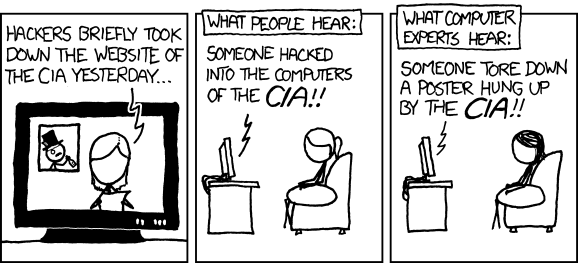
Some will point out that an MITM attack on the NSA is not really an ‘MITM attack on the NSA’ because NSA outsources its web presence to the Akamai CDN (see obligatory XKCD at right). These people may be right, but they also lack poetry in their souls.
Is it patched?
The most recent of OpenSSL does have a patch. This was announced (though not very loudly) in January of this year.
Apple is working on a patch.
Akamai and other CDNs are also rolling out a patch to solve these problems. Over the next two weeks we will hopefully see export ciphersuites extinguished from the Internet. In the mean time, try to be safe.
What does it all mean?
You might think this is all a bit absurd and doesn’t affect you very much. In a strictly technical sense you’re probably right. The client bugs will soon be patched (update your devices! unless you have Android in which case you’re screwed). With good luck, servers supporting export-grade RSA cipher suites will soon be rare curiosity.
Still, to take this as the main lesson of the work would, I think, be missing the forest for the trees. There’s a much more important moral to this story.
The export-grade RSA ciphers are the remains of a 1980s-vintage effort to weaken cryptography so that intelligence agencies would be able to monitor foreign traffic. This was done badly. So badly, that while the policies were ultimately scrapped, they’re still hurting us today.
This might be an academic point if it was only a history lesson. However, for the past several months, U.S. and European politicians have been publicly mooting the notion of a new set of cryptographic backdoors in systems we use today. While the proposals aren’t explicit, they would presumably involve deliberately weakening encryption tech so that governments can intercept and read our conversations. While officials carefully avoid the term “back door” — or any suggestion of weakening our encryption systems against real attackers — this is wishful thinking. These systems are already so complex that even normal issues stress them to the breaking point. There’s just no room for new backdoors.
To be blunt about it, the moral is pretty simple:
Encryption backdoors will always turn around and bite you in the ass. They are never worth it.
Acknowledgements
Special thanks to Karthik and Antoine for sharing this with me, Nadia for factoring, Ivan Ristic for interrupting his vacation to get us data, and the CADO-NFS team for the software that made this possible.
Notes:
 A Few Thoughts on Cryptographic Engineering