Apple in China: who holds the keys?

Last week Apple made an announcement describing changes to the iCloud service for tuhao-gold-iphone-640x405users residing in mainland China. Beginning on February 28th, all users who have specified China as their country/region will have their iCloud data transferred to the GCBD cloud services operator in Guizhou, China.

Chinese news sources optimistically describe the move as a way to offer improved network performance to Chinese users, while Apple admits that the change was mandated by new Chinese regulations on cloud services. Both explanations are almost certainly true. But neither answers the following question: regardless of where it’s stored, how secure is this data?

Apple offers the following:

Apple has strong data privacy and security protections in place and no backdoors will be created into any of our systems”

That sounds nice. But what, precisely, does it mean? If Apple is storing user data on Chinese services, we have to at least accept the possibility that the Chinese government might wish to access it — and possibly without Apple’s permission. Is Apple saying that this is technically impossible?

This is a question, as you may have guessed, that boils down to encryption.

Does Apple encrypt your iCloud backups?

Unfortunately there are many different answers to this question, depending on which part of iCloud you’re talking about, and — ugh — which definition you use for “encrypt”. The dumb answer is the one given in the chart on the right: all iCloud data probably is encrypted. But that’s the wrong question. The right question is: who holds the key(s)?
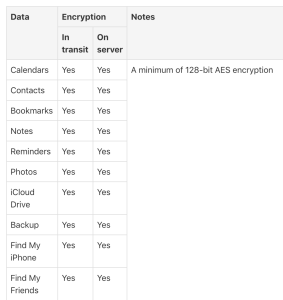
Untitled 4
This kind of thing is Not Helpful.

There’s a pretty simple thought experiment you can use to figure out whether you (or a provider) control your encryption keys. I call it the “mud puddle test”. It goes like this:

Imagine you slip in a mud puddle, in the process (1) destroying your phone, and (2) developing temporary amnesia that causes you to forget your password. Can you still get your iCloud data back? If you can (with the help of Apple Support), then you don’t control the key.

With one major exception — iCloud Keychain, which I’ll discuss below — iCloud fails the mud puddle test. That’s because most Apple files are not end-to-end encrypted. In fact, Apple’s iOS security guide is clear that it sends the keys for encrypted files out to iCloud.

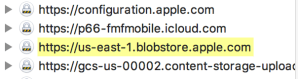
However, there is a wrinkle. You see, iCloud isn’t entirely an Apple service, not even here in the good-old U.S.A. In fact, the vast majority of iCloud data isn’t actually stored by Apple at all. Every time you back up your phone, your (encrypted)
Untitled 6
A list of HTTPS requests made during an iCloud backup from an iPhone. The bottom two addresses are Amazon and Google Cloud Services “blob” stores.

data is transmitted directly to a variety of third-party cloud service providers including Amazon, Google and Microsoft.

And this is, from a privacy perspective, mostly** fine! Those services act merely as “blob stores”, storing unreadable encrypted data files uploaded by Apple’s customers. At least in principle, Apple controls the encryption keys for that data, ideally on a server located in a dedicated Apple datacenter.*

So what exactly is Apple storing in China?

Good question!

You see, it’s entirely possible that the new Chinese cloud stores will perform the same task that Amazon AWS, Google, or Microsoft do in the U.S. That is, they’re storing encrypted blobs of data that can’t be decrypted without first contacting the iCloud mothership back in the U.S. That would at least be one straightforward reading of Apple’s announcement, and it would also be the most straightforward mapping from iCloud’s current architecture and whatever it is Apple is doing in China.

Of course, this interpretation seems hard to swallow. In part this is due to the fact that some of the new Chinese regulations appear to include guidelines for user monitoring. I’m no lawyer, and certainly not an expert in Chinese law — so I can’t tell you if those would apply to backups. But it’s at least reasonable to ask whether Chinese law enforcement agencies would accept the total inability to access this data without phoning home to Cupertino, not to mention that this would give Apple the ability to instantly wipe all Chinese accounts. Solving these problems (for China) would require Apple to store keys as well as data in Chinese datacenters.

The critical point is that these two interpretations are not compatible. One implies that Apple is simply doing business as usual. The other implies that they may have substantially weakened the security protections of their system — at least for Chinese users.

And here’s my problem. If Apple needs to fundamentally rearchitect iCloud to comply with Chinese regulations, that’s certainly an option. But they should say explicitly and unambiguously what they’ve done. If they don’t make things explicit, then it raises the possibility that they could make the same changes for any other portion of the iCloud infrastructure without announcing it.

It seems like it would be a good idea for Apple just to clear this up a bit.

You said there was an exception. What about iCloud Keychain?

I said above that there’s one place where iCloud passes the mud puddle test. This is Apple’s Cloud Key Vault, which is currently used to implement iCloud Keychain. This is a special service that stores passwords and keys for applications, using a much stronger protection level than is used in the rest of iCloud. It’s a good model for how the rest of iCloud could one day be implemented.

For a description, see here. Briefly, the Cloud Key Vault uses a specialized piece of hardware called a Hardware Security Module (HSM) to store encryption keys. This HSM is a physical box located on Apple property. Users can access their own keys if and only if they know their iCloud Keychain password — which is typically the same as the PIN/password on your iOS device. However, if anyone attempts to guess this PIN too many times, the HSM will wipe that user’s stored keys.

The critical thing is that the “anyone” mentioned above includes even Apple themselves. In short: Apple has designed a key vault that even they can’t be forced to open. Only customers can get their own keys.

What’s strange about the recent Apple announcement is that users in China will apparently still have access to iCloud Keychain. This means that either (1) at least some data will be totally inaccessible to the Chinese government, or (2) Apple has somehow weakened the version of Cloud Key Vault deployed to Chinese users. The latter would be extremely unfortunate, and it would raise even deeper questions about the integrity of Apple’s systems.

Probably there’s nothing funny going on, but this is an example of how Apple’s vague (and imprecise) explanations make it harder to trust their infrastructure around the world.

So what should Apple do?

Unfortunately, the problem with Apple’s disclosure of its China’s news is, well, really just a version of the same problem that’s existed with Apple’s entire approach to iCloud.

Where Apple provides overwhelming detail about their best security systems (file encryption, iOS, iMessage), they provide distressingly little technical detail about the weaker links like iCloud encryption. We know that Apple can access and even hand over iCloud backups to law enforcement. But what about Apple’s partners? What about keychain data? How is this information protected? Who knows.

This vague approach to security might make it easier for Apple to brush off the security impact of changes like the recent China news (“look, no backdoors!”) But it also confuses the picture, and calls into doubt any future technical security improvements that Apple might be planning to make in the future. For example, this article from 2016 claims that Apple is planning stronger overall encryption for iCloud. Are those plans scrapped? And if not, will those plans fly in the new Chinese version of iCloud? Will there be two technically different versions of iCloud? Who even knows?

And at the end of the day, if Apple can’t trust us enough to explain how their systems work, then maybe we shouldn’t trust them either.

Notes:

* This is actually just a guess. Apple could also outsource their key storage to a third-party provider, even though this would be dumb.

** A big caveat here is that some iCloud backup systems use convergent encryption, also known as “message locked encryption”. The idea in these systems is that file encryption keys are derived by hashing the file itself. Even if a cloud storage provider does not possess encryption keys, it might be able to test if a user has a copy of a specific file. This could be problematic. However, it’s not really clear from Apple’s documentation if this attack is feasible. (Thanks to RPW for pointing this out.)

Attack of the Week: Group Messaging in WhatsApp and Signal

If you’ve read this blog before, you know that secure messaging is one of my favorite whatsapp-icontopics. However, recently I’ve been a bit disappointed. My sadness comes from the fact that lately these systems have been getting too damned good. That is, I was starting to believe that most of the interesting problems had finally been solved.

If nothing else, today’s post helped disabuse me of that notion.

This result comes from a new paper by Rösler, Mainka and Schwenk from Ruhr-Universität Bochum (affectionately known as “RUB”). The RUB paper paper takes a close look at the problem of group messaging, and finds that while messengers may be doing fine with normal (pairwise) messaging, group messaging is still kind of a hack.

If all you want is the TL;DR, here’s the headline finding: due to flaws in both Signal and WhatsApp (which I single out because I use them), it’s theoretically possible for strangers to add themselves to an encrypted group chat. However, the caveat is that these attacks are extremely difficult to pull off in practice, so nobody needs to panic. But both issues are very avoidable, and tend to undermine the logic of having an end-to-end encryption protocol in the first place. (Wired also has a good article.)

First, some background.

How do end-to-end encryption and group chats work?

In recent years we’ve seen plenty of evidence that centralized messaging servers aren’t a very good place to store confidential information. The good news is: we’re not stuck with them. One of the most promising advances in the area of secure communications has been the recent widespread deployment of end-to-end (e2e) encrypted messaging protocols. 

At a high level, e2e messaging protocols are simple: rather than sending plaintext to a server — where it can be stolen or read — the individual endpoints (typically smartphones) encrypt all of the data using keys that the server doesn’t possess. The server has a much more limited role, moving and storing only meaningless ciphertext. With plenty of caveats, this means a corrupt server shouldn’t be able to eavesdrop on the communications.

In pairwise communications (i.e., Alice communicates with only Bob) this encryption is conducted using a mix of public-key and symmetric key algorithms. One of the most popular mechanisms is the Signal protocol, which is used by Signal and WhatsApp (notable for having 1.3 billion users!) I won’t discuss the details of the Signal protocol here, except to say that it’s complicated, but it works pretty well.

A fly in the ointment is that the standard Signal protocol doesn’t work quite as well for group messaging, primarily because it’s not optimized for broadcasting messages to many users.

To handle that popular case, both WhatsApp and Signal use a small hack. It works like this: each group member generates a single “group key” that this member will use to encrypt all of her messages to everyone else in the group. When a new member joins, everyone who is already in the group needs to send a copy of their group key to the new member (using the normal Signal pairwise encryption protocol). This greatly simplifies the operation of group chats, while ensuring that they’re still end-to-end encrypted.

How do members know when to add a new user to their chat?

Here is where things get problematic.

From a UX perspective, the idea is that only one person actually initiates the adding of a new group member. This person is called the “administrator”. This administrator is the only human being who should actually do anything — yet, her one click must cause some automated action on the part of every other group members’ devices. That is, in response to the administrator’s trigger, all devices in the group chat must send their keys to this new group member.

IMG_1291
Notification messages in WhatsApp.

(In Signal, every group member is an administrator. In WhatsApp it’s just a subset of the members.)

The trigger is implemented using a special kind of message called (unimaginatively) a “group management message”. When I, as an administrator, add Tom to a group, my phone sends a group management message to all the existing group members. This instructs them to send their keys to Tom — and to notify the members visually so that they know Tom is now part of the group. Obviously this should only happen if I really did add Tom, and not if some outsider (like that sneaky bastard Tom himself!) tries to add Tom.

And this is where things get problematic.

Ok, what’s the problem?

According to the RUB paper, both Signal and WhatsApp fail to properly authenticate group management messages.

The upshot is that, at least in theory, this makes it possible for an unauthorized person — not a group administrator, possibly not even a member of the group — to add someone to your group chat.

The issues here are slightly different between Signal and WhatsApp. To paraphrase Tolstoy, every working implementation is alike, but every broken one is broken in its own way. And WhatsApp’s implementation is somewhat worse than Signal. Here I’ll break them down.

Signal. Signal takes a pragmatic (and reasonable) approach to group management. In Signal, every group member is considered an administrator — which means that any member can add a new member. Thus if I’m a member of a group, I can add a new member by sending a group management message to every other member. These messages are sent encrypted via the normal (pairwise) Signal protocol.

The group management message contains the “group ID” (a long, unpredictable number), along with the identity of the person I’m adding. Because messages are sent using the Signal (pairwise) protocol, they should be implicitly authenticated as coming from me — because authenticity is a property that the pairwise Signal protocol already offers. So far, this all sounds pretty good.

The problem that the RUB researchers discovered through testing, is that while the Signal protocol does authenticate that the group management comes from me, it doesn’t actually check that I am a member of the group — and thus authorized to add the new user!

In short, if this finding is correct, it turns out that any random Signal user in the world can you send a message of the form “Add Mallory to the Group 8374294372934722942947”, and (if you happen to belong to that group) your app will go ahead and try to do it.

The good news is that in Signal the attack is very difficult to execute. The reason is that in order to add someone to your group, I need to know the group ID. Since the group ID is a random 128-bit number (and is never revealed to non-group-members or even the server**) that pretty much blocks the attack. The main exception to this is former group members, who already know the group ID — and can now add themselves back to the group with impunity.

(And for the record, while the group ID may block the attack, it really seems like a lucky break — like falling out of a building and landing on a street awning. There’s no reason the app should process group management messages from random strangers.)

So that’s the good news. The bad news is that WhatsApp is a bit worse.

WhatsApp. WhatsApp uses a slightly different approach for its group chat. Unlike Signal, the WhatsApp server plays a significant role in group management, which means that it determines who is an administrator and thus authorized to send group management messages.

Additionally, group management messages are not end-to-end encrypted or signed. They’re sent to and from the WhatsApp server using transport encryption, but not the actual Signal protocol.

When an administrator wishes to add a member to a group, it sends a message to the server identifying the group and the member to add. The server then checks that the user is authorized to administer that group, and (if so), it sends a message to every member of the group indicating that they should add that user.

The flaw here is obvious: since the group management messages are not signed by the administrator, a malicious WhatsApp server can add any user it wants into the group. This means the privacy of your end-to-end encrypted group chat is only guaranteed if you actually trust the WhatsApp server.

This undermines the entire purpose of end-to-end encryption.

But this is silly. Don’t we trust the WhatsApp server? And what about visual notifications?

One perfectly reasonable response is that exploiting this vulnerability requires a compromise of the WhatsApp server (or legal compulsion, perhaps). This seems fairly unlikely.

And yet, the entire point of end-to-end encryption is to remove the server from the trusted computing base. We haven’t entirely achieved this yet, thanks to things like key servers. But we are making progress. This bug is a step back, and it’s one a sophisticated attacker potentially could exploit.

A second obvious objection to these issues is that adding a new group member results in a visual notification to each group member. However, it’s not entirely clear that these messages are very effective. In general they’re relatively easy to miss. So these are meaningful bugs, and things that should be fixed.

How do you fix this?

The great thing about these bugs is that they’re both eminently fixable.

The RUB paper points out some obvious countermeasures. In Signal, just make sure that the group management messages come from a legitimate member of the group. In WhatsApp, make sure that the group management messages are signed by an administrator.*

Obviously fixes like this are a bit complex to roll out, but none of these should be killers.

Is there anything else in the paper?

Oh yes, there’s quite a bit more. But none of it is quite as dramatic. For one thing, it’s possible for attackers to block message acknowledgements in group chats, which means that different group members could potentially see very different versions of the chat. There are also several cases where forward secrecy can be interrupted. There’s also some nice analysis of Threema, if you’re interested.

I need a lesson. What’s the moral of this story?

The biggest lesson is that protocol specifications are never enough. Both WhatsApp and Signal (to an extent) have detailed protocol specifications that talk quite a bit about the cryptography used in their systems. And yet the issues reported in the RUB paper not obvious from reading these summaries. I certainly didn’t know about them.

In practice, these problems were only found through testing.

mallory5
Mallory.

So the main lesson here is: test, test, test. This is a strong argument in favor of open-source applications and frameworks that can interact with private-garden services like Signal and WhatsApp. It lets us see what the systems are getting right and getting wrong.

The second lesson — and a very old one — is that cryptography is only half the battle. There’s no point in building the most secure encryption protocol in the world if someone can simply instruct your client to send your keys to Mallory. The greatest lesson of all time is that real cryptosystems are always broken this way — and almost never through the fancy cryptographic attacks we love to write about.

Notes:

* The challenge here is that since WhatsApp itself determines who the administrators are, this isn’t quite so simple. But at very least you can ensure that someone in the group was responsible for the addition.

** According to the paper, the Signal group IDs are always sent encrypted between group members and are never revealed to the Signal server. Indeed, group chat messages look exactly like pairwise chats, as far as the server is concerned. This means only current or former group members should know the group ID.